

Welcome to Superman Month here on Tales from My Spinner Rack! 85 years ago, the dream of two Cleveland teenagers hit the newsstands for the very first time, kickstarting the entire comic book industry. Jerry Siegel and Joe Shuster’s Superman first appeared in Action Comics #1, cover-dated June 1938. Over the next few weeks, we’ll examine some of my favorite 1960s Super-stories.

Superman #137, May 1960. Cover by Curt Swan. Art in this post TM and © DC.
Click on the images below to see them larger on your screen!
This is one of the Superman stories that absolutely fascinated me as a kid. I was just about five years old when it came out (on March 17, 1960), so I probably didn’t read it at the exact moment it entered my home, brought in by my big (eight years older) brother, Rick, but I know I found it at some point and read it again and again. It’s one of those issues that probably should have been “an imaginary story,” editor Mort Weisinger’s way of getting around whatever continuity Superman and DC had at the time (not much, to be honest). In this case, there’s a whole other character exactly like Superman with all his powers, except he’s evil, and he’s been around since Baby Kal-El crash-landed on Earth. We’ll talk a bit more about DC’s imaginary stories next time, but Superman wasn’t the only character that embraced the somewhat oxymoronic phrase … because—when it comes to comic book stories as Alan Moore pointed out when he ended the Silver and Bronze Age run of Superman in issue #423—“aren’t they all [imaginary stories]?”
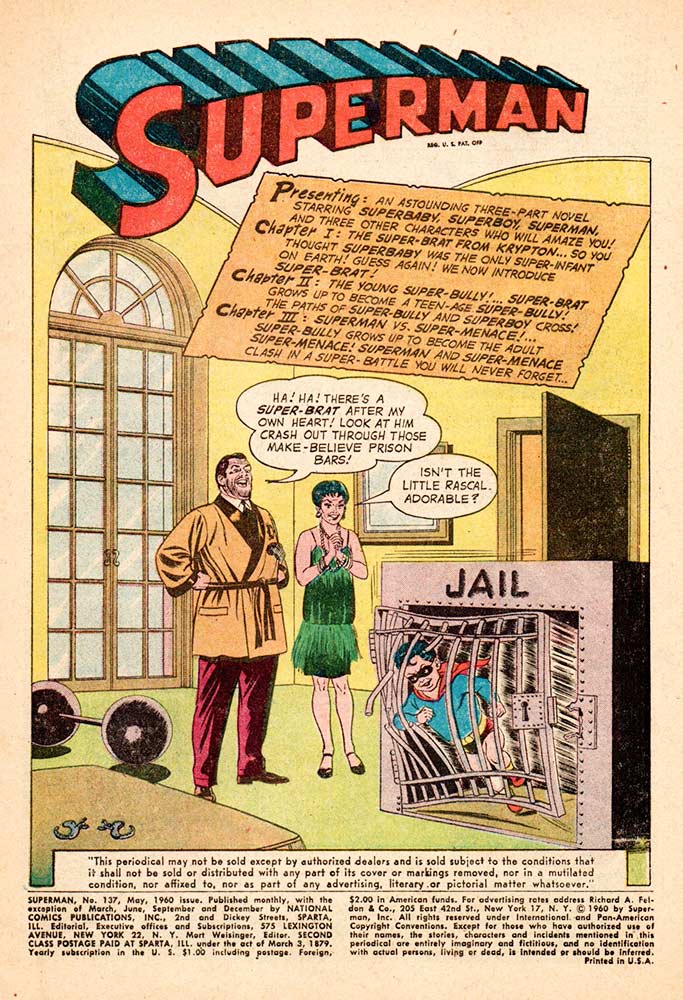


This story is billed as “A Great UNTOLD Story …” on the cover, and titled, “The Two Faces of Superman.” It’s a book-length tale (still a bit of a rarity at that point in the Super-books), written by Jerry Siegel, Superman’s co-creator and drawn by Curt Swan and John Forte. It features a duplicate Superman who was created as Kal-El’s rocket hurtled towards Earth and bounced off an alien spaceship, which created a duplicate of the rocket and the Babe of Steel inside it. The “other” Superman lands near gangster Wolf Derek’s home and he and his wife, Bonnie, raise the kid to become first a Super-Brat, then a Super-Bully, and finally a Super-Menace in the three chapters of this issue (which total 26 pages, which seems—to me, at least—like a lot of pages for a 1960s book from DC).


The Super-Brat grows as Superbaby does, into—respectively—Super-Bully (Superboy’s doppelgänger) and Super-Menace (Superman’s). While both Superboy and Superman do good—as their parents, Jonathan and Martha Kent, raised them to do so—Super-Bully and Super-Menace are, quite frankly, super-dicks. Wolf and Bonnie—such warm, loving, and manipulative parents—hate their adopted kid and raise him to commit crimes, like safe-robbing and eliminating their enemies. They keep his presence secret, allowing him to play some tricks on Clark Kent, but it’s Krypto the Super-Dog who literally sniffs out that there’s something rotten in Smallville when Super-Bully runs into him: “You phoney! Nobody tricks Krypto’s super nose!” thinks the Dog of Steel.


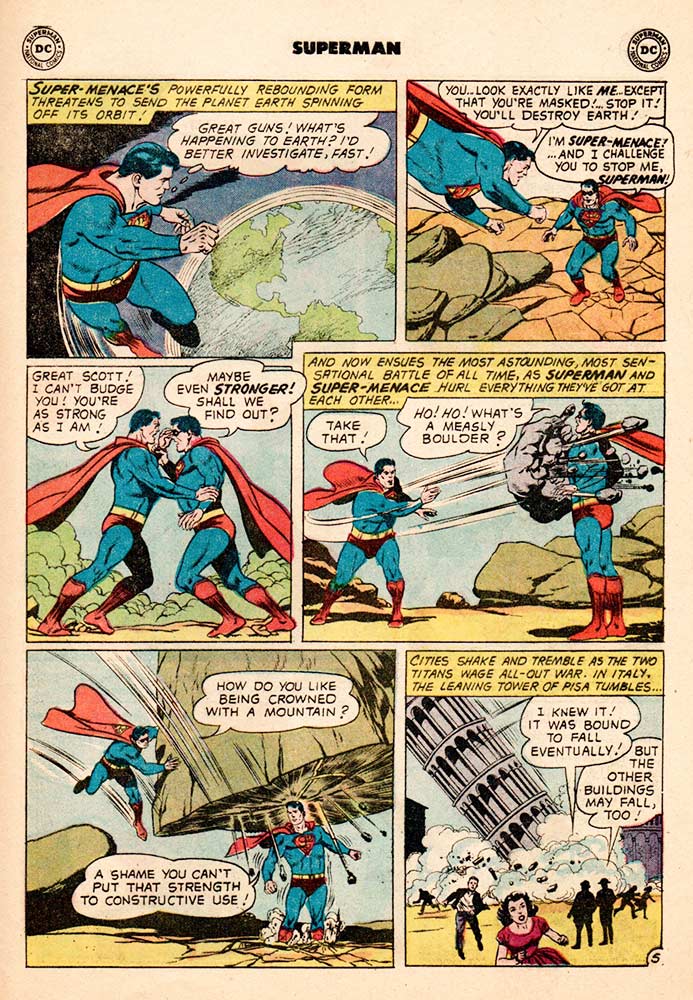
Along the way, Super-Bully realizes he isn’t affected by Kryptonite and—as a fully-grown adult—he uses the rare rock against Superman and gains the upper hand in the final chapter, “Superman vs. Super-Menace.” Pa Wolf introduces his super-powered son to his underworld cohorts and gives him the order to kill Superman. But Super-Menace uses his super-hearing and listens in on his adopted pop and his cronies, learning that Wolf and Bonnie only pretended to “love that freak.” This sends Super-Menace into a bit of a temper tantrum, which gets Superman’s attention as his bad-boy double tries to basically destroy the Earth. In the ensuing battle, Superman finds out that Super-Menace is not like the rest of us: He has no internal organs or bone structure. He’s basically just “an unearthly force manifested in human form.” Super-Menace tries to kill Superman through various means (they both survive an atomic blast), ending up with Kryptonite, but has a last minute conscience attack and goes off to instead kill his adopted parents, abandoning his human form and turning back into pure force, taking the evil gangster and his wife with him. Superman thoughtfully ponders the death of “the most dangerous menace to law-and-order this world has ever known,” hopefully also realizing that he almost got his butt kicked big-time. The End.




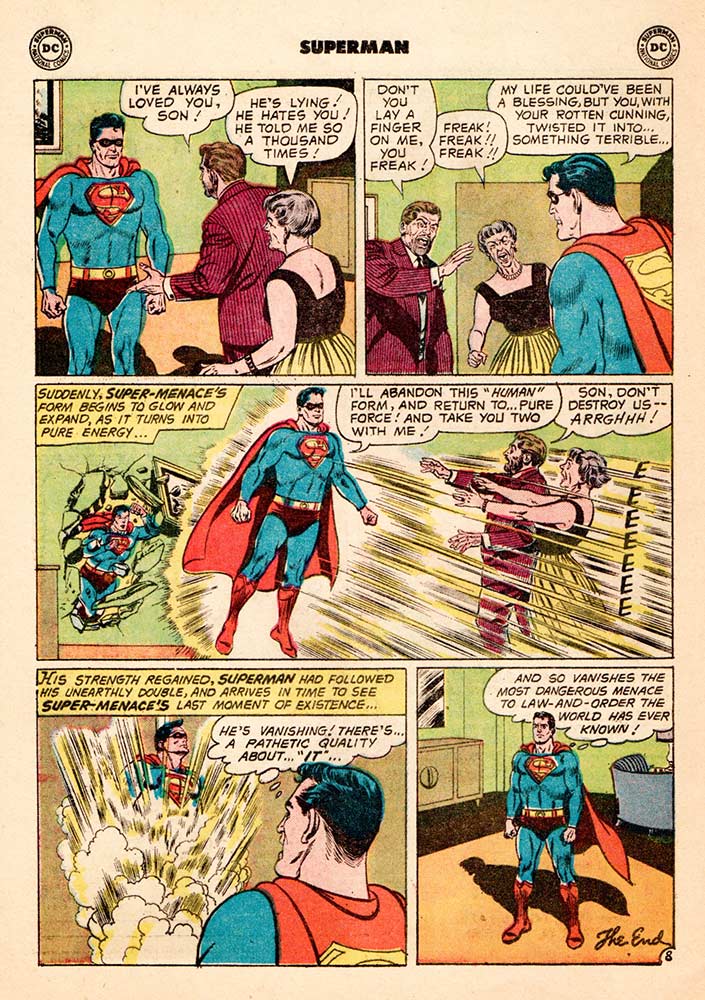
I think it’s that last page that shocked me so much as a kid. You didn’t see a lot of death in comics in general at the time—at least not the comics I was reading and especially not in Superman—and that panel where Super-Menace offs his adopted folks was truly horrifying to me. In retrospect, it’s one of the images that fascinated me most in this comic, along with the whole idea of an evil doppelgänger. I also think this is one of writer Jerry Siegel’s better, later Superman tales, and I’m thankful it was drawn by Curt Swan and not Wayne Boring, who, by the early 1960s, was drawing less and less of the Superman comic book stories and more and more of the syndicated daily and Sunday strips, and whose art I found, well … boring. (I know. I keep using that lame joke.) This is a very dense read for a little kid; as I mentioned earlier, I was too young to read it when it came out, but it was a Superman issue I enjoyed again and again as I grew older and learned how to read, which I find key to enjoying any comic book. Seeing the entire life of a character in one story—from baby to adult—was also fascinating to me.

As far as I know, Super-Menace—or his force energy—never came back. Superman suffered in that era from a lack of compelling and dangerous villains, and had grown so super-powered he was almost impossible to fight, let alone raise the threat of being killed. Here was a menace that was truly dangerous, all dressed up as Superman with all of his powers, which kind of makes mad scientist Lex Luthor, in his drab and dingy prison grays, pale in comparison. But Luthor would become a super-menace in his own right, as we’ll see in the next installment in Superman month.
This story hasn’t been reprinted much. It appears in 80-Page Giant #1 (which was originally supposed to be Giant Superman Annual #9). The DC Database (an indispensable research tool in all my Spinner Rack posts, along with its Marvel Comics counterpart), reminds us that this particular issue of 80-Page Giant is devoted to Superman imaginary stories, so maybe DC later thought of this story as another imaginary tale. Who knows? I do know that, then and now, I find it to be a thrilling and thoughtful issue of Superman, one with a true threat to the Man of Steel, and as such, it’s one of my all-time favorites.

Next time: Superman Month continues with a “real” imaginary story, “The Death of Superman,” from issue #149, another absolute classic by writer Jerry Siegel and artist Curt Swan.
To read all the “Tales from My Spinner Rack” posts, click here!

instagram.com/talesfrommyspinnerrack/
 @innocent-bystander.com