
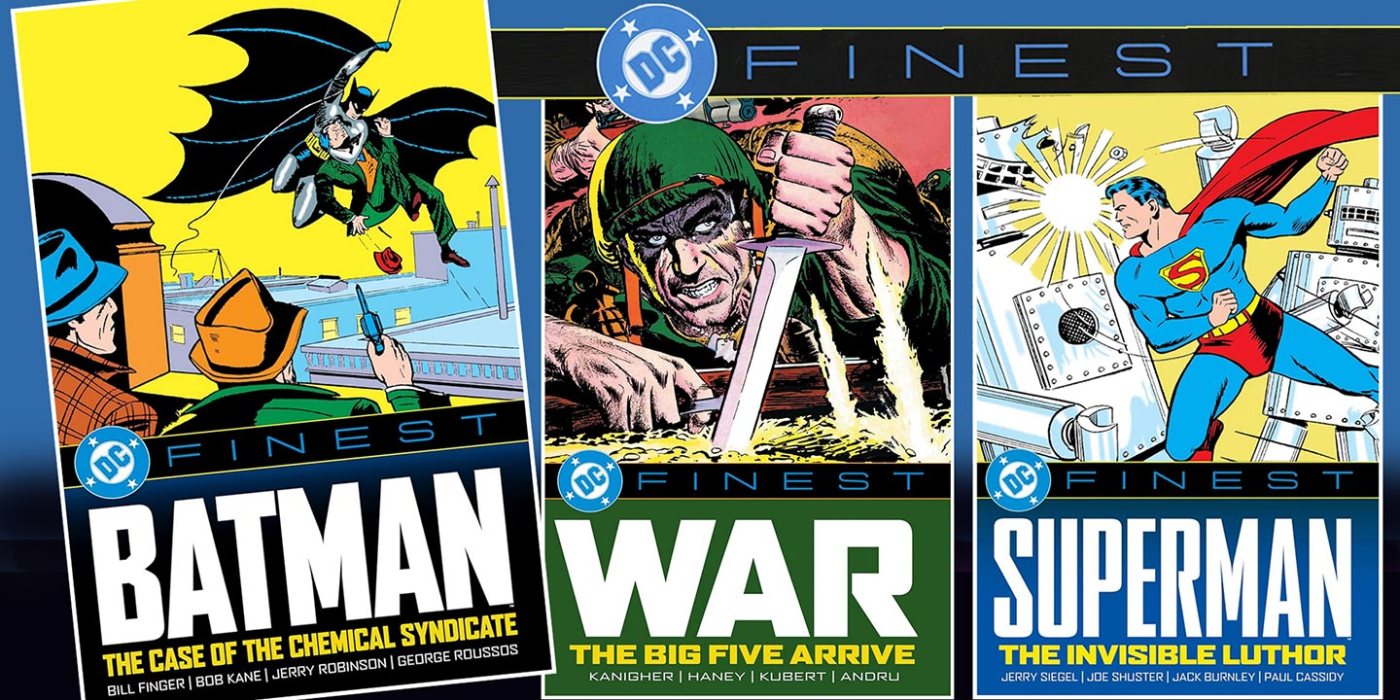
Been a little while since I’ve done one of these (partly because I’m doing them three at a time), but here we are … these are the three latest DC Finest volumes I’ve read and enjoyed.
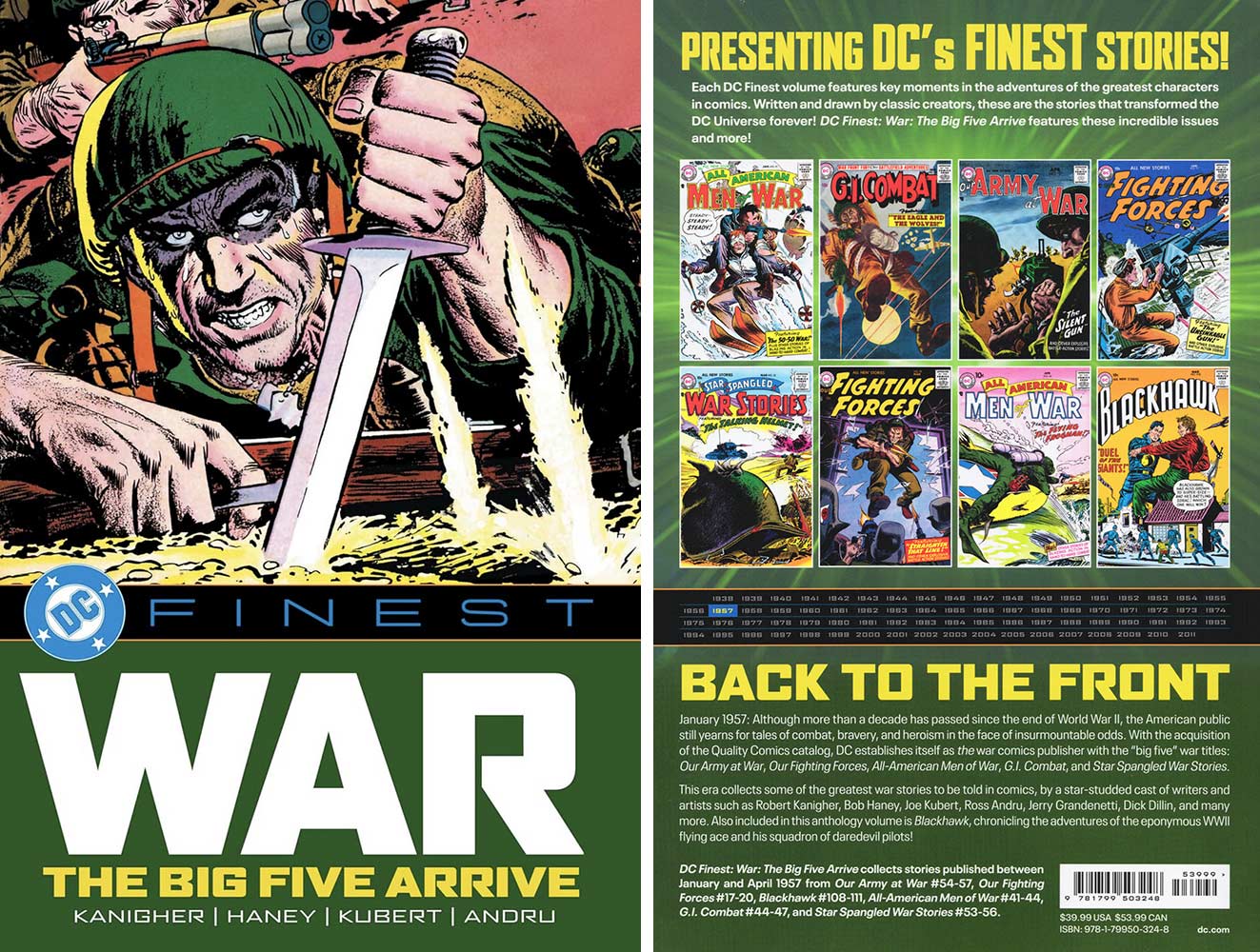
DC Finest War: The Big Five Arrive by Robert Kanigher, Bob Haney, Joe Kubert, and Ross Andru
This is the first of the DC Finest “genre” books I’ve bought (the others being Science Fiction, Horror, and the upcoming Western) and I enjoyed it a great deal. The “Big Five” in the sub-title refer to the series of books—almost an imprint in and of itself within DC—that were war titles: All American Men of War, GI Combat, Our Army at War, Our Fighting Forces, and Star-Spangled War Stories, alongside Blackhawk, which was never considered part of the Big Five, but evidently was a war book in DC’s eyes. I think this particular moment (all the books reprinted in this volume are from January through April 1957) is when DC took over both Blackhawk and G.I. Combat from Quality Comics (and maybe at least one romance title) when that company stopped publishing. Amazingly, all six titles were monthlies, and what you get here is four solid months, 24 issues, of war stories. Other than Blackhawk, these are all anthology titles; at this point none of the war books had recurring characters, although that would soon change. The issues included in this volume are: Our Army at War 54-57, Our Fighting Forces 17-20, Blackhawk 108-111, All-American Men of War 41-44, G.I. Combat 44-47, and Star Spangled War Stories 53-56.
The high point of this 616-page volume for me is the art; the stories—mainly written by Robert Kanigher and Bob Haney—are forgettable for the most part. But the war books had a “usual suspects” team of artists including Joe Kubert, Russ Heath, Ross Andru (with Mike Esposito), Jerry Grandenetti, Jack Abel, and someone named Art Peddy, who’s art I was unfamiliar with until this book (but I had heard his name before). All of Kubert and especially Heath’s stories are standouts, and for some reason they’re the only two artists who sign their stories. But beyond those two artists, you’ll spend a lot of time looking back to the contents pages to help figure out who drew each story. Each title has four stories per issue, too, ranging anywhere from 4 to 8 pages each, so what we have here is 80 stories in the Big Five books, plus an additional 12 from Blackhawk, which had three 8-page stories each issue. That’s a whopping 92 stories in this volume! The next war book—due in May—will be devoted to the earliest stories of Sgt. Rock, DC’s perennial war hero. Not sure I’ll pick that one up, but I liked this glimpse into DC’s war comics output for four months of 1957.
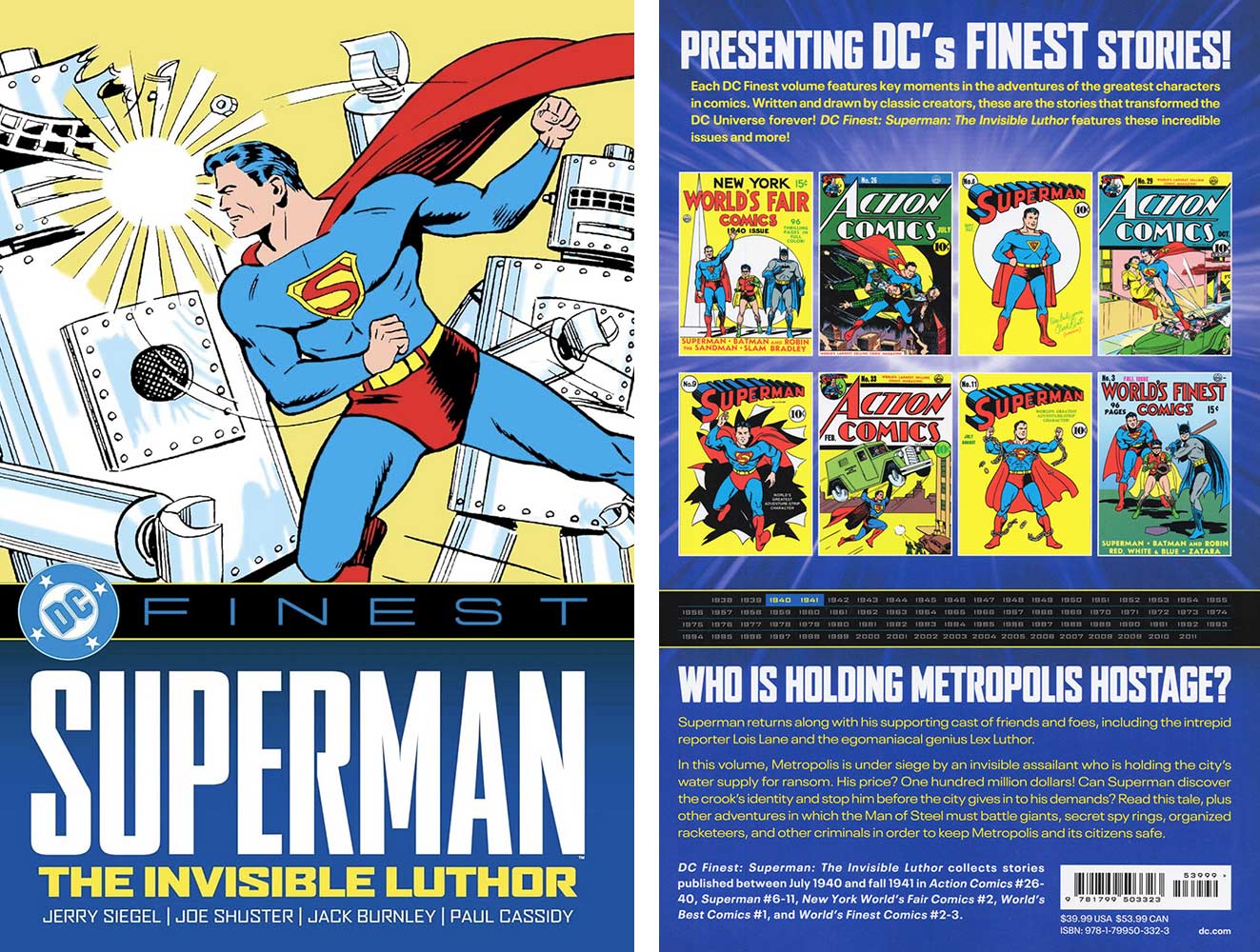
DC Finest Superman: The Invisible Luthor by Jerry Siegel, Joe Shuster, Jack Burnley and Paul Cassidy
This is the direct sequel to last year’s very first DC Finest volume, Superman: The First Superhero, and picks up with reprints following the issues in that volume. This one, which is 602 pages, features books published from July 1940 until fall 1941, including Action Comics 26 through 40, Superman 6 through 11, and the Superman stories from New York World’s Fair Comics 2 and World’s Best Comics 1 (which quickly became World’s Finest with issue 2, included here along with issue 3). It’s all a mixed bag, to be honest. Superman, for the most part, is still fighting low-level gangsters and racketeers, plus doing the occasional social good the hero was famous for in his earliest years. Jerry Siegel writes all the stories (as far as I know) and there is already less and less of Joe Shuster’s art. Paul Cassidy and Wayne Boring pick up the slack, but the Jack Burnley stories are real standouts; he’s light years ahead of the rest of the artists who joined the Siegel and Shuster studio at this point in time. Reproduction throughout the book is very good, with the exception of some of the later Superman issues, starting with 9, which at times seems a little wispy in the line work; issue 11 is also bad, but it’s drawn entirely by Leo Nowak, whose linework seems wispy at best.
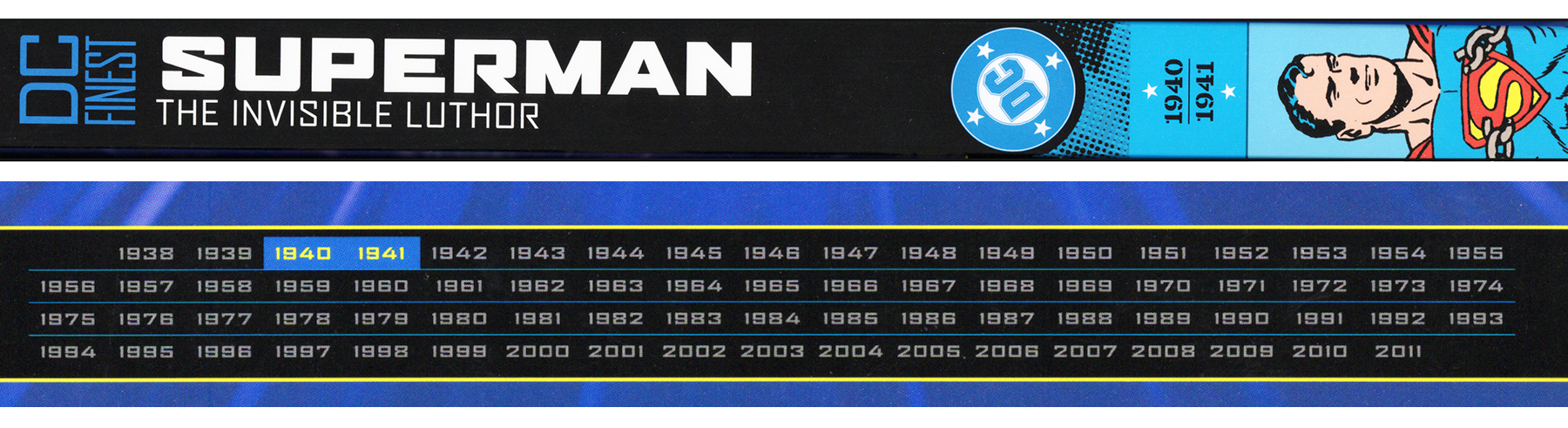
One thing that was missing from this volume: Superman’s Christmas Adventure, a promotional comic that was sold to retailers and manufacturers to give out during the 1940 holiday season. Macy’s gave it out, along with Skippy Peanut Butter, among others. It’s recently been reprinted in the Christmas with the Super-Heroes Treasury edition facsimile (issue C-43), but I feel it really belongs in this book. It too was written by Siegel and drawn by Burnley.
I’m really enjoying these Golden Age reprints of Superman and it’s fascinating to watch the progression of the character. One thing is certain: NOBODY seems to know how to draw the S-shield on Superman’s chest. It varies from issue to issue and certainly from artist to artist (as does the hand-drawn “Superman” logo, which gets obviously improved and standardized by letterer Ira Schnapp with Action Comics issue 36).
DC Finest Batman: The Case of the Chemical Syndicate by Bill Finger, Bob Kane, Jerry Robinson, George Roussos
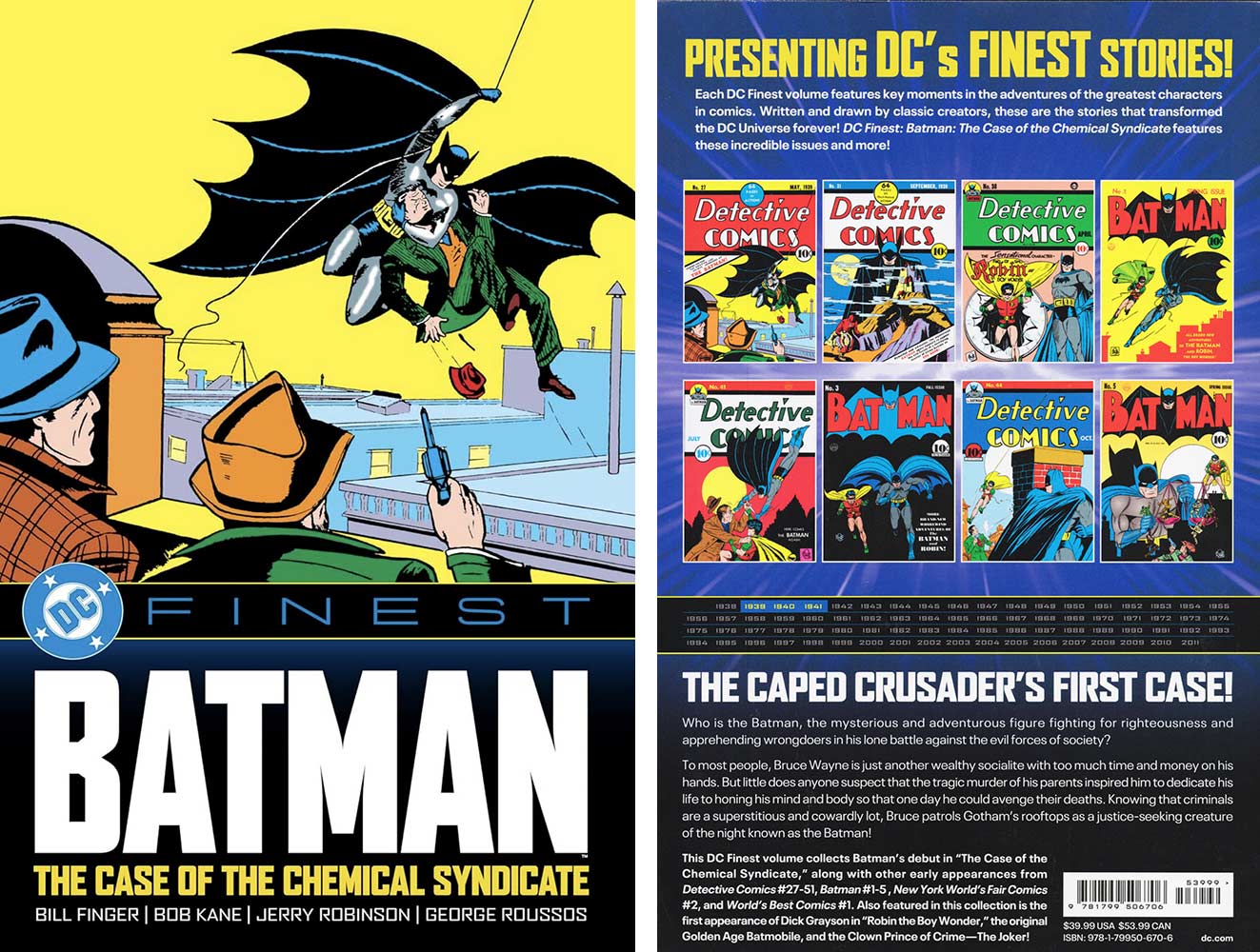
This volume presents the earliest adventures of the Caped Crusader, currently celebrating his 87th birthday, with the March 30th anniversary of the publication of Detective Comics 27 in 1939, featuring Batman’s first appearance, in a short, six-page story, “The Case of the Chemical Syndicate.” This 616-page volume includes the character’s earliest adventures, and reprints Detective Comics 27-51, Batman 1-5, New York World’s Fair Comics 2, and World’s Best Comics 1, all from 1939 through 1941. And it’s the start of the Bat-Family: Batman/Bruce Wayne, Commissioner Gordon, Robin/Dick Grayson, and the Bat-Villains, Dr. Hugo Strange, the first Clayface, The Joker, and Catwoman (first known as The Cat), with, of course, many more Bat-villains and supporting characters to come. You can see Bob Kane’s earliest clumsy attempts at drawing superheroes, and how his first assistant, Jerry Robinson, helped make the art more interesting and professional. Bill Finger (and Gardner Fox’s) scripts go from just describing the art to fully-realized stories, and it’s easy to see how The Bat-Man (as he was first known) became a huge hit so fast with the pre-World War II crowd.
This volume was particularly interesting to me because I’ve never seen a lot of these stories. I’m curious as to how many Bob Kane actually drew. It almost seems like that very first “The Bat-Man” story from Detective Comics 27 is by a totally different artist, since it seems a little bit tighter and more professional than the stories that follow. The lettering in some of the early Detective stories is atrocious (probably by George Roussos), but some of Kane’s splash pages are very imaginative. You can see Jerry Robinson’s influence starting around the time of Detective 38 (first Robin story) and Batman 1 (first Joker story, which Robinson inked), and by issue 4 or so of Batman, the art is better and more polished, and the scripts, mainly by Bill Finger, stop being panel-by-panel descriptions of the drawings. I’m amazed at how many panels show Batman without his chest emblem, including the cover of Batman 5! (I thought Jack Kirby drawing Spider-Man was the worst at this particular faux pas.) This was a mainly enjoyable read, although some of the stories (most are 13 pages each in both the monthly Detective Comics and quarterly Batman titles … hard to believe you got four 13-page stories in the latter for 10 cents!), are a bit long-winded, script-wise, and that awful lettering sure doesn’t help when the word balloons are packed with letters.
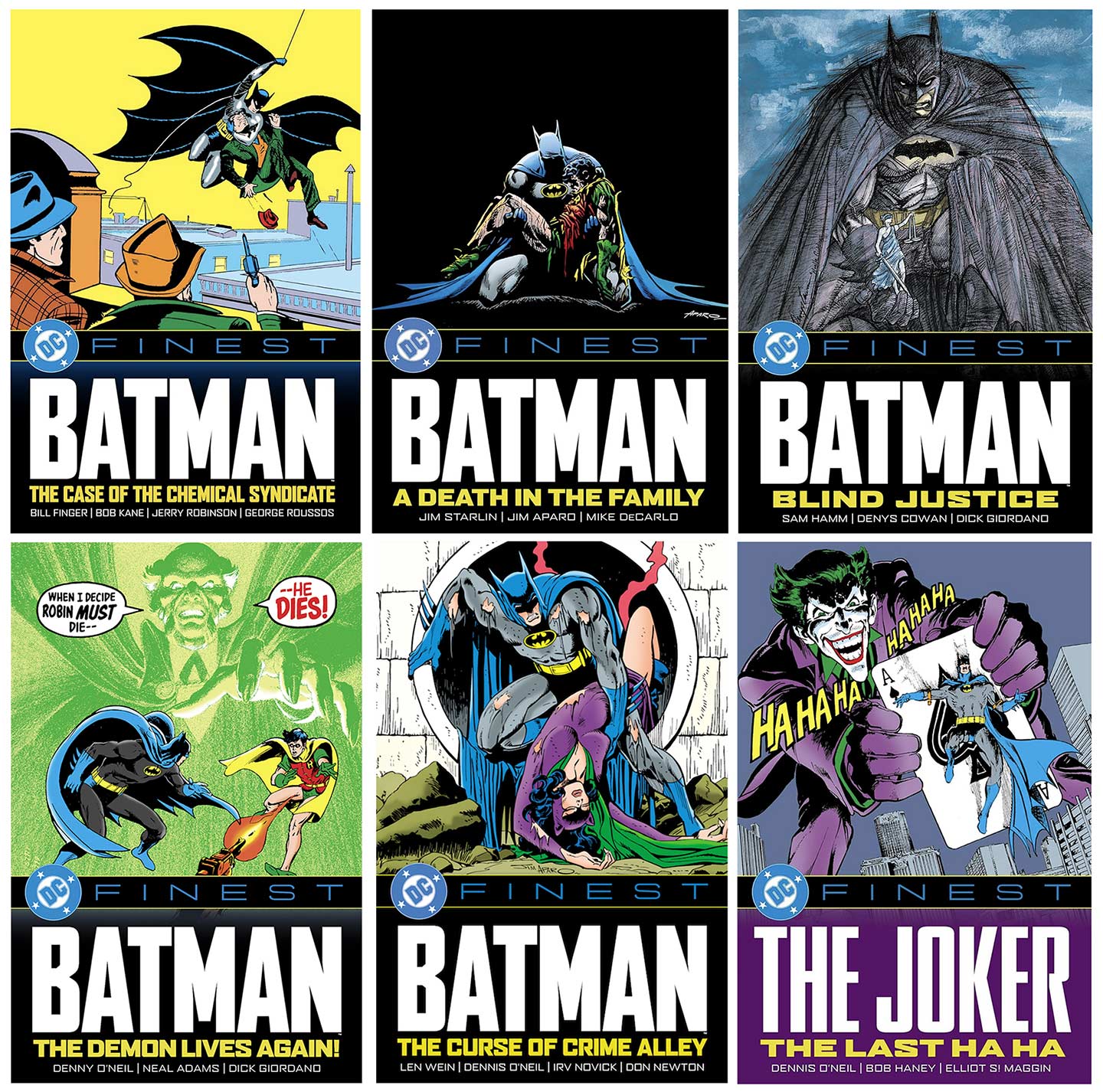
This year’s crop of DC Finest Batman titles.
I am still really loving the DC Finest series of reprint collections and look forward to upcoming volumes. 2026 is a bountiful year for Batman in the line. In addition to “The Case of the Chemical Syndicate,” we just discussed, there are four more volumes coming, including “A Death in the Family” (April), “Blind Justice” (July), “The Demon Lives Again” (September), and “The Curse of Crime Alley” (November), plus a Batman-adjacent Joker volume, “The Last Ha Ha” (also April), marking SIX Batman volumes in 2026. Welp, there goes my book budget for the year!
Up next for me: DC Finest Superman: Time and Time Again, a 1990s era reprint and the first DC Finest volume from the “Triangle Era” of the Man of Steel followed by Batman: A Death in the Family.
 @innocent-bystander.com
Leave a comment