
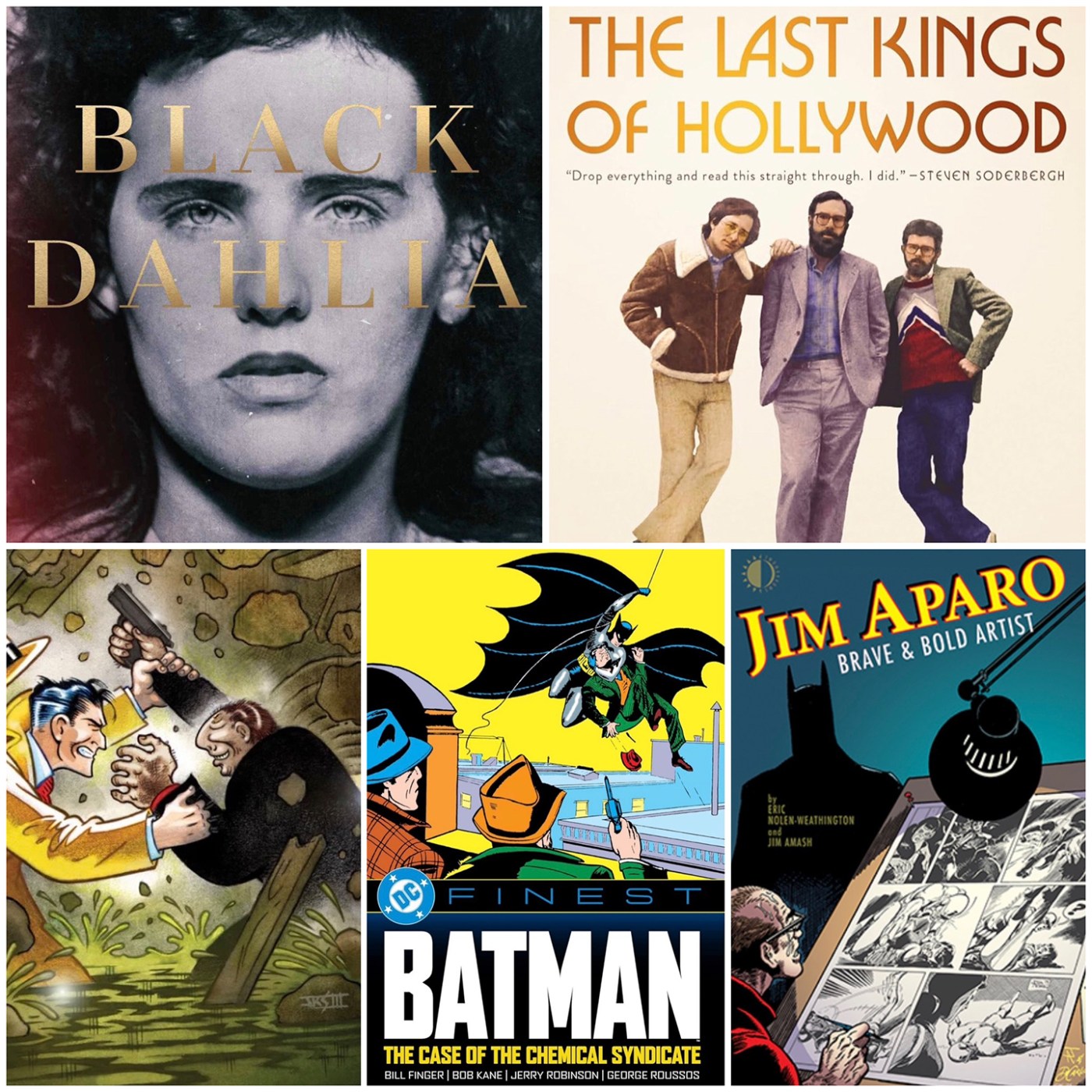
Unless you’re involved in a life-threatening situation or—like me—can upgrade to a nicer place and save some monthly moolah, don’t move, kids. My recent move carved two months out of my life, losing valuable walking, watching, and reading space. I finished exactly ONE book in all of February, that coldest, darkest month, and I am just now getting caught up. Plus I had picked two books to start the year that were incredibly dense and not real enjoyable, like this one …
Black Dahlia: Murder, Monsters, and Madness in Midcentury Hollywood by William J. Mann • 3 Stars on Goodreads
I was really looking forward to this one on a number of different levels, but ended up being a bit disappointed. The Black Dahlia case, still unsolved after all these years (or maybe not), concerns young Elizabeth Short who was found in a vacant lot in 1947 in Los Angeles, cut in two and horribly mutilated. Beyond that, I really liked author Mann’s Tinseltown book a few years back, dealing with the unsolved murder of movie director William Desmond Taylor. And thirdly, I have been listening to Bosch creator Michael Connelly’s new podcast, Killer in the Code, which basically solves the Black Dahlia case and—amazingly—links it to the unsolved Zodiac Killer cases that plagued the Bay Area more than 20 years after Short was found. Mann goes into exhaustive detail to tell us who Elizabeth Short was and the subsequent investigation of her horrible murder, and that’s part of the problem I have with this book: It is, at times, so far off in the weeds, it was next to impossible for me to read. I really admire the author’s intent—painting a picture of Short as a real person—in which he succeeds, but to be honest, Short’s life is not very exciting. It’s her death that made her somebody, sad to say. And while he didn’t set off to find the Dahlia’s killer, he does come to the same conclusion—minus the Zodiac Killer tie-in—that Connelly and company come up with on their podcast (Mann actually appears in one episode of the podcast). The book also offers—as the title states—a look at Los Angeles (and the United States) after World War II, a city and country in a period of flux. The book itself is an amazing achievement, I will admit that … just a bit tedious and long-winded.
The Last Kings of Hollywood: Coppola, Lucas, Spielberg and the Battle for the Soul of American Cinema by Paul Fischer • 5 Stars on Goodreads
Well, here’s a Hollywood book I can get behind. I thoroughly enjoyed this bit of 1970s and beyond movie history by Paul Fischer, which chronicles the rise of Francis Ford Coppola, George Lucas, and Steve Spielberg. It’s both an excellent biography of all three filmmakers in their early years and a thoughtful, insightful view into that era of Hollywood, when these three redefined the system and invented the summer blockbuster. Coppola comes off as the soulful filmmaker, Spielberg as the consummate filmmaker, always a step ahead of everyone, including the studios, but Lucas is a bit of a man-child, with a lot of issues. Martin Scorsese, Paul Schrader, and Brian De Palma are also thrown in for good measure, as well as a number of stars, including (especially) Harrison Ford. Fischer’s writing style is easy to read and digest, too, which is a plus after some of the other books I’ve read so far this year.
Dick Tracy 1943 and 1944 by Chester Gould • 5 Stars on Goodreads
I finished my reading of this first four-volume set of Dick Tracy comic strip reprints published by Clover Press. This is a no-frills reprinting of the Library of American Comics hardbounds from over a decade ago, minus all the historical articles. They were offered on Kickstarter in a plan where you get all four volumes at once, with this initial package including years 1941 through 1944, each being a separate volume running from January 1 to December 1 of each year. I jumped at it, even though I’ve read most of these stories numerous times. 1943 is the weakest of the bunch with 88 Keys and Mrs. Pruneface as the main villains, but lo and behold, Chester Gould gifts us with Flattop right at Christmas 1943, and he’s the gift that keeps on giving until almost halfway into the 1944 volume, one of the cartoonists’ most popular villains ever (he even introduced the character’s son a decade later, in one of my all-time favorite storylines, in a successful effort to capture some of that 1944 Flattop magic). I like these volumes, but I don’t dig the fancy-shmancy slipcases or the new interpretations of Tracy that adorn the covers. Just give me the stories, please, and covers with Gould art. Also, it would’ve been nice to reprint the Sunday strips in color, like Clover’s other current reprint project, the Amazing Spider-Man comic strip by Stan Lee and John Romita, offered in a similar Kickstarter scheme and price-point. Not sure why they didn’t do that, since the original Sundays were in color.
Jim Aparo: Brave and Bold Artist by Eric Nolen-Weatherington and Jim Amash • 5 Stars on Goodreads
This book from TwoMorrows Publishing is a long overdue—over two decades in the making!—tribute to Jim Aparo, one of the great Batman artists drawing the character in the 1970s through the ‘90s. Aparo’s style was reminiscent of Neal Adams, but a bit less realistic and earthier. He came over from Charlton Comics with editor Dick Giordano in the late 1960s, and drew DC characters like Aquaman, the Phantom Stranger, and a wild run of The Spectre in Weird Adventure Comics with writer Michael Fleischer. He took over The Brave and the Bold title with issue 100, becoming the regular penciller—and inker AND letterer—for most of the next 100 issues until the title ended with issue 200. The Brave and the Bold is probably his best work, alongside Bob Haney’s sometimes wonky team-up choices, and for a time the title was DC’s best-selling Bat-book. Aparo moved over to the main Batman title, and was the illustrator of the controversial “Death in the Family” story arc, when writer Jim Starlin killed off the Jason Todd version of Robin (don’t worry, he came back from the dead … they always do). I always enjoyed Aparo’s art, especially on those Brave and the Bold issues that teamed up the Caped Crusader with someone you least expected, like Kamandi, the Last Boy on Earth, Sgt. Rock, or the Blackhawks. Chock full of full color and black and white illustrations, this 176-page hardbound book on Jim Aparo is well worth the wait!
DC Finest: Batman: The Case of the Chemical Syndicate by Bill Finger, Bob Kane, Jerry Robinson, George Roussos • 5 Stars on Goodreads
This recent DC Finest volume presents the earliest adventures of the Caped Crusader, currently celebrating his 87th birthday, with the March 30th anniversary of the publication of Detective Comics 27 in 1939, featuring Batman’s first appearance, in a short, six-page story, “The Case of the Chemical Syndicate.” This 616-page volume includes the character’s earliest adventures, and reprints Detective Comics 27-51, Batman 1-5, New York World’s Fair Comics 2, and World’s Best Comics 1. And it’s the start of introducing the Bat-Family: Batman/Bruce Wayne, Commissioner Gordon, Robin/Dick Grayson, and the Bat-Villains, Dr. Hugo Strange, the first Clayface, The Joker, and Catwoman (first known as The Cat), with, of course, many more Bat-villains and supporting characters to come. You can see Bob Kane’s earliest clumsy attempts at drawing superheroes, and how his first assistant, Jerry Robinson, helped make the art more interesting and professional. Bill Finger (and Gardner Fox’s) scripts go from just describing the art to fully-realized stories, and it’s easy to see how The Bat-Man (as he was first known) became a huge hit so fast with the pre-World War II crowd. I am still really loving the DC Finest series of reprint collections (at least the ones that interest me) and look forward to upcoming volumes. Up next for me: Superman: Time and Time Again, a 1990s era reprint.
 @innocent-bystander.com
Leave a comment