
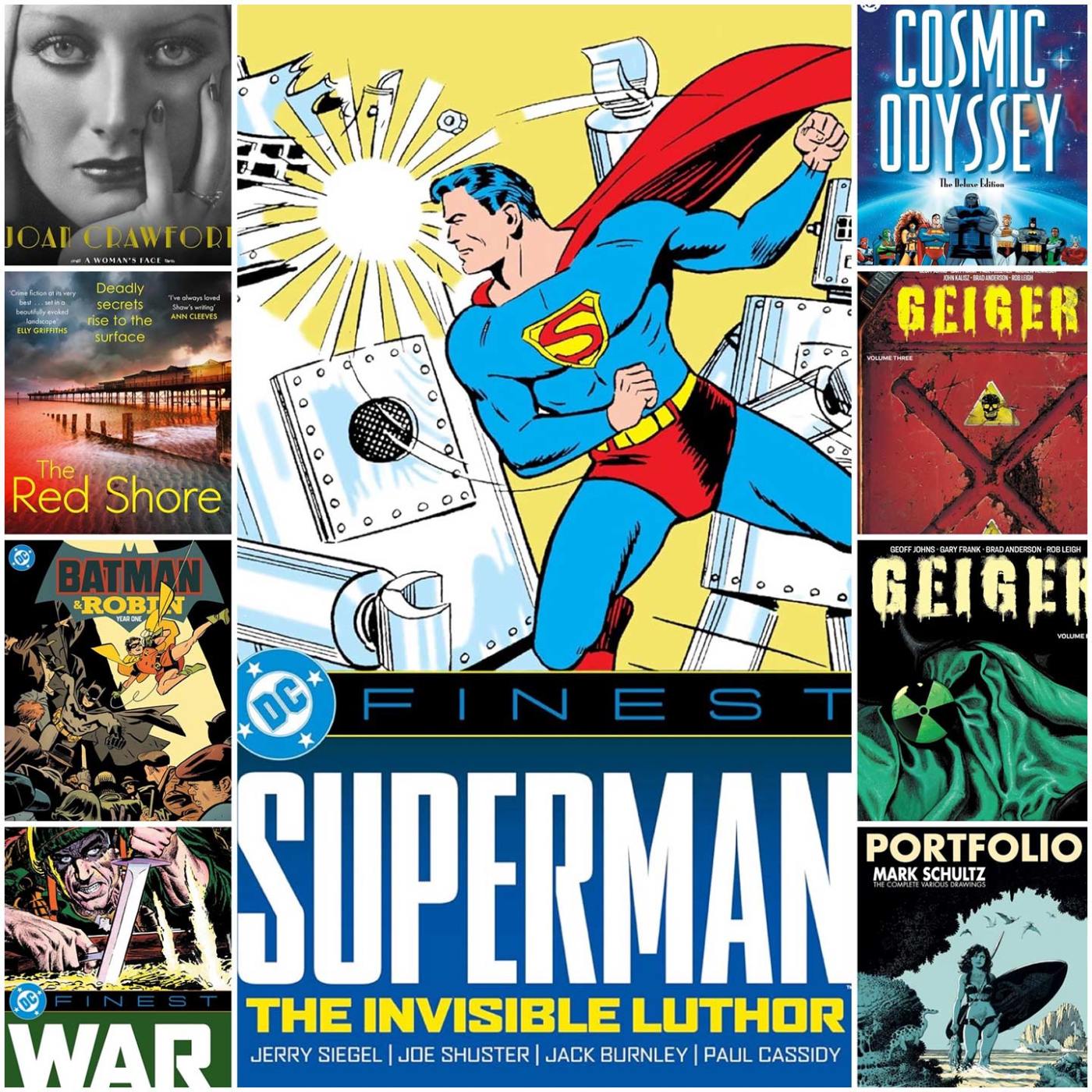
Finishing off the year strong and making my Goodreads goal of 75 books a reality. Here are the final books I read in December that put me over the top for 2025.
The Red Shore by William Shaw • 5 Stars on Goodreads
A new book by William Shaw is a cause for celebration any year, although I would definitely prefer it to star D S Alexandra Cupidi. Instead we have a new recurring character, London copper Eden Driscoll, who finds out his sister, Apple, is missing. Driscoll has been estranged from her for many years and finds out she has a young son, who was found locked in the cabin of a boat that Driscoll’s family previously owned. He’s called away from London to become a father-figure to a nephew he never knew he had. The Red Shore is definitely a very slow burn, but Shaw’s characters are always great. Driscoll is a loner and longs for his London homebase rather than reluctantly a family man in the small seaside town of Teignmouth. And of course, copper that he is, he gets involved in trying to solve what happened to his sister—with little help from the local police. I liked this book, but I felt the long and complicated explanation of what happened to Apple and who caused it was a bit much in the end. Regardless, Shaw has another Eden Driscoll novel already in the bag, due out in the summer. I will, of course, be reading it.
Joan Crawford: A Woman’s Face by Scott Eyman • 4 Stars on Goodreads
I’ve read and enjoyed a lot of movie-oriented books by author Scott Eyman, and this one is no exception, even though its subject is a star who does absolutely nothing for me. Joan Crawford always struck me as a STAR (all caps) and a very predictable actress; of her contemporaries, I always preferred Barbara Stanwyck over Crawford and her main rival, Bette Davis. Eyman produces a thorough examination of Crawford’s life and career, but the whole tone of the book is a little too idolatry for me. Crawford’s reputation certainly took a downturn after the publication of her adopted daughter’s Mommie Dearest purported tell-all (and it’s subsequent movie, starring Faye Dunaway), but there’s very little mention of that kind of abusive behavior here, until Eyman chronicles the publication of Mommie Dearest and its subsequent fallout after Crawford’s death. Crawford is someone who was definitely a product of the Hollywood studio system and her career failed as that system fell apart and she aged. Still, this is a sometimes-fascinating look at a major movie star, who—I feel—today pretty much elicits a “I don’t get it …” response from people … well, me at least. You had to be there in her heyday, I guess, to really get the appeal of Joan Crawford.
Portfolio: The Complete Various Drawings by Mark Schultz • 5 Stars on Goodreads
This thick—432 pages—book reprints all five volumes of artist Mark Schultz’s series of sketchbooks, Various Drawings, published from 2005 through 2012 by Flesk Publications, and includes over 160 pages of unpublished work. To me, Schultz’s style is a hybrid of Frank Frazetta and Dave Stevens, with all the best qualities of both (especially their skill at drawing beautiful women), but he still exhibits a detailed and meticulous style all his own. He is a master at both graphite and carbon pencil drawings and equally adept at pen and ink rendering. His work is definitely on the fantastic side and a large bulk of all the Various Drawings books—and this volume—are devoted to Conan preliminaries and finished art, plus a book he did titled Storms at Sea, and his comic book work, Subhuman and his most famous creation, Xenozoic Tales. This is—like all Flesk books—a beautifully designed package, by publisher John Fleskes and Schultz himself. This is a new edition of the one originally published in 2016 and long out of print.
Geiger Vols. 3 & 4 by Geoff Johns and Gary Frank • 4 Stars on Goodreads
Geiger Volume 3 continues the story of Tariq Geiger, also known as The Glowing Man, as he roams across a post-apocalyptic America with his companions, Nate the Nuclear Knight (and his baby zebra), and Barney, the two-headed wolf. They are being pursued by the New King and his men, out for revenge for killing the Old King. This volume includes Geiger issues 7 through 9 and the two-issue mini-series, Geiger: Ground Zero, which recounts the time directly after the The Unknown War and tells the origin of how Geiger got his radioactive powers under control with the help of a Russian defector/scientist named Molotov. Volume 4 continues Geiger’s journey, as he teams up with Junkyard Joe, a robot from the Vietnam War era and introduces the Glowing Woman. I enjoy this series as something different from either Marvel or DC (where Johns made his name) and not a typical superhero story. Johns is a writer who understands comics, letting the art of his collaborators (especially Gary Frank, with whom he did some memorable Superman stories) tell the story. I always enjoy a comic book writer who knows when to shut up and let the art tell the story. That’s what comics are all about.
Batman and Robin: Year One by Mark Waid and Chris Samnee • 5 Stars on Goodreads
What a joy it is to see Chris Samnee finally draw a Batman book, at least for an entire year. Samnee regularly picked Batman as his go-to character for his Inktober sketches each October, so to finally see him unleashed on the Caped Crusader—and with his old Daredevil partner, Mark Waid, doing the scripts—resulted in one of my favorite series of 2025. The storyline takes place right after Dick Grayson—Robin—joins Batman in his crusade against crime in Gotham City, and includes Two-Face, Clayface, and a new villain, The General, who tries to take over Gotham. I think this is Samnee’s best art in years, too, since his long stint on Daredevil a decade ago. His lean, graphic style is totally suited for the Dark Knight and his and Waid’s story collaboration is one of the better Bat-stories of the past decade. Totally worth picking up in the TPB version, but I’m hoping for a deluxe hardbound volume further down the line.
Cosmic Odyssey Deluxe Edition by Jim Starlin, Mike Mignola, Carlos Garzon, and Steve Oliffe • 3 Stars on Goodreads
I hadn’t read Cosmic Odyssey since it appeared in its original “Prestige” format in 1988, as a four-issue mini series, so I was excited to re-read it in this new Deluxe Edition. Sadly, it turned out to be a bit disappointing, to be honest. Jim Starlin’s script is a bit overwrought at times, and this “Deluxe Edition” turns out to just be a pricey ($39.99), slightly oversized hardbound with almost no special features, just a reprint of the aforementioned four issues and a couple of covers of other reprints, plus a poster Mike Mignola did, which is also the cover for this edition. (There outta be a law about calling something “deluxe” that requires special features; I sure would have loved to see some of Mignola’s sketches, roughs, layouts, etc., if they still exist). Mignola is the real star of this book, though, drawing some of DC’s heavyweights, including Superman and Batman, and Jack Kirby’s New Gods and the Demon (wasted in this story as a plot device), at a time before Hellboy, his most famous creator-owned property (Mignola would have been perfect for an ongoing Demon series). He’s the real reason I wanted to re-read this, and I find his art in this volume to be quirky and entertaining … it’s at this point in his career when his style was really starting to come together and I love his versions of some of these characters, in particular Darkseid. Anyway, the story involves the ol’ “Anti-Life Equation” coming to life and trying to destroy all life in every universe and Darkseid plotting to somehow capture it for his own ends, while seemingly acting like a hero … you know, the usual Darkseid stuff. I enjoyed re-reading it, but some more special features—and an introduction by Starlin and/or Mignola—would have been nice. Otherwise, this is just an expensive reprint.
DC Finest War: The Big Five Arrive by Robert Kanigher, Bob Haney, Joe Kubert, and Ross Andru • 4 Stars on Goodreads
This is the first of the DC Finest “genre” books I’ve bought (the others being Science Fiction, Horror, and the upcoming Western) and I enjoyed it a great deal. The “Big Five” in the sub-title refer to the series of books—almost an imprint in and of itself within DC—that were war titles: All American Men of War, GI Combat, Our Army at War, Our Fighting Forces, and Star-Spangled War Stories, alongside Blackhawk, which was never considered part of the Big Five, but evidently was a war book in DC’s eyes. I think this particular moment (all the books reprinted in this volume are from January through April 1957) is when DC took over both Blackhawk and G.I. Combat from Quality Comics when that company stopped publishing. Amazingly, all six titles were monthlies, and what you get here is four solid months worth of their issues. Other than Blackhawk, these are all anthology titles; at this point none of the war books had recurring characters, although that would soon change. The high point of this volume for me is the art; the stories—mainly written by Robert Kanigher and Bob Haney—are forgettable for the most part. But the war books had a “usual suspects” team of artists including Joe Kubert, Russ Heath, Ross Andru (and Mike Esposito), Jerry Grandenetti, Jack Abel, and someone named Art Peddy, who I was unfamiliar with until this book. All of Kubert and especially Heath’s stories are standouts, and for some reason they’re the only two artists who sign their stories. But beyond those two artists, you’ll spend a lot of time looking back to the contents pages to help figure out who drew each story. Each title has four stories per issue, too, ranging anywhere from 4 to 8 pages each, so what we have here is 80 stories in the Big Five books, plus an additional 12 from Blackhawk, which had three 8-page stories each issue. That’s a whopping 92 stories in this volume! The next war book—due in May—will be devoted to the earliest stories of Sgt. Rock, DC’s perennial war hero. Not sure I’ll pick that one up, but I liked this glimpse into DC’s war comics output for four months of 1957.
DC Finest Superman: The Invisible Luthor by Jerry Siegel, Joe Shuster, Jack Burnley and Paul Cassidy • 4 Stars on Goodreads
This is the direct sequel to last year’s very first DC Finest volume, Superman: The First Superhero, and picks up with reprints following the issues in that volume. This one features books published from July 1940 until fall 1941, including Action Comics 26 through 40, Superman 6 through 11, and the Superman stories from New York World’s Fair Comics 2, World’s Best Comics 1 (which quickly became World’s Finest with issue 2, included here along with issue 3). It’s all a mixed bag, to be honest. Superman, for the most part, is still fighting low-level gangsters and racketeers, plus doing the occasional social good the hero was famous for in his earliest years. Jerry Siegel writes all the stories (as far as I know) and there is already less and less of Joe Shuster’s art. Paul Cassidy and Wayne Boring pick up the slack, but the Jack Burnley stories are real standouts; he’s light years ahead of the rest of the artists who joined the Siegel and Shuster studio at this point in time. Reproduction throughout the book is very good, with the exception of some of the later Superman issues, starting with 9, which at times seems a little wispy in the line work; issue 11 is also bad, but it’s drawn entirely by Leo Nowak, whose linework seems wispy at best.. One thing that was missing from this volume: Superman’s Christmas Adventure, a promotional comic that was sold to retailers and manufacturers to give out during the 1940 holiday season. Macy’s gave it out, along with Skippy Peanut Butter, among others. It’s recently been reprinted in the Christmas with the Super-Heroes Treasury edition facsimile (issue C-43), but I feel it really belongs in this book. It too was written by Siegel and drawn by Burnley.
I’m really enjoying these Golden Age reprints of Superman (soon to be joined by Batman, next month, with his earliest stories in a new DC Finest volume), and it’s fascinating to watch the progression of the character. One thing is certain: NOBODY seems to know how to draw the S-shield on Superman’s chest. It varies almost from issue to issue and certainly from artist to artist (as does the hand-drawn “Superman” logo, which gets obviously improved and standardized by letterer Ira Schnapp with Action Comics issue 36).
 @innocent-bystander.com
Leave a comment