
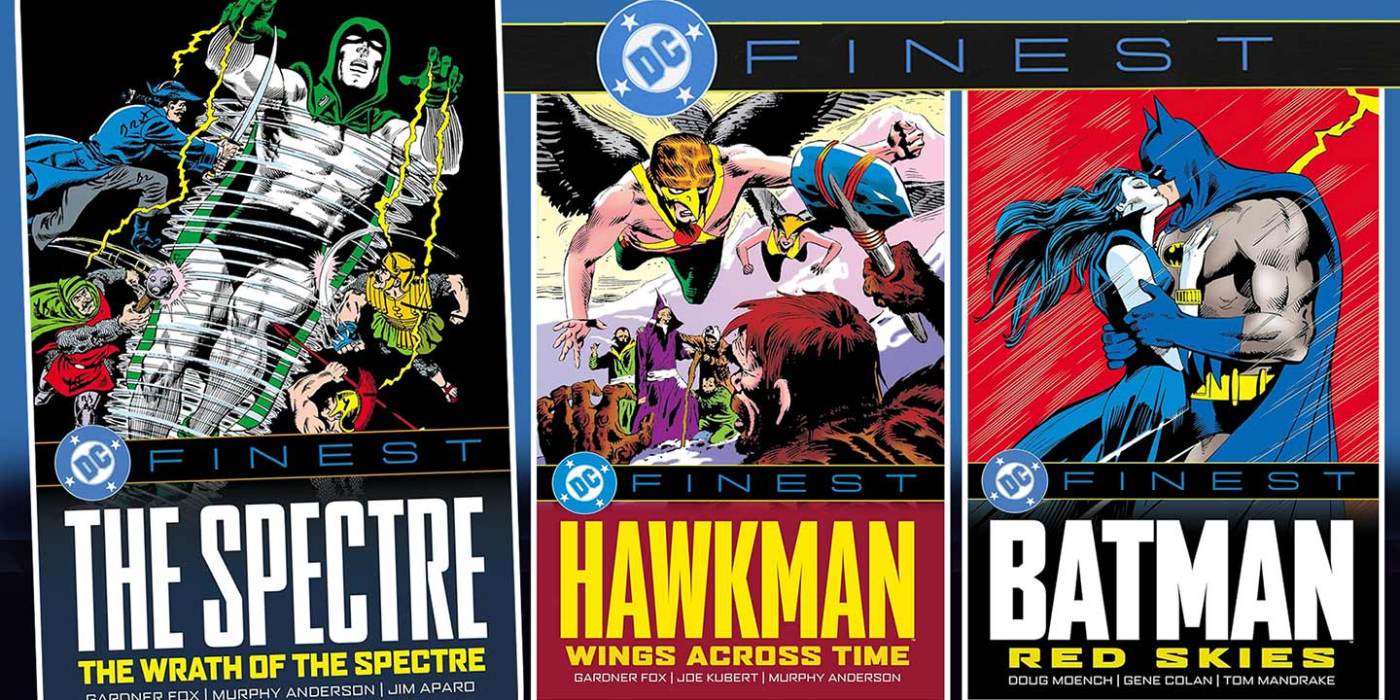
A newish trio of DC Finest volumes I’ve picked up over the past few months are here for your enjoyment … well, maybe one of them, not so much. But let’s start with the good news.
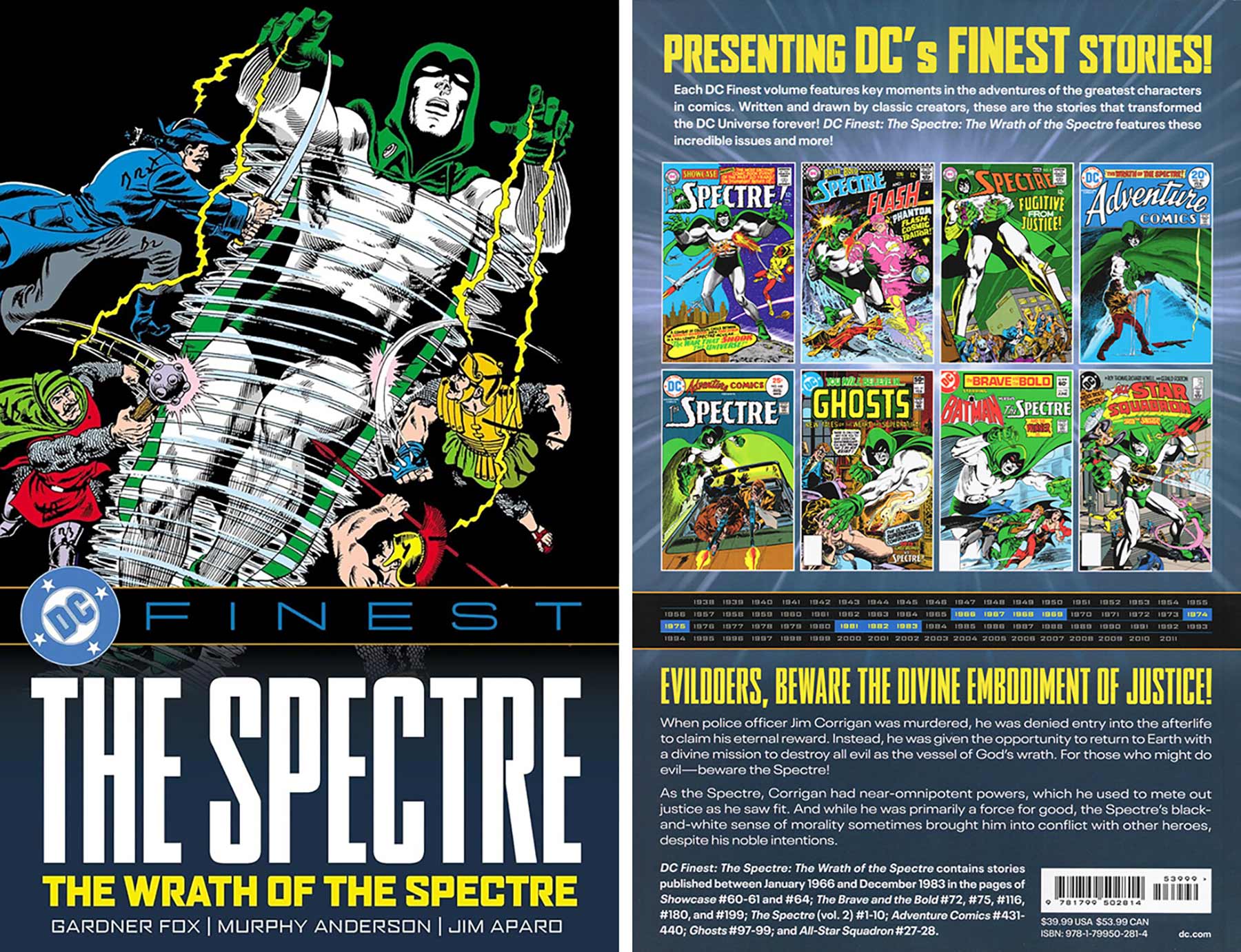
The Spectre: The Wrath of the Spectre by Gardner Fox, Murphy Anderson, and Neal Adams
I think I’m correct in saying that The Spectre was the last of the Golden Age revamps to come forth in the 1960s Silver Age from editor Julius Schwartz, and it didn’t quite take. The character never had its own book back in the 1940s and was featured in solo stories in Adventure Comics and as a member of the Justice Society of America in the Golden Age. Created by Jerry “Superman” Siegel and artist Bernard Bailey, The Spectre was a bit too omnipotent for comics, i think. In this volume, I liked the four issues by Fox and Anderson (the three Showcase try-outs—60, 61, and 64—and The Spectre issue 1) and the Neal Adams issues (2 through 5), but after that it went downhill pretty quickly. Gardner Fox left the book (but not before creating a plethora of nicknames for the character, including the “Astral Avenger,” the “Disembodied Daredevil,” the “Disembodied Detective,” the “Ghostly Guardian,” the “Grim Guardian,” the “Spirit Sleuth,” and the “Wonder Wraith”), after one issue (number 2) with Neal Adams as artist (not sure if Fox was making a statement about being rewritten, something Adams did regularly). Adams wrote—badly—issues 3 through 5, and then Fox returned with Jerry Grandinetti as penciller and Murphy Anderson on inks, with the latter actually bringing some control and sense into Grandinetti’s chaotic layouts (“Panel borders? We don’t need no stinkin” panel borders!”). Towards the end of The Spectre’s 10-issue run, the character took over the “spirit of vengeance” persona he would become more famous for and the last two issues, featuring short stories by various writers and artists (including a very early Berni Wrightson), have more of a horror bent. The Spectre then went on hiatus, returning five years later when Michael Fleischer and Jim Aparo brought the character back in the mid-1970s with a 10-issue run in Adventure Comics, in which The Spectre became a quasi-horror title (the book was called Weird Adventure Comics for a spell) and the character killed criminals in truly horrible ways, at least for the first few stories. I do love Aparo’s art on those issues, though.
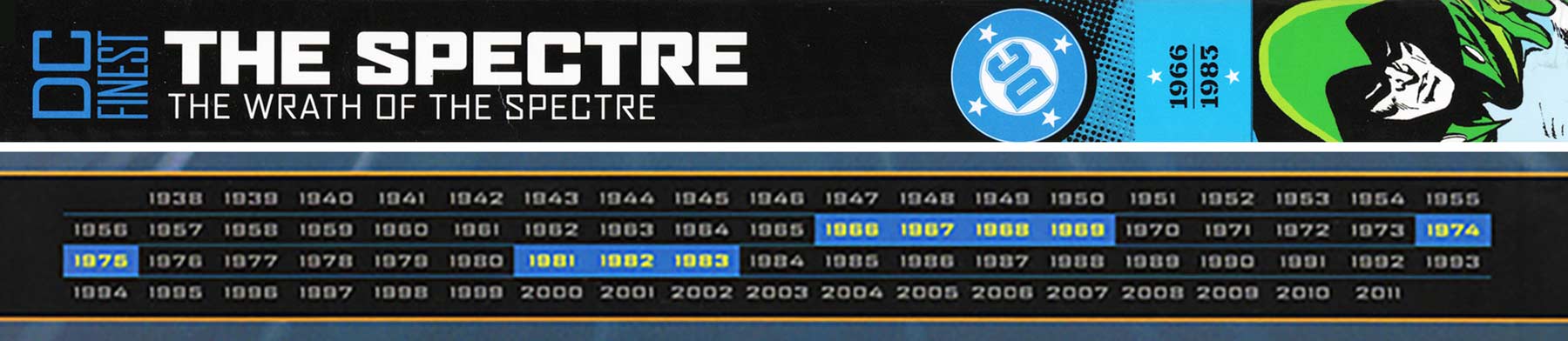
The DC Finest timeline on this volume wanders around from 1966 through ’69, 1974-75, and 1981 through ’83, and includes the above-mentioned Showcase issues, The Spectre 1-10 (mysteriously listed as “volume 2,” when there was no volume 1), Adventure Comics 431-440, Ghosts 97-99, The Brave and the Bold 72, 76, 116, 180, and 199 (mainly team-ups with Batman), and All-Star Squadron 27-28. The Spectre would return in another series to more long-lasting success in the 1990s, running for 63 issues (0 through 62) by writer John Ostrander and artist Tom Mandrake. I’m sure there’s at least another bunch of volumes of DC Finest content featuring the Astral Avenger, although I would probably pass on them. To be honest, I never quite got the character, especially his costume … is the white color a long-underwear onesie or his naked, ghost-like skin? And he just wears briefs, and a green cloak and cowl? I guess the Lord does work in mysterious ways, especially with his “vessels of God’s Wrath.” Still I enjoyed this book a great deal, having not read any of these stories since they were first published 50-60 (!) years ago. The array of artists–from Anderson to Adams to Aparo, a literal “A-list”–certainly helps.
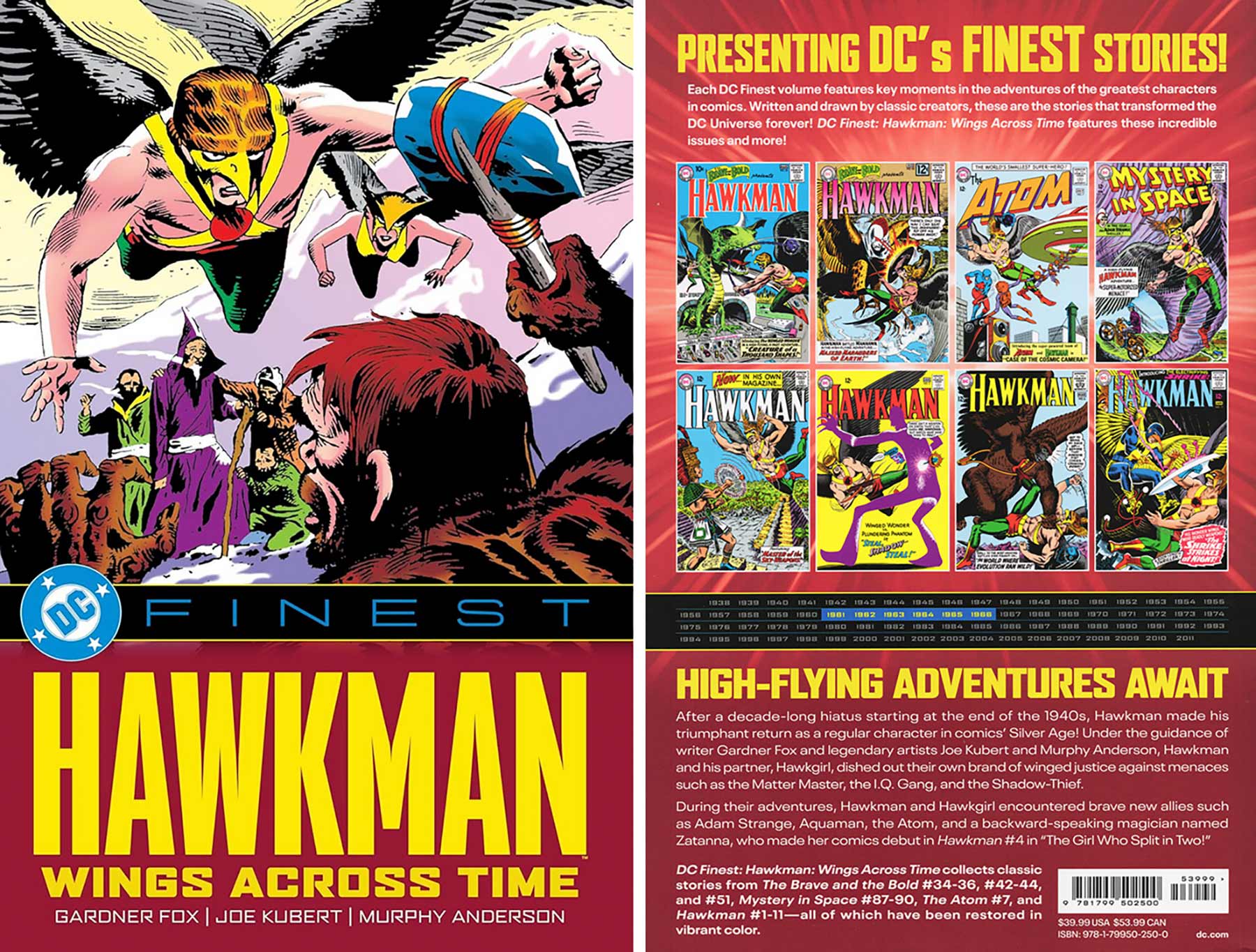
Hawkman: Wings Across Time by Gardner Fox, Joe Kubert, and Murphy Anderson
After the Silver Age of Comics started with the relaunch (and revamp) of The Flash in Showcase issue 4 in 1956, Green Lantern and The Atom followed under editor Julius Schwartz’s direction. Fourth on the list of revamps was Hawkman, and while the other three heroes had little problem jumping into their own books, Hawkman had to take flight several times before he got his wings. It started with a three-issue tryout in The Brave and The Bold issues 34-36 in 1961, written by Gardner Fox and drawn by Joe Kubert, who had done the feature in some of the later issues of The Flash in the late 1940s, when the artist was just barely out of his teenage years. A second B&B appearance followed a year later in 1962 in issues 42 through 44 (again illustrated by Joe Kubert), but still no solo book. Hawkman made a four-issue appearance as a back-up feature in Mystery in Space in late 1963-early 1964, but this time he was drawn by Murphy Anderson, much to some fans’ annoyance (they preferred Kubert; personally I didn’t like the artist’s superhero work as much as his war books, especially Enemy Ace, and I think his Tarzan is superb). Finally after that short run in MiS, he graduated to his own title, with number 1 cover-dated for May 1964. All those books are present in this DC Finest volume, plus Hawkman’s appearance in the second team-up issue of Brave and Bold (51), and his first team-up with The Atom in that hero’s issue number 7, plus issues 1-11 of the solo Hawkman title in this volume. Anderson illustrated all 11 issues, and they’re beautifully drawn. Mostly known at DC for his inking work on Carmine Infantino (Adam Strange) and Curt Swan (Superman), Anderson was also a gifted penciller and even moreso when he was allowed to ink his own work. Hawkman is his greatest work as both penciller/inker at the company (in my humble opinion). Fox’s scripts are a little old-fashioned (it’s amazing how many nicknames he has for Hawkman, albeit not as many as for The Spectre: the “Winged Wonder,” the “Flying Fury,” the “Aerial Ace,” the “Pinioned Paladin,” to name a few), with Hawkgirl’s—the “Aerial Amazon”—first name (“Shayera?” … “Shiera?”) changing periodically. The timeline on this volume runs from 1961 through 1966.
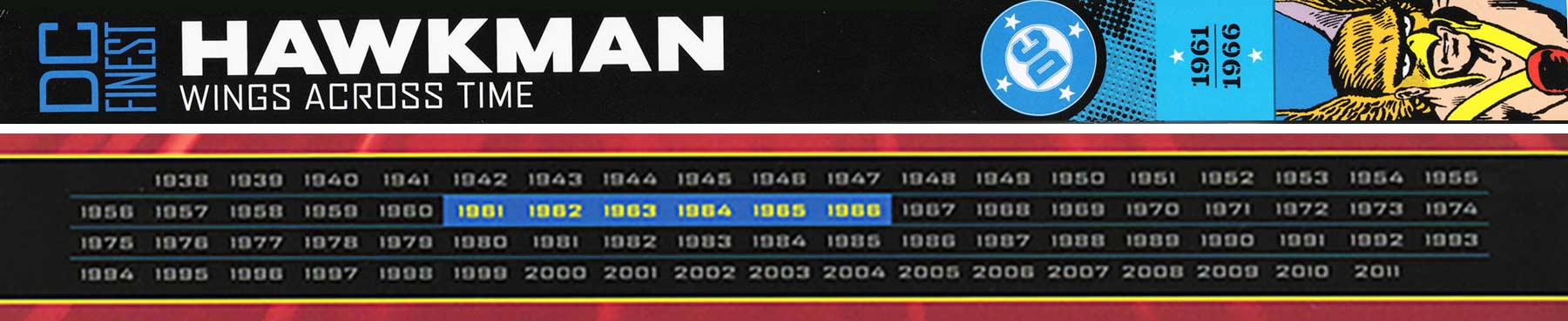
Hawkman as a solo book lasted until issue 27 in September 1968. Fox and Anderson’s last issue was 21 (August 1967), but the title never graduated to monthly status, probably a sign that sales weren’t that great compared to his other Silver Age revival compatriots. Fox wrote some of the issues of The Atom when Hawkman joined that character for a brief run after his solo book ended. That lasted from issue 39, November 1968 (continuing The Atom’s numbering, with a title change to The Atom and Hawkman, with covers by Joe Kubert), through 45 (November 1969), so there’s hope for a second Hawkman DC Finest volume. In the meantime, this is a great collection with stellar reproduction (although one issue, number 9, has a lot of dropouts in the word balloons for some reason). If you’ve never read any of Hawkman’s 1960s adventures, this is the best jumping-on point you could hope for.

Batman Red Skies by Doug Moench, Tom Mandrake, and Gene Colan
Sad to say, this is my least favorite Batman volume in the DC Finest line to-date. One of my first buys in this now year-old line was Batman Year One & Two, which helped launch the series and started with Batman 401 (post-Crisis on Infinite Earth) and included the legendary “Batman Year One” story arc by Frank Miller and David Mazzucchelli. I guess I shouldn’t have strayed before that post-Crisis line in the sand (or red skies, as it is), though, because this 1985-86 volume collects Batman issues 388-400 (a great anniversary issue, with story by Doug Moench and chapter art by the likes of George Perez, Joe Kubert, Art Adams, Brian Bolland, and many more), Batman Annual 10 (with the unlikely art duo of Denys Cowan and Alfredo Alcala), Secret Origins 6 (by Roy Thomas, Marshall Rogers, and Terry Austin), and Detective Comics 554-567.
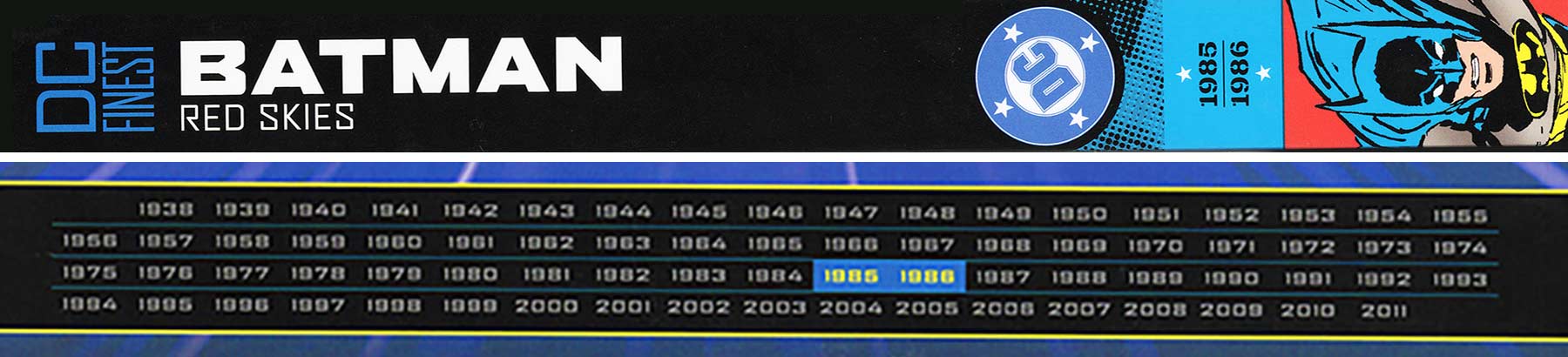
Just about all the Batman and Detective stories are written by Doug Moench, with the Batman issues drawn by Tom Mandrake and the Detective ones by Gene Colan, and that’s where my problem lies. I’ve always felt—even when I was buying these comics as they originally came out—that Colan was totally unsuited for Batman (and his run on Wonder Woman, for that matter, when he left Marvel for DC in the ‘80s). His work looks sketchy and rushed in my opinion and the inking by Bob Smith is not a good fit with Colan. And while I loved Moench on Master of Kung Fu, his Batman just didn’t appeal to me. Two issues that really disappoint in this volume are when Moench is teamed up once again with his MoKF artist, Paul Gulacy. I don’t know what it is with the reproduction on those two issues, but it’s among the worst I’ve seen in a DC Finest volume so far. I wonder if Gulacy did super-tight pencils on those issues and they were not inked, but while the stories are fine (and it’s great to see Moench & Gulacy together again, especially on Batman), there’s just a loss of sharpness on those two issues. With Moench being the only writer on both Bat-books, the Batman stories often continued into the following Detective issue (or vice versa), and the disconnect between Tom Mandrake’s hyper-detailed and very busy art (he inked his own work) and Colan’s sparse style, lightly inked by Smith, is really apparent. Anyway, I think I will stay north of the Crisis line on subsequent Batman volumes (Red Skies refers to the year in which Crisis was published, when all DC comics were affected with that phenomenon). It looks like two of the Batman volumes coming in 2026 will continue along those lines: Batman: A Death in the Family (due in April), and Batman: Blind Justice (July), will bring the complete run of Batman in DC Finest from 388-435, including this volume. A third Batman volume will go back to the very beginning and start with Detective 27 in 1939 and Batman 1 in 1940. That one is due in January and I’m really looking forward to it. I was surprised how much I enjoyed the first Superman volume that started with Action Comics 1 and Superman 1.
Up next for me:
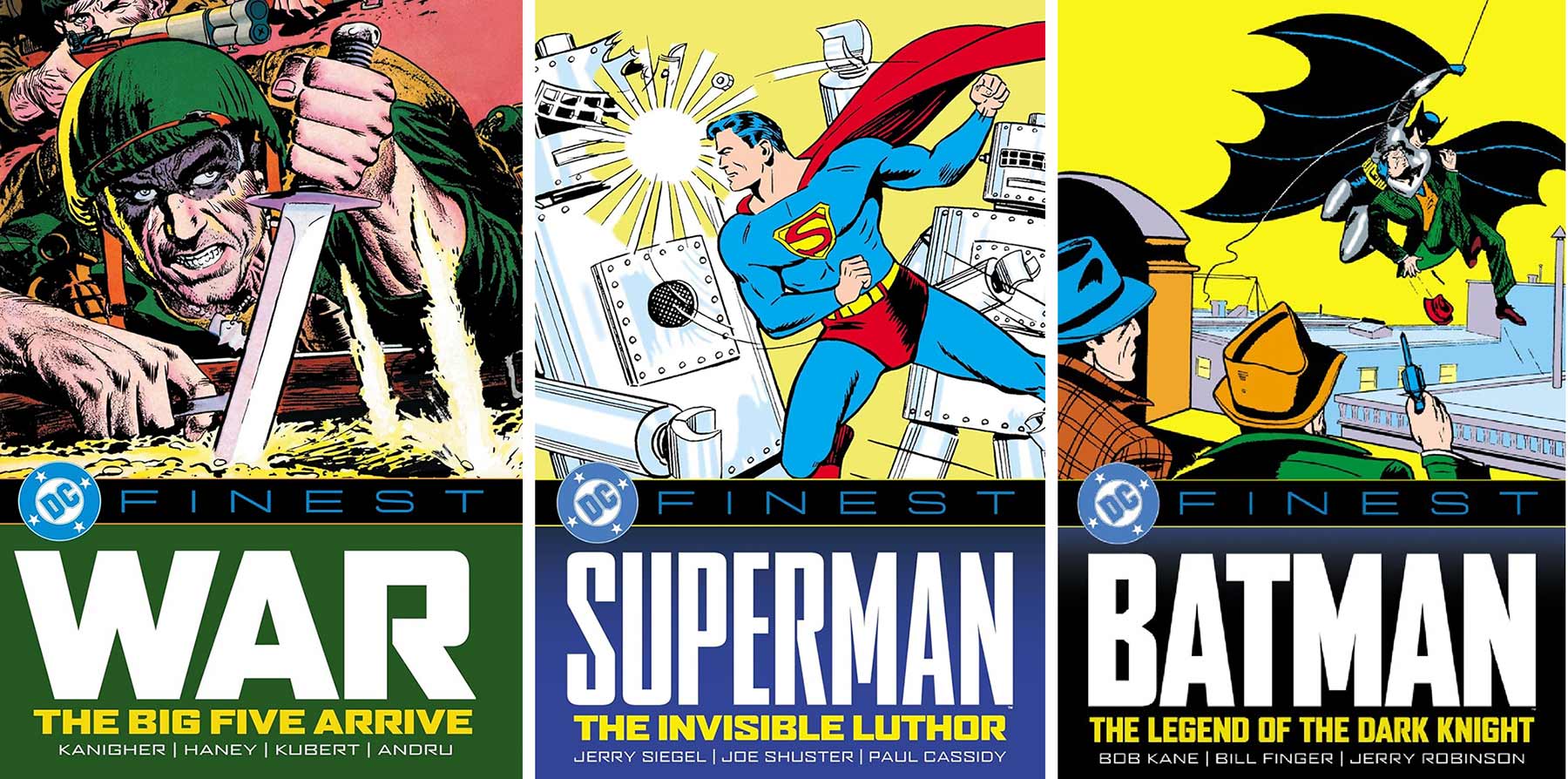
Another genre volume, War: The Big Five Arrive (due November 11), featuring the beginning of DC’s “Big Five” war titles (All-American Men of War, G.I. Combat, Our Army at War, Our Fighting Forces, Star Spangled War Stories) with four issues of each title, plus a bonus, the first four issues of Blackhawk, after DC picked up the title from the defunct Quality Comics in 1958.
Superman: The Invisible Luthor (December), which picks up with Golden Age reprints directly after Superman: The First Superhero volume, featuring Action Comics, Superman, and World’s Fair/World’s Best, and World’s Finest.
The afore-mentioned Batman: The Legend of the Dark Knight (January 2026), which reprints the very first Detective Comics and Batman issues starting with Detective 27 from 1939.
It looks like a FINEST three months … happy reading, everybody!
 @innocent-bystander.com
Leave a comment