
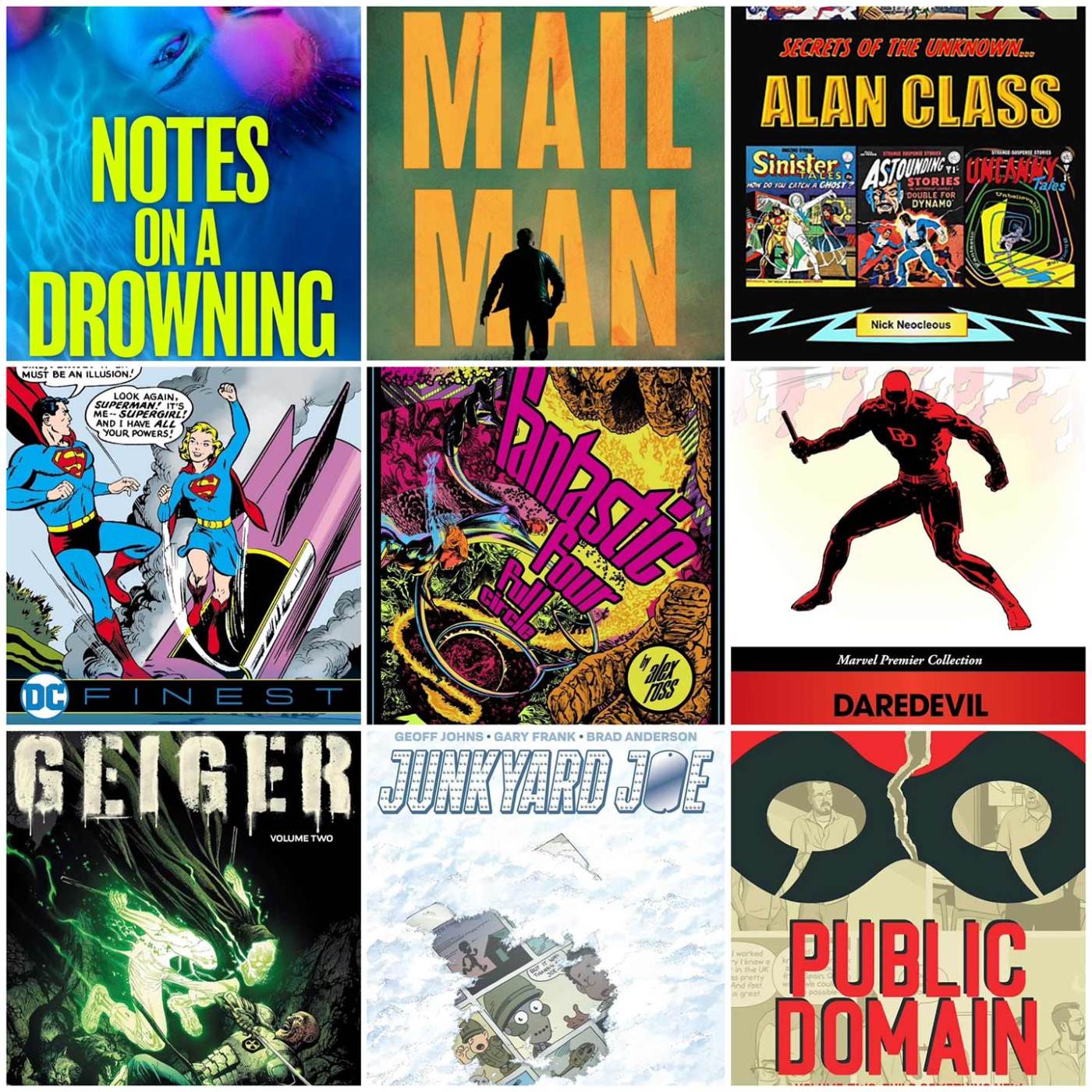
Lots and lots of graphic novels and otherwise comics-related books in February, which has always seemed like the darkest, dreariest of each and every year to me, even here in sunny San Diego. But I also managed to fit in two mystery/thriller novels somehow.
The Mail Man by Andrew Welsh-Huggins • 3.5 Stars on Goodreads
Boy, I have mixed emotions about this book. I thought it started out great and then just got way too complicated with too many characters. It concerns Mercury Carter, a freelance “mailman” who, while delivering a letter to a woman happens upon the woman and her husband about to be tortured by a team of men over something they want: the location of another woman. At times there are more than a half-dozen bad guys, with three bosses, a husband hiding $20 million dollars, a lottery scam, a drug trial, and a chase across the lovely landscape of Indiana and Illinois. Oh, and throw in a kidnapped daughter with Sherlock-level powers of deduction. As Carter pursues the kidnappers, trying to save the person he was originally supposed to deliver the letter to (a MacGuffin if ever there was one), more and more ancillary characters are introduced making this a huge mishmash of people whose involvement in the actual story is tentative at best. It’s a novel that would have benefited by losing some of these useless subplots (the $20 million comes in handy at one point, but otherwise it’s totally unnecessary to the story). Carter is a fascinating character, a kind of mashup of Jack Reacher and Jason Bourne, and I’d like to read another book with him in it, but this debut novel was a little hard to follow.
Notes on a Drowning by Anna Sharpe • 5 Stars on Goodreads
Any book that mentions both Line of Duty and Slow Horses is okay with me, but I was surprised at how much I enjoyed this thriller by Anna Sharpe, the nom-de-plume of British author Anna Mazzola. Alex is an attorney who deals in occasional pro-bono work for the law firm she works for, including inquests. Kat is a young woman who is an assistant to a rising British political star. The two of them have a checkered past together: Kat was with Alex’s sister, Elissa, in Tokyo when she suddenly disappeared, never to be seen again, alive or dead. Kat escaped her life in Japan and now she and Alex’s paths cross again when Alex investigates the death of a Moldovan girl named Natalia, and the file ends up on Kat’s desk. The two fight against the odds and outside forces, including the police, to find out what happened to Natalia, whose sad tale of dying in a foreign country echoes that of Elissa. Sharpe’s story moves along quickly, but it doesn’t really get going until Kat and Alex are thrust together, when the reluctant Kat decides to get involved in Alex’s investigation to what happened to Natalia. I really enjoyed the London setting, and while the subject matter—trafficked young women with more than a passing resemblance to the real-life horror story known as Jeffrey Epstein—it still makes for a suspenseful and well-told tale. Sharpe already has a second book planned that doesn’t feature Kat and Alex, but I certainly hope a future book is wrapped around their prickly collaboration.
Fantastic Four: Full Circle Expanded Edition by Alex Ross • 5 Stars on Goodreads
This is a large-format, deluxe edition of Alex Ross’s amazing Fantastic Four: Full Circle original graphic novel from 2022, supplemented by close to 300 pages of new material including the artist’s commentary, thumbnails, pencils, inks, and color guides for the original 64-page story, which is also reprinted here, alongside the story that inspired it all, “This Man, This Monster,” from Fantastic Four 51. It’s a fascinating, deep behind the scenes look at the creation of this story, which I think is the best FF tale since John Byrne did the book in the 1980s. While I was reading this, the first teaser trailer for Fantastic Four: First Steps debuted and the second the Thing appeared on the screen, all i could think of was how much it looked like Alex Ross’s version of the character. One small caveat though: Even though the book is printed on the same paper as the original graphic novel, somehow the art looks better in its first iteration, at a smaller size, which tightens it up. I think it has to do with Ross’s “inking” style, which is not done in traditional pen and brush line art, but rather filled with texture. At the larger size, the texture is more noticeable and the art doesn’t seem as sharp. Still, if you ever wanted a very deep-dive into an artist’s process on a great graphic novel, this is it.
Public Domain Vol. 2: Build Something New by Chip Zdarsky • 5 Stars on Goodreads
I’m really enjoying this series written and drawn by Chip Zdarsky. It’s published by Image and creator-owned by Chip, and that’s important to note since that’s the point of the whole ongoing story. If you haven’t read volume one—or even if you have—I urge you to read it first (or again). Zdarsky both writes and draws the book (with some assistance), and each volume collects five issues. It’s about Syd Dallas, the co-creator of The Domain, a comic book character that has seen huge success in a series of movies (and related merchandise), but like a lot of comics people, Syd was left out in the cold by his writer and Domain co-creator, Jerry Jasper. But then Jasper’s assistant finds a document stating that Syd actually owns The Domain and sends it to the artist. The Dallas family sues and gets the rights to publish new Domain stories, separate from the Singular Entertainment ones. Volume 2 chronicles their efforts to set up their own comics publishing company and includes an issue devoted to “San Diego Comic Expo,” with the fledgling company setting up a booth at the huge convention and holding a panel to announce their coming series. Public Domain is a fascinating look at the business end of comics, focusing on the big IP that movies and TV make out of the much smaller comics. I like Zdarsky’s art on this, too; his simple yet expressive faces and figures bring to life what is basically a book with little action (save for loan sharks) and a lot of talking heads. Only problem? It takes too long for each volume to come out! Maybe now that Chip isn’t writing that loser, Batman, he can concentrate on Public Domain.
Junkyard Joe Vol. 1 by Geoff Johns, Gary Frank, and Brad Anderson • 5 Stars on Goodreads
This collection of the “Mad Ghost” miniseries, Junkyard Joe, collects issues 1 through 6, published by Image Comics. (Mad Ghost eventually became Ghost Machine, I guess.) It features a robot GI from the Viet Nam war who shuts down after saving “Muddy Davis,” a grunt who survives a horrific attack that kills his entire squad. Davis goes back home to become a cartoonist and creates “Junkyard Joe,” a syndicated comic strip not unlike Beetle Baily, but featuring the titular robot. The characters in the strip often gently comment and raise awareness on veterans’ issues. Flash forward to now, and Davis retires after his wife dies, and the strip ends after a very successful run that included merchandise and a TV Christmas animated special. The real Junkyard Joe—who “didn’t exist” as Davis was told, under threat of being committed to a psychiatric ward—shows up on the cartoonist’s doorstep, just as a young family moves in next door, including a budding artist. But Joe, also known as “Unit Beta,” is being hunted by his creator, the crazy doctor who told Davis Joe didn’t exist. I really liked Geoff Johns’s story and Gary Frank’s art on this and the way they’re slowly buidling a universe character by character, with Junkyard Joe being the second after Geiger, the Glowing Man. And this story definitely reads better in collected form, all at once, than in monthly installments.
Geiger Vol. 2 by Geoff Johns, Gary Frank, and Brad Anderson • 5 Stars on Goodreads
I’m enjoying some of Geoff Johns “Ghost Machine” imprint books published by Image Comics. Despite his latest work for DC, the continually-delayed JSA, which was fairly awful, I’ve always liked Johns’s writing, especially on Superman when he first teamed up with artist Gary Frank. Geiger concerns a post-apocalyptic America, after the “Unknown War,” and Geiger himself has radioactive superpowers, controlled by boron rods tucked into his shoulders. He also has the cutest mutant two-headed dog—Barney—you’ve ever seen. This volume features his battle with the electricity-powered bounty hunter, the Electrician, who dognaps Barney. Along the way, Geiger gets a kind of Sancho Panza to his Don Quixote, named Nate, one of the Knights from Las Vegas (sort of a callback back to the Atomic Knights of DC Comics in the 1960s, another post-apocalyptic radiation-filled series). This volume reprints issues 6 through 10 of the Image series. I like Frank’s art a lot and one thing I’ve always liked about Johns’s writing is he knows when to shut up and let the art tell the story. They make a great team, and colorist Brad Anderson makes them even better. I’m looking forward to trying some of the other Ghost Machine books as they come out in trade paperback.
Secrets of the Unknown: Alan Class by Nick Neocleous • Not Available on Goodreads (but 5 stars)
I’m always fascinated by foreign versions of American comics, especially the British ones. Alan Class was a UK publisher who licensed various U.S. series for publication like Creepy Worlds, Secrets of the Unknown, Amazing Stories of Suspense, Sinister Tales, Astounding Stories, and Uncanny Tales. The books were of a smaller size, with color covers and black and white interiors, and square-bound, and ran about 68 pages or so. But here’s the really interesting thing about them: Class licensed Marvel, Tower, Charlton, ACG, and maybe a few more (but not DC, whose rights were tied up elsewhere in the UK), so you’d have all these various American series appearing in the same books side-by-side with each other. This magazine-sized collection deals mainly with covers, all reproduced in color, and all of them looking pretty familiar if you’re a Silver Age fan. Class operated from 1959 through 1989 with his various reprint titles; I own two of them, both with Steranko Nick Fury covers, and one of them is part of a set signed by Class and includes some of the actual printing plates used to print the cover. This book also features an interview with the still around (as of this writing) Alan Class, plus some fun facts about his publishing empire and a reprint of the very first story he published. There isn’t a lot of information available about British reprints of American Comics (Infinity Magazine, a Brit import you might be able to find at your local Barnes & Noble or by subscription is a great pop culture mag, profusely illustrated, and often runs British comics oriented articles), so this kind of volume is greatly appreciated.
Daredevil: Born Again by Frank Miller and David Mazzucchelli • 5 Stars on Goodreads
This is a new “Born Again” edition published in Marvel’s new “Premier Collection” format, a smaller-sized trade paperback priced at $14.95. I like this format, although the ink doesn’t look as crisp and black on the paper they’re using as it did in previous editions; having said that, I prefer this $5.00+ higher-priced version to DC’s Compact Comics (which are priced at $9.95), where the ink just looks dark and muddy on their paper choice. I think this is one of Frank Miller’s finest written efforts, up there with Batman: Year One, another collaboration with artist David Mazzucchelli, whose work on this earlier mini-series within a series is not as assured and stripped down as the later Batman one. (Don’t get me wrong, the art is still great.) This arc was originally published in Daredevil issues 227-233, almost exactly one full year before Batman: Year One. Miller’s story of the ultimate takedown of Matt Murdock by the Kingpin is a great one, but I think it loses a little steam when “Nuke,” a super-soldier gone wrong, is introduced near the end. Also included are Mazzzucchelli’s breakdowns for issue 228, his recolored covers for all the issues, and Miller’s script for issue 233. Plus there’s a reprint of issue 226, by Miller and Mazzucchelli, and co-written by Denny O’Neil, with a story unrelated to the “Born Again” arc. All-in-all, this is a great, bargain-priced edition of this seminal Marvel storyline. They’ve announced three more books in this format: Black Panther by Ta-nahisi Coates (out now), Ed Brubaker’s Captain America (the Winter Soldier), and Fantastic Four by Jonathan Hickman. I think they may be following DC’s Compact Comics playbook of reprinting popular stories that have been collected numerous times before, like Watchmen and All Star Superman, trying—no doubt—to squeeze every last penny out of stories that have stood the test of time. Nothing wrong with that, I guess.
DC Finest: Supergirl The Girl of Steel by Otto Binder, Jerry Siegel, and Jim Mooney • 5 Stars on Goodreads
This latest entry (for me, at least; I’m trying to be a good boy and not buy EVERY DC Finest volume), features the earliest adventures of Linda Lee, Supergirl, who lands on Earth via rocketship from Argo City, a part of Krypton that survived after the destruction of that planet. Supergirl is actually Kara, the cousin of Superman, and the Man of Steel—once he gets over his shock—parks the poor space orphan at Midvale Orphanage, where she becomes his “emergency weapon,” in the event that anything happens to him, and while he trains her. The stories—mainly by Otto Binder and Jerry Siegel and just about all drawn by Jim Mooney—appeared in Action Comics and this volume includes a big, early chunk of them: issues 257 through 288, including the story when Superman finally introduces her to the world (issue 285). Other stories in this volume include ones from Superman, Superboy, Lois Lane, and Jimmy Olsen that feature the Girl of Steel. To be honest, the Action Comics tales are insipid at best, and Mooney’s art is weak in parts (although his depictions of both the blonde Supergirl and brunette Linda Lee are charming), with a lot of stock Wayne Boring and Curt Swan Superman poses recreated by Mooney throughout. The stories also introduce Streaky, the Super-Cat, and bring together Supergirl with the Legion of Super-Heroes, Jimmy Olsen, Lois Lane, and Krypto, the Super-Dog, among other Superman Family members. It’s an enjoyable read, though, and another great collection in the DC Finest run. I’m looking forward to what DC reveals for the next phase of this series, from July through the end of the year.
To read more about this volume in the DC Finest series, please click here!
 @innocent-bystander.com
Leave a comment