
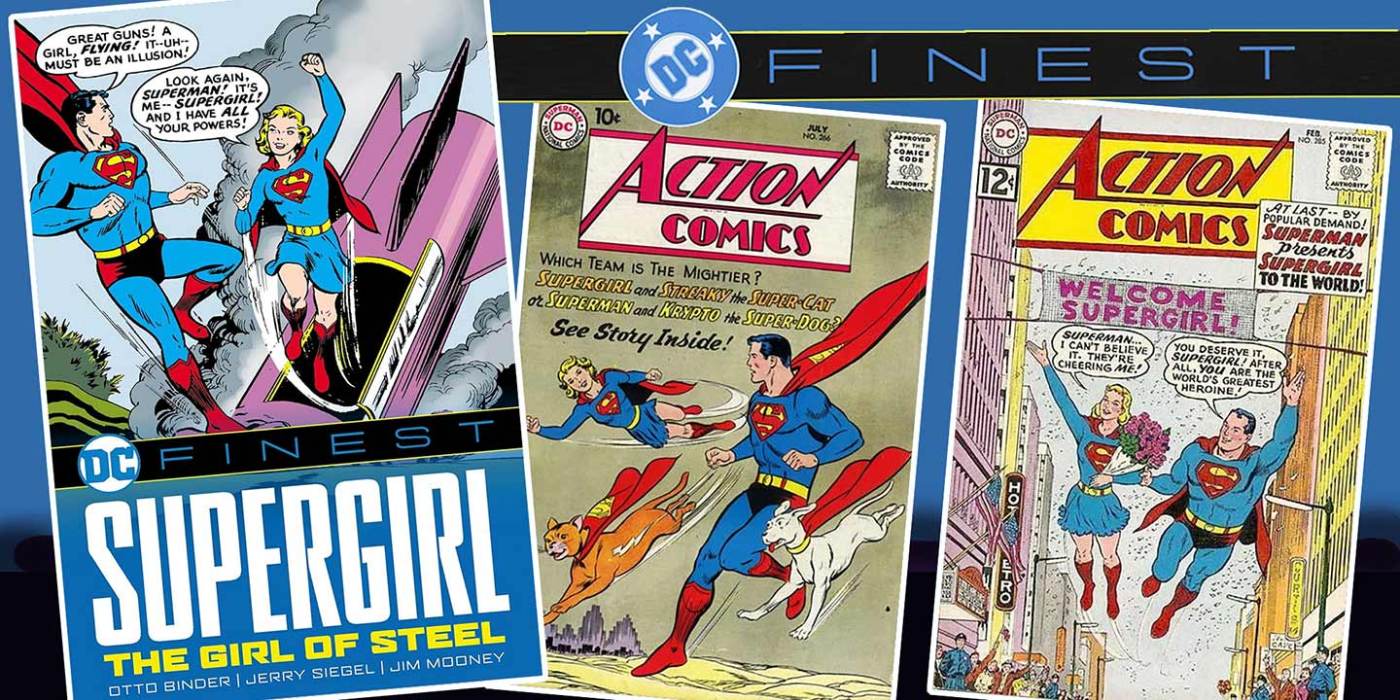
While I’m concentrating on the Superman and Batman books that are being published in the new DC Finest format, I wasn’t planning on buying this volume featuring Supergirl. I don’t have many fond memories of reading the feature as a kid; in fact, if I had to categorize the stories even back then when I was 4-7 years old when they first came out, I would have used the word “insipid,” if I knew what it meant. And to be honest, re-reading them now, almost 60 years later, that’s how I’d categorize them still.
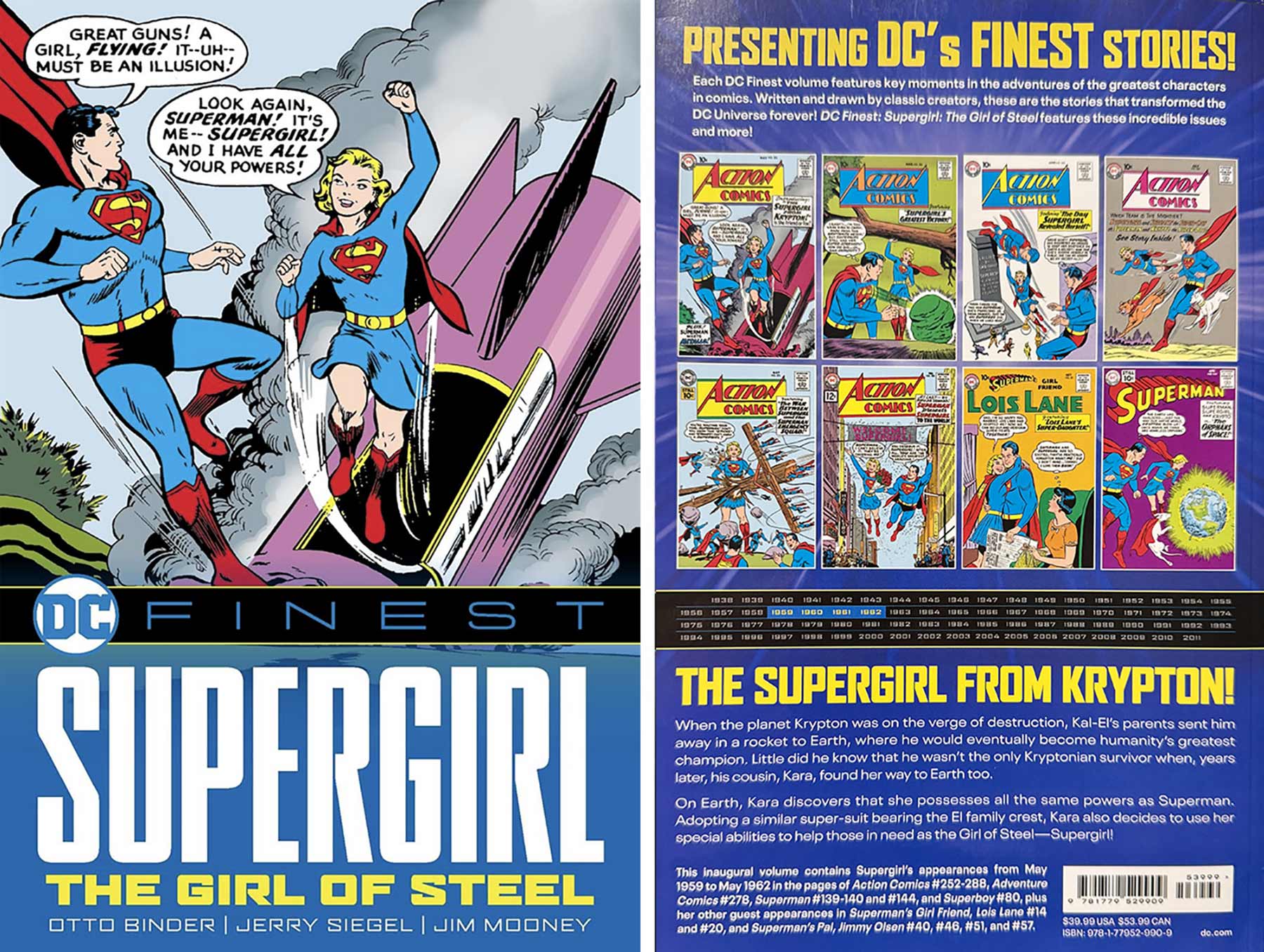
DC Finest: Supergirl The Girl of Steel (yes, the new/old DC logo is fixed on the actual printed book!)
These stories—mainly by Otto Binder and Superman co-creator Jerry Siegel—are so hokey and contrived, I’ve gotten a sore neck from shaking my head so much as I read them. Let me give you an example. Here’s the plot of “Supergirl’s Three Time Trips!” from Action Comics 274, March 1961, written by Jerry Siegel and drawn by Jim Mooney. Supergirl, in her Linda Lee identity at the orphanage in which Superman has parked her, is given a school assignment to write a paper on “the famous person in the past” she’d most like to be. She subs in her handy-dandy Linda Lee robot (conveniently hidden in a hollow tree outside the orphanage) and travels back in time (yes, she can do that) to visit Annie Oakley, Pocahontas, and Betsy Ross. I won’t bore you with the details on Annie and Pocahontas, but when Supergirl encounters Betsy Ross, it’s at the moment in which she has just been commissioned to make the first United States flag. She does so, and hands it off to a messenger who proceeds on horseback to deliver the flag to George Washington. Said messenger promptly lets the flag blow away into a wildfire, and IN THE BLINK OF AN EYE (emphasis added, because something like this happens in almost EVERY Supergirl story), the Girl of Steel quickly grabs a British flag off a pole in a nearby invading army camp, spots a scarecrow wearing a dark blue coat, which she also grabs (pausing to compress the head of the scarecrow to make it look scarier, assuring that more crows than ever will be scared), and then sews a NEW flag at super-speed from the red and white threads in the British one and the dark blue cloth from the coat. She then returns to the wildfire and gently wafts the new flag she super-sewed towards the messenger, who proclaims, “How amazingly fortunate! The flag has returned safely to me, blown back by a gust of wind before the fire could destroy it!” This process takes eight panels over two pages, but it all takes place in less than a second, story-wise.
What sold me on this volume, besides a chronological reprinting of all the Supergirl stories not only from Action Comics, but also Superman, Superboy, Jimmy Olsen, and Lois Lane, is all those extra stories (one notable one that’s missing: Supergirl saves Jimmy from being “The Wolf-Man of Metropolis” in Superman’s Pal Jimmy Olsen issue 44 by kissing him in the dark, changing him back to normal). Besides Binder and Siegel on scripts, Jim Mooney draws all the Supergirl stories from Action Comics, and Curt Swan, Wayne Boring, Kurt Schaffenberger, and Al Plastino provide the art from the other books. Issues included are Action Comics 252-288, Adventure Comics 278, Superboy 80, Superman 139, 140, and 144, Jimmy Olsen 40, 46, 51, and 57, and Lois Lane 14 and 20, so yes … it’s a big, fat, 624-page volume, one of the things I love about the DC Finest format.

The Supergirl spine and back cover dates; this volume features stories from 1959 through 1962.
I was never a huge fan of Jim Mooney’s work, but his Supergirl/Linda Lee art does have a certain amount of charm to it. I always regarded him as a solid member of the B-list of Mort Weisinger artists, alongside Al Plastino. Beyond all of these early tales of Supergirl, most of which feature her trying to remain hidden from the eyes of us mere Earthlings, kept in reserve as Superman’s “secret weapon” (she is finally revealed to the world in Action Comics 285, February 1962, included in this volume), these stories also introduce Streaky the Super-Cat, Supergirl’s very own pet, and include Superboy (more time travel tales), the Legion of Super-Heroes, Krypto the Super-Dog, and, of course, Superman, her Cousin of Steel.
I could never quite figure out who Supergirl’s audience was. Maybe her creation was just copyright protection. With the success of the Adventures of Superman TV series riding high when Supergirl first appeared in Action Comics #252 (May 1959), but maybe DC felt the character was inevitable. Supergirl has her own romantic flirtations with the likes of Brainiac-5 and Jerro, yet another waterlogged merman character (both Superman and Wonder Girl had romantic entanglements with underwater denizens … seems fishy to me, or that someone at DC was obsessed with humans with dolphin-like tails), but the romance aspects of the book are nothing more than occasional chaste kisses on the cheek and mild heart flutters, especially when Supergirl realizes Jerro the merboy can read her mind, just like fellow Atlantean Lori Lemaris, Superman’s first major crush, could. There is the occasional “Pick a New Hairstyle” for Supergirl; the page that presents the winners has a very rare callout to artist Jim Mooney, but there’s nothing like the DC or Marvel romance/teenage books of the time, dealing exclusively with affairs of the heart.
One interesting side-note about this volume: It contains a long, continued story, something that DC wasn’t known for doing in the early 1960s. Supergirl is targeted by a new arch-enemy in Kandor, Lesla-Lar, who—unbeknownst to Linda Lee—changes places with Supergirl on a regular basis, making the Girl of Steel think she’s actually Lesla-Lar in Kandor. The story is written by Superman co-creator Jerry Siegel and drawn by Jim Mooney, and it lasted over seven issues, from Action Comics 278 through 284, July 1961 to January 1962, leading into the big reveal of Supergirl to an unsuspecting world by her cousin, Superman. Nobody was doing this kind of continued story at this point—yet alone a seven-parter!—so it was kind of shocking for me to come across it.
Will I buy a second Supergirl volume? Probably not. Later in the sixties the Girl of Steel takes over Adventure Comics with issue 381 (June 1969) and eventually has stories by Mike Sekowsky, but that would probably be in volume 3 at the earliest. This first volume is enough for me, to be honest, a kind of quaint artifact featuring stories I mostly ignored as a kid. Your mileage may vary, though, especially if you’re a Jim Mooney fan.
Next up in DC Finest for me: Superman Family: The Giant Turtle Man, Superboy: The Super-Dog from Krypton, and Superman: Kryptonite Nevermore, all coming out in April, May, and June. Jeez, you’d almost think there’s a Superman movie coming soon, wouldn’t you?

To read my other DC Finest posts, click on the DC Finest link in the category list to the right on this page!
 @innocent-bystander.com