
New year, new books!
I made my 2024 Goodreads goal of 75 books (even surpassed it a bit with 78 books read), but being the shy, retiring type that I am, I decided to just up my 2025 goal by a reasonable 5 books, to 80. Let’s begin the year at the starting point for that quest with the six books I read in January, which sure seemed like the longest month of the year …
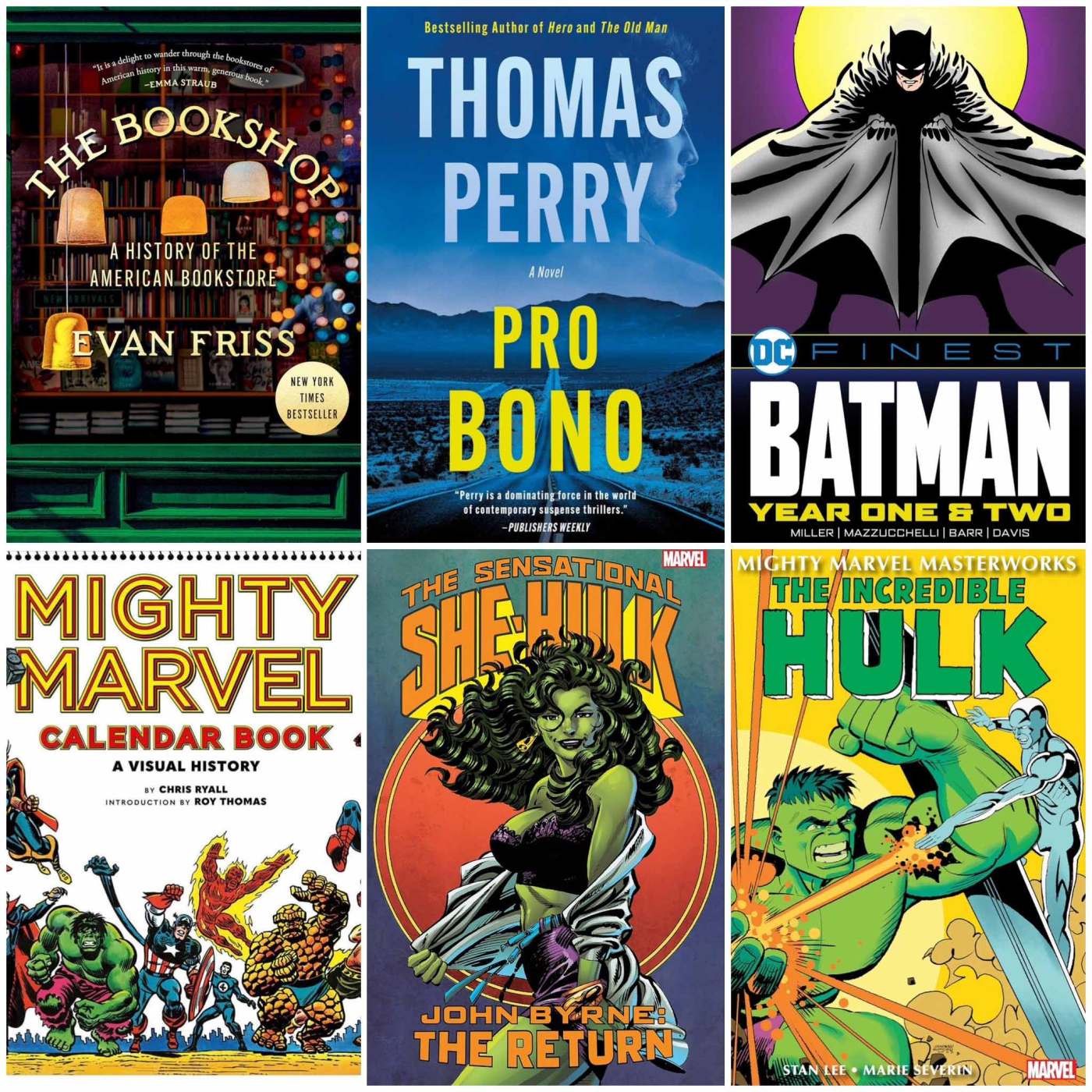
The Bookshop: A History of the American Bookstore by Evan Friss • 5 Stars on Goodreads
I love books about books, and I really enjoyed this stroll through the history of the American bookstore by Evan Friss. It starts with Benjamin Franklin, patriot, statesman, printer and bookseller and follows all the way through to Amazon’s abortive attempt at physical bookstores and the rise of independent stores like author Ann Patchett’s Parnassus in Nashville, TN. Along the way, Friss stops at all kinds of bookstores, oriented to all kinds of Americans and talks about some of the major shops that set the pace on book-selling, like The Strand and Gotham Book Mart, both in NYC; Chicago’s Marshall Field’s department store, which had a major impact on book sales for decades; and even talks about street vendors in New York City, offering a fascinating look at their own toll on book sales. It’s a great read, and one that speaks to both my heart and mind. I sometimes think I’m at my happiest when I’m exploring a new bookstore or back in one that I’ve visited before. Either way, it feels like home, and this book happily reminded me of that feeling.
Pro Bono by Thomas Perry • 3.5 Stars on Goodreads
For a title like Pro Bono, this sure doesn’t feel like an out-and-out legal thriller. Charlie Warren is an attorney specializing in finding people’s money—like in divorce cases. He’s approached by Vesper Ellis, a friend of a former client, who thinks her dead rich husband’s money—left to her—is being siphoned out of her accounts, and Charlie agrees to take on her case. But Charlie has a deep, dark secret in his past, one that eventually involves a lot of money and the attention of two ex-cons, and Vesper finds herself in the middle of it all. This book almost feels like two separate stories, and in fact, about three-quarters through it, a whole new cast of characters are introduced relating to Charlie’s hidden past. I normally enjoy Thomas Perry’s yearly offerings, but this one, not so much—despite a fairly exciting final act that sadly just fades out. I finished it, I guess out of loyalty to the author, but it didn’t land with me like some of his other books have. I’ll still look forward to his next book next year, though.
Mighty Marvel Masterworks: The Incredible Hulk Vol. 4 by Stan Lee and Marie Severin • 4 Stars on Goodreads
This volume collects the final stories from the Hulk’s Tales to Astonish run (issues 92-101), plus the first issue of ol’ Greenskin’s second solo series, which continued the book’s numbering with 102, and stories from two issues of Not Brand Ecch, 3 and 9. This is also the end of Stan Lee’s scripting on the series; Gary Friedrich takes over in issue 102 with the new solo series. But the best part of these stories—which feature the Silver Surfer, the High Evolutionary, and a battle royale between those Tales to Astonish co-stars, Sub-Mariner and the Hulk to celebrate issue 100,—is the great art by Marie Severin. She definitely goes toe-to-toe with Jack Kirby when it comes to action scenes, especially in that Hulk/Subby big fight issue (instigated by the Puppet Master, one of Stan and Jack’s lamer Fantastic Four villains). Marie’s art reveals she was born to draw superhero comics, not just color them and do art corrections. This volume is a great showcase for her art; she was never better except for her King Kull stories, inked by her brother, the equally great John Severin.
She-Hulk: John Byrne The Return • 5 Stars on Goodreads
John Byrne first tackled She-Hulk in January 1989. He left the series after just eight issues, only to return with issue 31, two years later. This trade paperback collection collects the rest of his run on the series from issues 31 through 50 (with one fill-in issue, 47, by someone else and not included in this book). This was published in 2016 at $39.99 (ouch, Marvel!), and is a little hard to find these days for a decent price, but someone on ebay must have found a stash of them, because I got one for 25 bucks, instead of the $80 or so others were asking for it. Anyway, this is a very enjoyable read, combining Byrne’s great (at times) art and storytelling skill with a fourth-wall breaking humorous bent. He also resurrects some old Marvel heroes and villains and has fun showcasing She-Hulk in various cheesecake poses, in hopes of getting more sales for the series. After a while Byrne decided to both ink and letter the book (jeez, John, give somebody else a job!) and the art goes downhill a bit. He also pokes fun at some of his contemporaries in the comics field and himself. He left the book with issue 50 (I won’t tell you how), but if you’re looking for a nice, angst-free, 1990s comic book series that is fun, with a nod towards Marvel history and with some great guest stars (Blonde Phantom? Sure, why not?), this is definitely a great read. One quibble: The horribly over-colored cover. Marvel had a thing about “realistic coloring” (for lack of a better term) at the time this was published; still does, I guess. Look for the original coloring for this cover (issue 43) inside. (The TPB that collects issues 1-8 has even WORSE coloring on its cover!)
Mighty Marvel Calendar Book: A Visual History by Chris Ryall • 5 Stars on Goodreads
And now for something completely different, Marvel fans. From 1975 to 1981, Marvel created their own yearly calendars, which were published by Simon & Schuster, who had been publishing Stan Lee’s Origin of Marvel Comics series around the same time. This book collects all the art produced for these seven calendars by some of Marvel’s famous artist, including: Jack Kirby, John Buscema, John Byrne, Frank Miller, Walter Simonson, Gil Kane, George Pérez, Gene Colan, Jim Starlin, Sal Buscema, Mike Ploog, and dozens more. And it reproduces each complete calendar year-by-year at the actual size it was published, a whopping 13 x 13”, and it even has a faux spiral binding across the top of each calendar page to mimic the original. Chris Ryall offers historical info on each year, and former Marvel editor-in-chief and writer Roy Thomas—who did the first calendar under orders from Stan the Man himself—provides the introduction. Unfailingly, I got these each year as a Christmas gift, and in fact, some years even had two of them, one for my art school dorm room, and one for home. I’ve long since parted with my originals, but here they are, all gussied up in a beautiful hardbound collection. Also, as a bonus, Abrams MarvelArts has republished the very first calendar from 1975 because 50 years later, it’s also the calendar for 2025! This book is such a treat and belongs on every Marvel Comics fan’s bookshelf!
DC Finest: Batman Year One & Two by Miller, Barr, Mazzucchelli, and Davis • 5 Stars on Goodreads
For my second volume in the DC Finest series—one that I scored at a half-price sale at a local comics shop—I got Batman: Year One & Year Two, collecting stories from Batman and Detective Comics from 1986 and 1987. “Year One” is, of course, the classic Frank Miller/David Mazzucchelli tale from Batman 404-407; “Year Two” is from Detective 575-578 and by Mike W. Barr, Alan Davis, and Todd McFarlane, who replaced Davis on the final three chapters. It’s interesting to see “Year One” within the context of the Batman stories surrounding it. This was the period when writer Max Allan Collins reinvented Jason Todd to be a borderline juvenile delinquent. It didn’t help, even with a title-change, after the“Year One” issues, to Batman: The New Adventures. Nothing could save Jason from his seemingly preordained demise via call-in phone poll; he was too obnoxious to live. The Detective Comics stories in this volume are much better than the Batman series ones (except for “Year One” of course, which was operating on a much higher level than any other superhero comic of that era). Mike W. Barr’s scripts and Alan Davis’s energetic and action-packed art presented a Batman that was more like Adam West, “old chum,” and the use of a Batman and Robin 1950s style logo on each splash page signaled these stories were more fun than its companion book. It’s too bad Davis didn’t draw more Batman stories. The next DC Finest Batman book picks up right where this one ends, with a direct continuation of the numbering of Batman and Detective Comics and The Killing Joke and Son of the Demon graphic novels. I’ll be picking that one up, too.
(For a more in-depth look at this DC Finest volume, please click here.)
 @innocent-bystander.com
Leave a comment