

You can go All In, you can even go Absolute, but the one thing from DC Comics that excites me most these days is their new line of DC Finest trade paperbacks. I have in my hot little hands the very first volume, appropriately devoted to Superman, and aptly subtitled “The First Superhero.”
I’m thrilled for this new series of reprint books from DC. It only took them 10 years or so to glom onto Marvel’s Epic Collection format, but they actually do it one better. The Epic Collection books have volume numbers on them, even though they’re published out of sequence. That unfortunate fact affects OCD collector-types like me. How in God’s name can I own Volume. 3 of The Avengers Epic Collections (“Behold, the Vision!”) and not own Volumes 1 and 2? (It’s okay, I got over it … I just own Volumes 3 and 4, because they contain the stories I‘m most interested in.) DC has come up with a chart featuring all the years the Finest series covers on the back cover of each volume, from 1938 (Action Comics 1) through 2011, the end of their purview for this series. No annoying volume numbers! I’m hoping the way these volumes are set up—like their Epic Collection counterparts—they all flow into each other, but I think this chart is brilliant. Each volume has their years highlighted on the chart, which are also included on the spine.

DC Finest’s year chart on each volume’s back cover solves the age-old problem of having to collect them all; (below) the spine also features the years featured in each volume.



But let’s look at this very first DC Finest volume, which features Superman from the very beginning. It reprints Action Comics issues 1 through 25, Superman 1 through 5, and New York World’s Fair Comics 1, basically encompassing 1938, 1939, and part of 1940, the first two full years of the Super-saga). This is primitive comic book stuff, to say the least. At times, Joe Shuster’s artwork is barely beyond sketch level. The inking is scratchy, but I don’t know how much of that is Shuster or what kind of source material DC is working from. How much of the original stats or negatives actually exist from this era? DC was always really good about saving those things, with an eye more to foreign reprints, but with a bonus side effect: the future—a future they couldn’t have imagined would include reprinting stories and series in more permanent, upscale formats, for sale in honest-to-God bookstores and newfangled comic book shops.
One of the things I dearly love about the history of American pop culture is that there were no rules when everything started. Comic books, movies, radio, television—all media had a starting point where nobody knew nothin’. They all just made it up as they went along. Comics are particularly a part of this, and you can see Superman progress in this volume alone, from Shuster’s scratchy panels and redrawn logos each time one appears, to a more sophisticated look and an evolution of the character. The art does improve in this volume, but slowly, as Siegel and Shuster’s studio gets set up and artists such as Wayne Boring and Paul Cassidy join in. There are Action Comics stories that take a big leap forward, artwork-wise, but then fall back a bit with the next issue.
I’m surprised at how readable these stories are, and how politically aware they are. I’ve always known Superman was a crusader in this era, and writer Jerry Siegel’s liberal consciousness shows. In one story involving teenagers from the slums gone bad, Superman arrives on the idea that he should just tear down the slums so the government has to build new, better housing. This makes him a wanted man, and is an early example of a continued plot-thread from one issue of Action Comics to another. Siegel’s writing has a certain 1930s gangster movie quality to it, lots of tough talk and slang, and it’s kind of charming.
There’s a lot of quaintness to these tales, too, at least in how they’re presented. In the early Action Comics stories, each panel is numbered individually, usually ending around panel 100 or so. There’s a predominance of an eight-panel grid, all panels the same size, per page. The editor—Vince Sullivan—doesn’t even feature Superman on the cover each issue. He’s on the iconic cover for Action Comics 1, of course, an image that has been presented as an homage so many times, I’m surprised it hasn’t popped up on a cave wall somewhere. Superman doesn’t appear again until issue 7’s cover, then on issue 10, and then Sullivan and company seem to realize, oh, yeah—we have something here. Starting with issue 9, he gets mentioned on the cover if he’s not actually appearing there; with issue 12 a Superman logo of sorts is added and ends up in the top left corner. It isn’t until issue 19 that he takes over the cover slot permanently. Coloring differences crop up. One Action Comics story has his boots colored yellow, there’s an occasional yellow cape, and nobody seems to know how to color the symbol on his chest (to be honest, the rendering of said symbol leaves a lot to be desired).
I’ve kind of decided to concentrate mainly on the Superman books in the DC Finest series, although I’m sure there will be others that come up that will pique my interest. They’ve already announced quite a few of them and it’s an interesting—and enticing—line-up, including Justice Society of America stories dating back to the Golden Age (I’d be very interested in a volume that reprints the final JSA issues of All Star Comics); there’s a volume devoted to Metamorpho which caught my eye with that beautiful Ramona Fradon art and wonky Bob Haney writing. There’s even a volume devoted to Peacemaker—no surprise since its a hit show by James Gunn on MAX—which includes his earliest Charlton Comics appearances. All the volumes are very attractive; whomever came up with the trade dress and design deserves an award … it’s a very pleasing package. I wish there was some historical articles in each volume, but that’s probably a bit too much to ask.
And speaking of James Gunn and trade dress … I think this line was announced before Gunn revealed the DC Studios logo, which of course is Milton Glaser’s DC logo from the 1970s through the 1990s. It’s a great choice, but my immediate—again, OCD-influenced—fear was what are they going to do with the DC Finest volumes? DC was presenting the covers in advance as they rolled out this line and they all had the then-current, rather hum-drum DC logo on it, and everything appearing online kept that. Well, lo and behold, when the books actually appeared, the new/old DC logo was on them, thank God! I’d hate to start collecting these books and have the first handful of them with a different company logo on them.
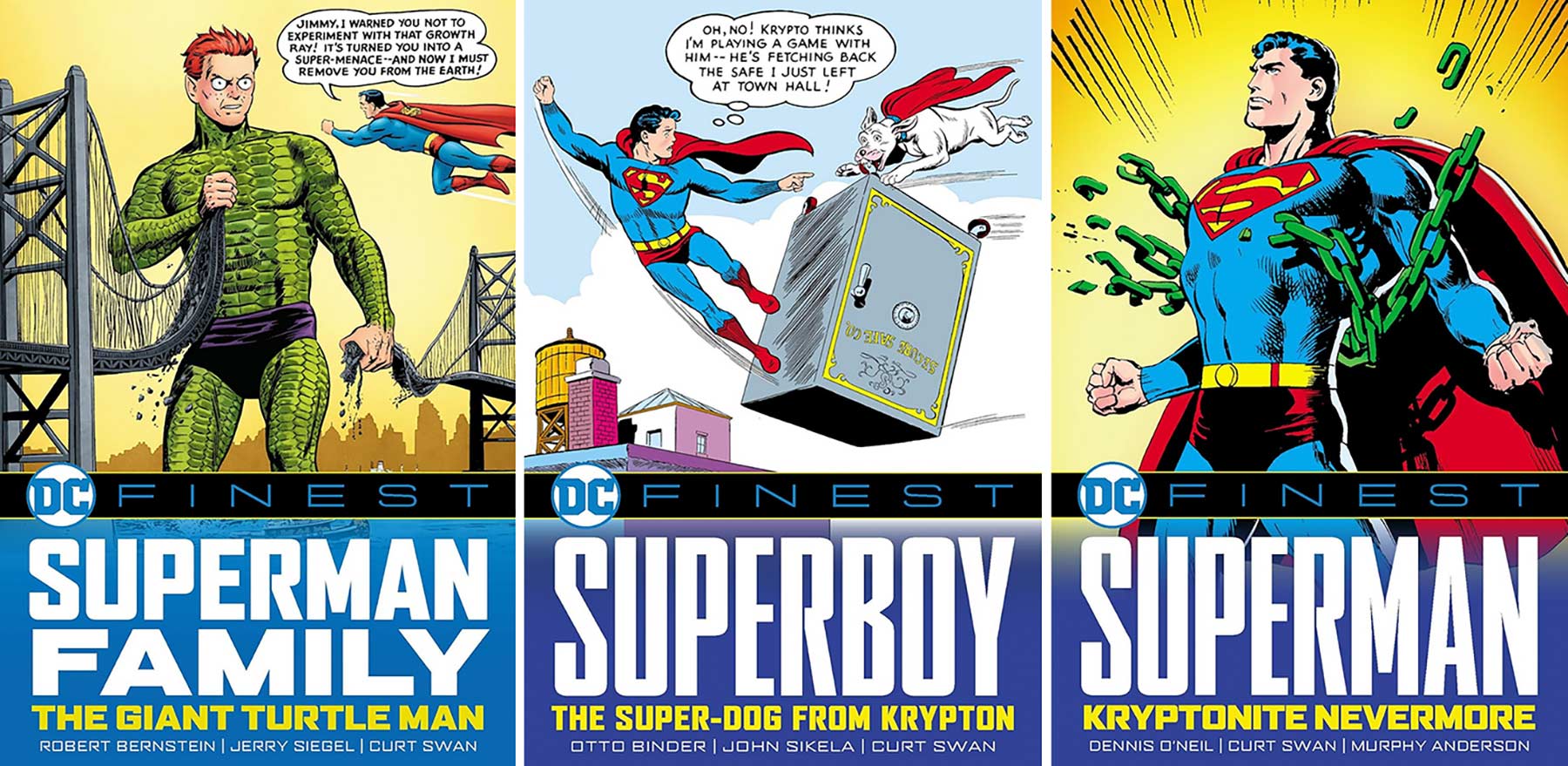
Upcoming DC Finest volumes featuring Superman and friends, human, canine and turtle, too.
I’m looking forward to the next few Superman-oriented titles (you can see that they all have the wrong logo on them, but that’s okay, I’m sure they’ll be fixed). Superman Family: The Giant Turtle Man debuts in April, and features both Jimmy Olsen and Lois Lane issues from that wonky Mort Weisinger era I love (click here for comfirmation of what I mean), alongside some stories from Action Comics and Superman. Superboy: The Super-Dog from Krypton, out in May, includes Krypto’s origin, when he was kind of a goofy-looking mutt, before he became the streamlined good boy we all know and love. And Superman: Kryptonite Nevermore, coming in June, reprints the classic first Super-stories of the Julius Schwartz edited era, written by Denny O’Neil and drawn by the super-team supreme, Curt Swan and Murphy Anderson. All these volumes weigh in at around 600 pages for $39.95, five to ten bucks cheaper than Marvel’s Epic Collection line, another plus. I wish I could buy them all, but I can’t, so I’ll concentrate on what appeals to me most … I recommend you do the same, unless you just GOTTA GET THEM ALL!
I read Absolute Batman, Wonder Woman, and Superman, and they pretty much left me cold. I think Wonder Woman by Kelly Thompson and Hayden Sherman was the most original of the trio, but I won’t be purchasing any of them on a regular basis. Batman by Scott Snyder and Nick Dragotta was okay, Superman by Jason Aaron and Rafa Sandoval was a bit of a slog, even though the art was beautiful. The whole thing reminds me of the time back in the early 2000s or so when DC and Marvel “discovered” alternative/indy comics and let those creators play in their respective sandboxes, in titles like Bizarro Comics and Strange Tales, and even invited some of them to write things like Batman and Captain America. The Absolute titles seem to be well-received so far, but I’m going to opt to spend my comics buying money on DC Finest, if only for the sweet and simple reason of nostalgia. That’s where my heart—and my wallet—currently lie.
 @innocent-bystander.com