
They say the criminal always returns to the scene of the crime and this year, I had a rare opportunity to do so. In early June, I was contacted by my friend and former co-worker at Comic-Con, Laura Jones, who asked me if I’d be willing to write an article for this year’s Souvenir Book on the 50th anniversary of the Inkpot Awards. Laura, who’s part of the Programming Department at the event, was putting together the initial slate of articles and co-editing the book.
I edited and designed the Comic-Con Souvenir Books from 2007 through 2020, the first year the book went to an online-only, downloadable PDF. That run of books remain the things I miss most about working at Comic-Con. Each year’s book presented itself as another 5,000-piece jigsaw puzzle, all blue skies and ocean. I loved putting them together, and when they stopped being printed in 2020, I realized my heart wasn’t in it anymore. I craved the validation of a printed book. It was a six to eight month odyssey for me every year, starting with the planning of the contents and selecting the cover topic and artist. And I absolutely loved seeing all the submissions roll in from around the world. To be honest, there was nothing more thrilling to me about my work than getting the first sample copies from the printer in late June. You can read more about my experiences doing the Souvenir Book in these two articles here on my blog:
Comic-Con Souvenir Books, Part 01
Comic-Con Souvenir Books, Part 02
A bit of Inkpot Award history: When I was director of programming for Comic-Con, I suddenly had the Inkpot Awards thrust upon me when they were dropped from their usual berth at the Will Eisner Comic Industry Awards. That gala event was running way too long, so Eisner Awards administrator Jackie Estrada suggested that the Inkpots—which are Comic-Con’s own special achievement awards to individuals in various categories, as I explained in the article—would be better served by being given out during the special “Spotlight” panels devoted to each individual guest. She was right; this way people that were actually familiar with and interested in the recipients got to see them honored in this quintessential Comic-Con manner.
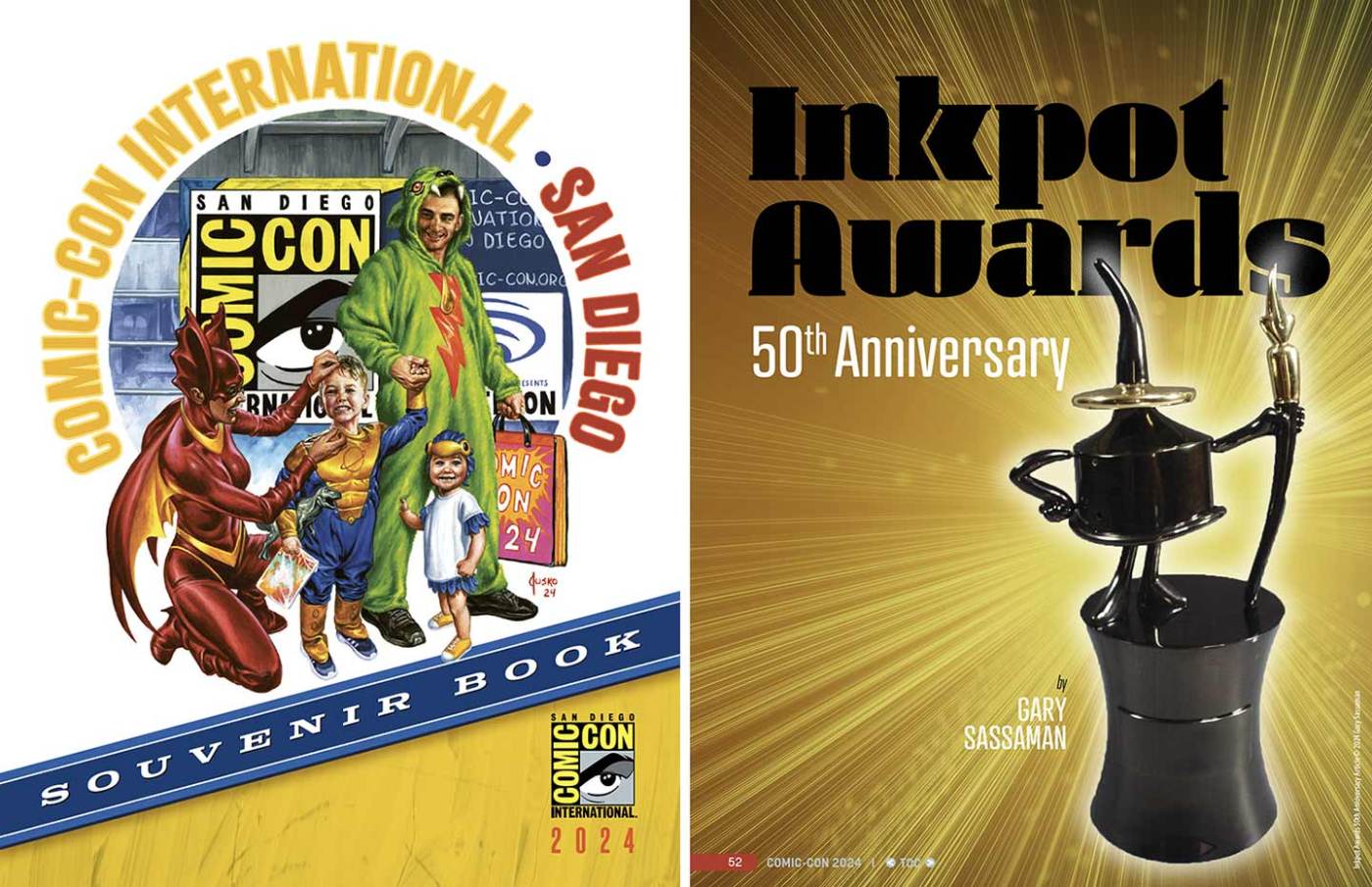
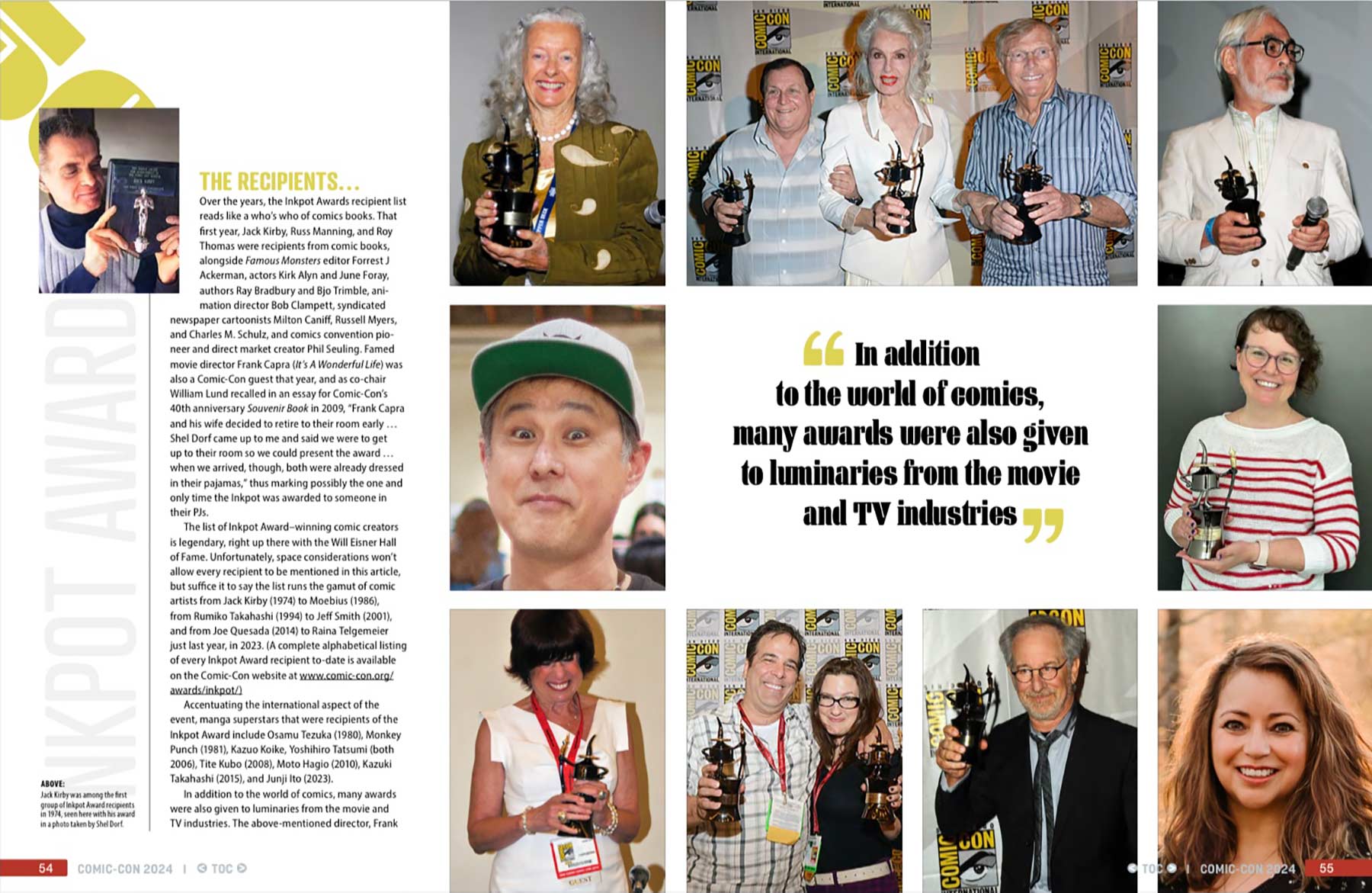
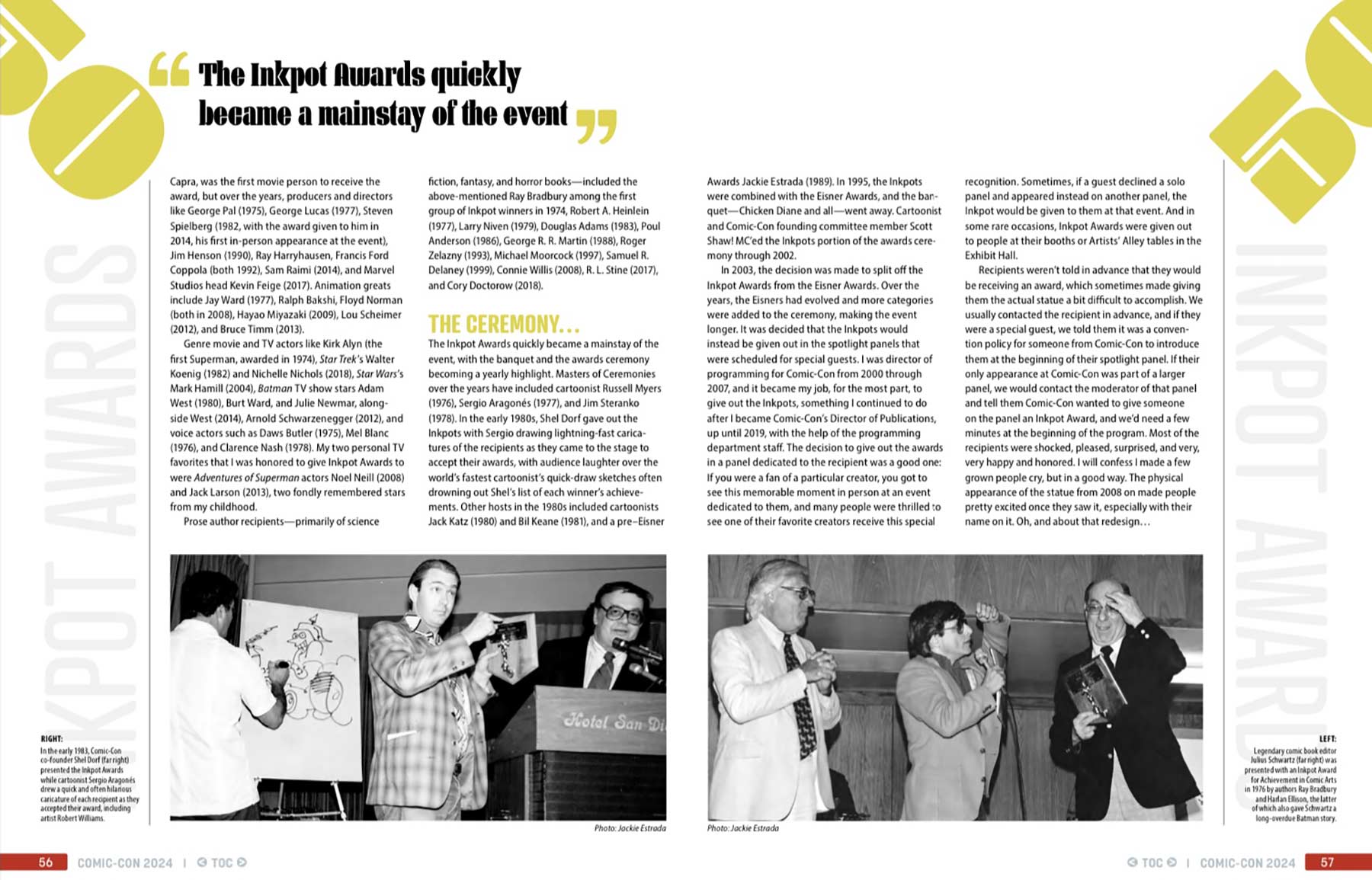
Here are screen-grabs of the pages from the Souvenir Book, designed by Josh Beatman, who did another great job with this year’s book. Once again the Souvenir Book (its cover, shown above, is illustrated by Comic-Con 2024 special guest Joe Jusko), is certainly print-worthy.
The complete article is reproduced below the screen-grabs, if you don’t feel like clicking on them to enlarge them and zooming in and out. The article is © 2024 Gary G. Sassaman; layout and book presentation is © 2024 SDCC; cover art shown above © 2024 Joe Jusko.
You can download the 2024 Souvenir Book at this link or—if it’s not working—click here for more info on the Comic-Con 2024 Souvenir Book.
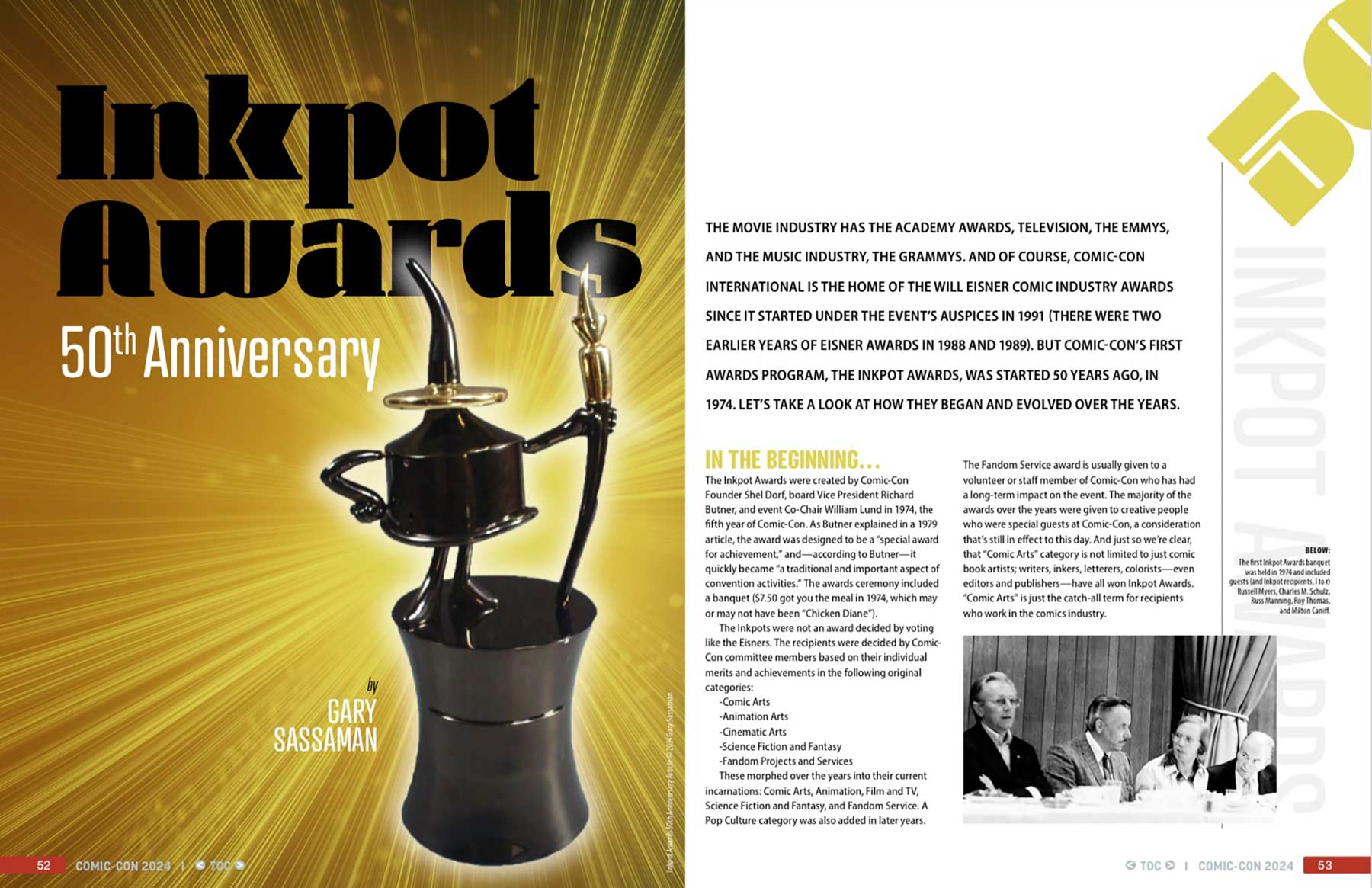
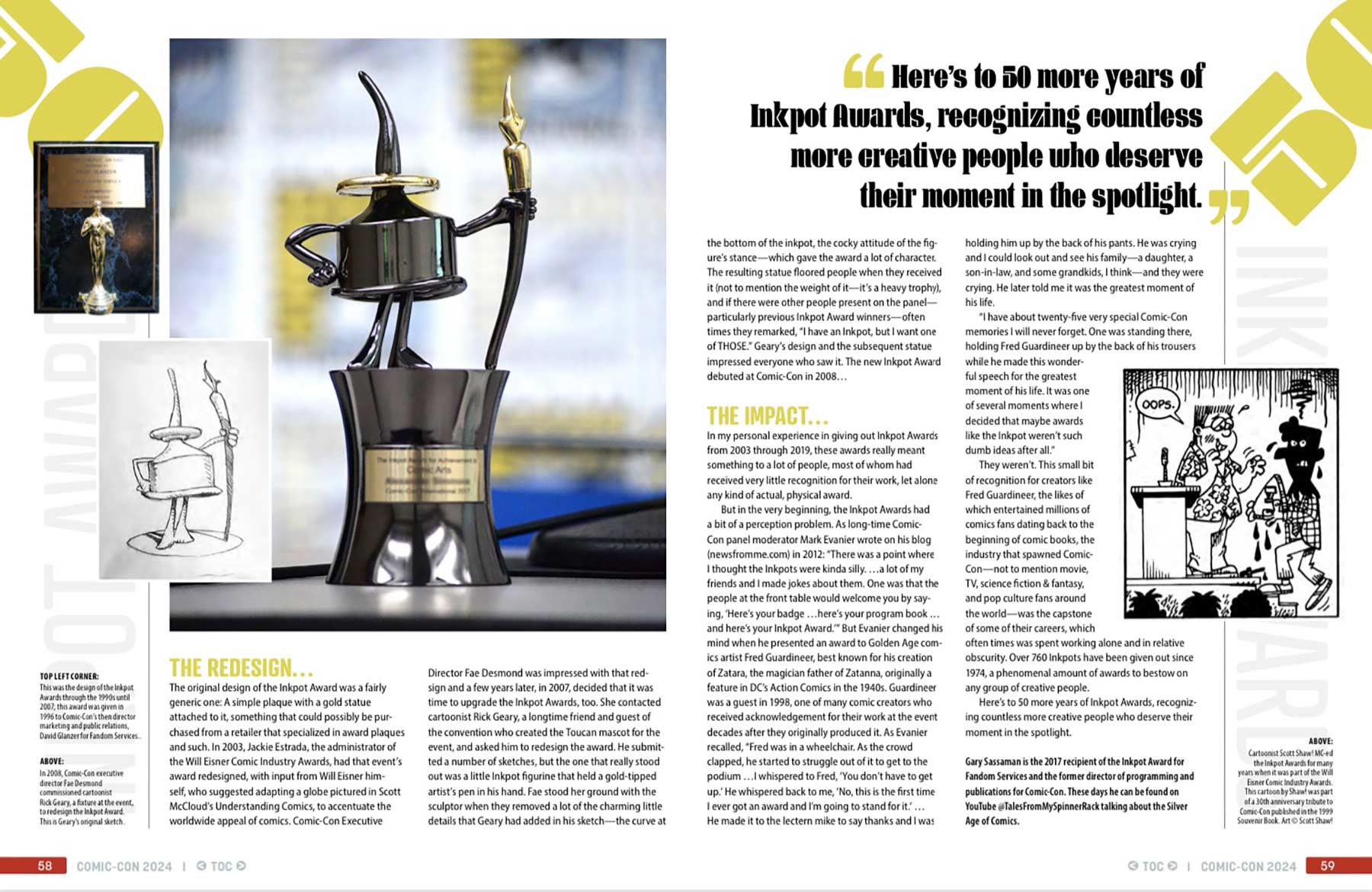
Inkpot Awards 50th Anniversary
by Gary Sassaman
The movie industry has the Academy Awards, television, the Emmys, and the music Industry, the Grammys. And of course, Comic-Con International is the home of the Will Eisner Comic Industry Awards since it started under the event’s auspices in 1991 (there were two earlier years of Eisner Awards in 1988 and 1989). But Comic-Con’s first awards program, the Inkpot Awards, was started 50 years ago, in 1974. Let’s take a look at how they began and evolved over the years.
In the Beginning …
The Inkpot Awards were created by Comic-Con co-founder Shel Dorf, board vice president Richard Butner, and event co-chair William Lund in 1974, the fifth year of Comic-Con. As Butner explained in a 1979 article, the award was designed to be a “special award for achievement,” and—according to Butner—it quickly became “a traditional and important aspect of convention activities.” The awards ceremony included a banquet ($7.50 got you the meal In 1974, which may or may not have been “Chicken Diane”).
The Inkpots were not an award decided by voting like the Eisners. The recipients were decided by Comic-Con committee members based on their individual merits and achievements in the following original categories:
-Comic Arts
-Animation Arts
-Cinematic Arts
-Science Fiction and Fantasy
-Fandom Projects and Services
These morphed over the years into their current incarnations: Comic Arts, Animation, Film and TV, Science Fiction and Fantasy, and Fandom Service. A Pop Culture category was also added in later years. The Fandom Service award is usually given to a volunteer or staff member of Comic-con who has had a long-term impact on the event. The majority of the awards over the years were given to creative people who were special guests at Comic-Con, a consideration that’s still in effect to this day. And just so we’re clear, that “Comic Arts” category is not limited to just comic book artists; writers, inkers, letterers, colorists—even editors and publishers—have all won Inkpot Awards. “Comic Arts” is just the catch-all term for recipients who work in the comics industry.
The Recipients …
Over the years, the Inkpot Awards recipient list reads like a who’s who of comics book. That first year, Jack Kirby, Russ Manning, and Roy Thomas were recipients from comic books, alongside Famous Monsters editor Forrest J Ackerman, actors Kirk Alyn and June Foray, authors Ray Bradbury and Bjo Trimble, animation director Bob Clampett, syndicated newspaper cartoonists Milton Caniff, Russell Myers, and Charles M. Schulz, and comics convention pioneer and direct market creator Phil Seuling. Famed movie director Frank Capra (It’s A Wonderful Life) was also a Comic-Con guest that year, and as co-chair William Lund recalled in an essay for Comic-Con’s 40th anniversary Souvenir Book in 2009, “Frank Capra and his wife decided to retire to their room early … Shel Dorf came up to me and said we were to get up to their room so we could present the award … when we arrived, though, both were already dressed in their pajamas,” thus marking possibly the one and only time the Inkpot was awarded to someone in their PJs.
The list of Inkpot Award-winning comic creators is legendary, right up there with the Will Eisner Hall of Fame. Unfortunately, space considerations won’t allow every recipient to be mentioned in this article, but suffice it to say the list runs the gamut of comic artists from Jack Kirby (1974) to Moebius (1986), from Rumiko Takahashi (1994) to Jeff Smith (2001), and from Joe Quesada (2014) to Raina Telgemeier just last year, in 2023. (A complete alphabetical listing of every Inkpot Award recipient to-date is available on the Comic-Con website at www.comic-con.org/awards/inkpot/)
Accentuating the international aspect of the event, manga superstars that were recipients of the Inkpot Award include Osamu Tezuka (1980), Monkey Punch (1981), Kazuo Koike, Yoshihiro Tatsumi (both 2006), Tite Kubo (2008), Moto Hagio (2010), Kazuki Takahashi (2015), and Junji Ito (2023).
In addition to the world of comics, many awards were also given to luminaries from the movie and TV industries. The above-mentioned director, Frank Capra, was the first movie person to receive the award, but over the years, producers and directors like George Pal (1975), George Lucas (1977), Steven Spielberg (1982, with the award given to him in 2014, his first in-person appearance at the event), Jim Henson (1990), Ray Harryhausen, Francis Ford Coppola (both 1992), Sam Raimi (2014), and Marvel Studios head Kevin Feige (2017). Animation greats include Jay Ward (1977), Ralph Bakshi, Floyd Norman (both in 2008), Hayao Miyazaki (2009), Lou Scheimer (2012), and Bruce Timm (2013).
Genre movie and TV actors like Kirk Alyn (the first Superman, awarded in 1974), Star Trek’s Walter Koenig (1982) and Nichelle Nichols (2018), Star Wars’s Mark Hamill (2004), Batman TV show stars Adam West (1980), Burt Ward, and Julie Newmar, alongside West (2014), Arnold Schwarzenegger (2012), and voice actors such as Daws Butler (1975), Mel Blanc (1976), and Clarence Nash (1978). My two personal TV favorites that I was honored to give Inkpot Awards to were Adventures of Superman actors Noel Neill (2008) and Jack Larson (2013), two fondly remembered stars from my childhood.
Prose author recipients—primarily of science fiction, fantasy, and horror books—included the above-mentioned Ray Bradbury among the first group of Inkpot winners in 1974, Robert A. Heinlein (1977), Larry Niven (1979), Douglas Adams (1983), Poul Anderson (1986), George R. R. Martin (1988), Roger Zelazny (1993), Michael Moorcock (1997), Samuel R. Delaney (1999), Connie Willis (2008), R. L. Stine (2017), and Cory Doctorow (2018).
The Ceremony …
The Inkpot Awards quickly became a mainstay of the event, with the banquet and the awards ceremony becoming a yearly highlight. Masters of Ceremonies over the years have included cartoonist Russell Myers (1976), Sergio Aragonés (1977), and Jim Steranko (1978). In the early 1980s, Shel Dorf gave out the Inkpots with Sergio drawing lightning-fast caricatures of the recipients as they came to the stage to accept their awards, with audience laughter over the world’s fastest cartoonist’s quick-draw sketches often drowning out Shel’s list of each winner’s achievements. Other hosts in the 1980s included cartoonists Jack Katz (1980) and Bil Keane (1981), and a pre-Eisner Awards Jackie Estrada (1989). In 1995, the Inkpots were combined with the Eisner Awards, and the banquet—Chicken Diane and all—went away. Cartoonist and Comic-Con founding committee member Scott Shaw! MC’ed the Inkpots portion of the awards ceremony through 2002.
In 2003, the decision was made to split off the Inkpot Awards from the Eisner Awards. Over the years, the Eisners had evolved and more categories were added to the ceremony, making the event longer. It was decided that the Inkpots would instead be given out in the spotlight panels that were scheduled for special guests. I was director of programming for Comic-Con from 2000 through 2007, and it became my job, for the most part, to give out the Inkpots, something I continued to do after I became Comic-Con’s director of publications, up until 2019, with the help of the programming department staff. The decision to give out the awards in a panel dedicated to the recipient was a good one: If you were a fan of a particular creator, you got to see this memorable moment in person at an event dedicated to them, and many people were thrilled to see one of their favorite creators receive this special recognition. Sometimes, if a guest declined a solo panel and appeared instead on another panel, the Inkpot would be given to them at that event. And in some rare occasions, Inkpot Awards were given out to people at their booths or Artist’s Alley tables in the Exhibit Hall.
Recipients weren’t told in advance that they would be receiving an award, which sometimes made giving them the actual statue a bit difficult to accomplish. We usually contacted the recipient in advance, and if they were a special guest, we told them it was a convention policy for someone from Comic-Con to introduce them at the beginning of their spotlight panel. If their only appearance at Comic-Con was part of a larger panel, we would contact the moderator of that panel and tell them Comic-Con wanted to give someone on the panel an Inkpot Award, and we’d need a few minutes at the beginning of the program. Most of the recipients were shocked, pleased, surprised, and very, very happy and honored. I will confess I made a few grown people cry, but in a good way. The physical appearance of the statue from 2008 on made people pretty excited once they saw it, especially with their name on it. Oh, and about that redesign …
The Redesign …
The original design of the Inkpot Award was a fairly generic one: A simple plaque with a gold statue attached to it, something that could possibly be purchased from a retailer that specialized in award plaques and such. In 2003, Jackie Estrada, the administrator of the Will Eisner Comic Industry Awards, had that event’s award redesigned, with input from Will Eisner himself, who suggested adapting a globe pictured in Scott McCloud’s Understanding Comics, to accentuate the worldwide appeal of comics. Comic-Con executive director Fae Desmond was impressed with that redesign and a few years later, in 2007, decided that it was time to upgrade the Inkpot Awards, too. She contacted cartoonist Rick Geary, a longtime friend and guest of the convention who created the Toucan mascot for the event, and asked him to redesign the award. He submitted a number of sketches, but the one that really stood out was a little Inkpot figurine that held a gold-tipped artist’s pen in his hand. Fae fought with the sculptor when they removed a lot of the charming little details that Geary had added in his sketch—the curve at the bottom of the inkpot, the cocky attitude of the figure’s stance—which gave the award a lot of character. The resulting statue floored people when they received it (not to mention the weight of it—it’s a heavy trophy), and if there were other people present on the panel—particularly previous Inkpot Award winners—often times they remarked, “I have an Inkpot, but I want one of THOSE.” Geary’s design and the subsequent statue impressed everyone who saw it. The new Inkpot Award debuted at Comic-Con in 2008.
The Impact …
In my personal experience in giving out Inkpot Awards from 2003 through 2019, these awards really meant something to a lot of people, most of whom had received very little recognition for their work, let alone any kind of actual, physical award.
But in the very beginning, the Inkpot Awards had a bit of a perception problem. As long-time Comic-Con panel moderator Mark Evanier wrote on his blog (newsfromme.com) in 2012: “There was a point where I thought the Inkpots were kinda silly. … a lot of my friends and I made jokes about them. One was that the people at the front table would welcome you by saying, ‘Here’s your badge … here’s your program book … and here’s your Inkpot Award.’” But Evanier changed his mind when he presented an award to Golden Age comics artist Fred Guardineer, best known for his creation of Zatara, the magician father of Zatanna, originally a feature in DC’s Action Comics in the 1940s. Guardineer was a guest in 1998, one of many comic creators who received acknowledgement for their work at the event decades after they originally produced it. As Evanier recalled, “Fred was in a wheelchair. As the crowd clapped, he started to struggle out of it to get to the podium … I whispered to Fred, ‘You don’t have to get up.’ He whispered back to me, ‘No, this is the first time I ever got an award and I’m going to stand for it.’ … He made it to the lectern mike to say thanks and I was holding him up by the back of his pants. He was crying and I could look out and see his family—a daughter, a son-in-law and some grandkids, I think—and they were crying. He later told me it was the greatest moment of his life.
“I have about twenty-five very special Comic-Con memories I will never forget. One was standing there, holding Fred Guardineer up by the back of his trousers while he made this wonderful speech for the greatest moment of his life. It was one of several moments where I decided that maybe awards like the Inkpot weren’t such dumb ideas after all.”
They weren’t. This small bit of recognition for creators like Fred Guardineer, the likes of which entertained millions of comics fans dating back to the beginning of comic books, the industry that spawned Comic-Con—not to mention movie, TV, science fiction & fantasy, and pop culture fans around the world—was the capstone of some of their careers, which often times was spent working alone and in relative obscurity. Over 760 Inkpots have been given out since 1974, a phenomenal amount of awards to bestow on any group of creative people.
Here’s to 50 more years of Inkpot Awards, recognizing countless more creative people who deserve their moment in the spotlight.
Gary Sassaman is the 2017 recipient of the Inkpot Award for Fandom Services and the former director of programming and publications for Comic-Con. These days he can be found on YouTube @TalesFromMySpinnerRack talking about the Silver Age of Comics.
 @innocent-bystander.com
Leave a comment