
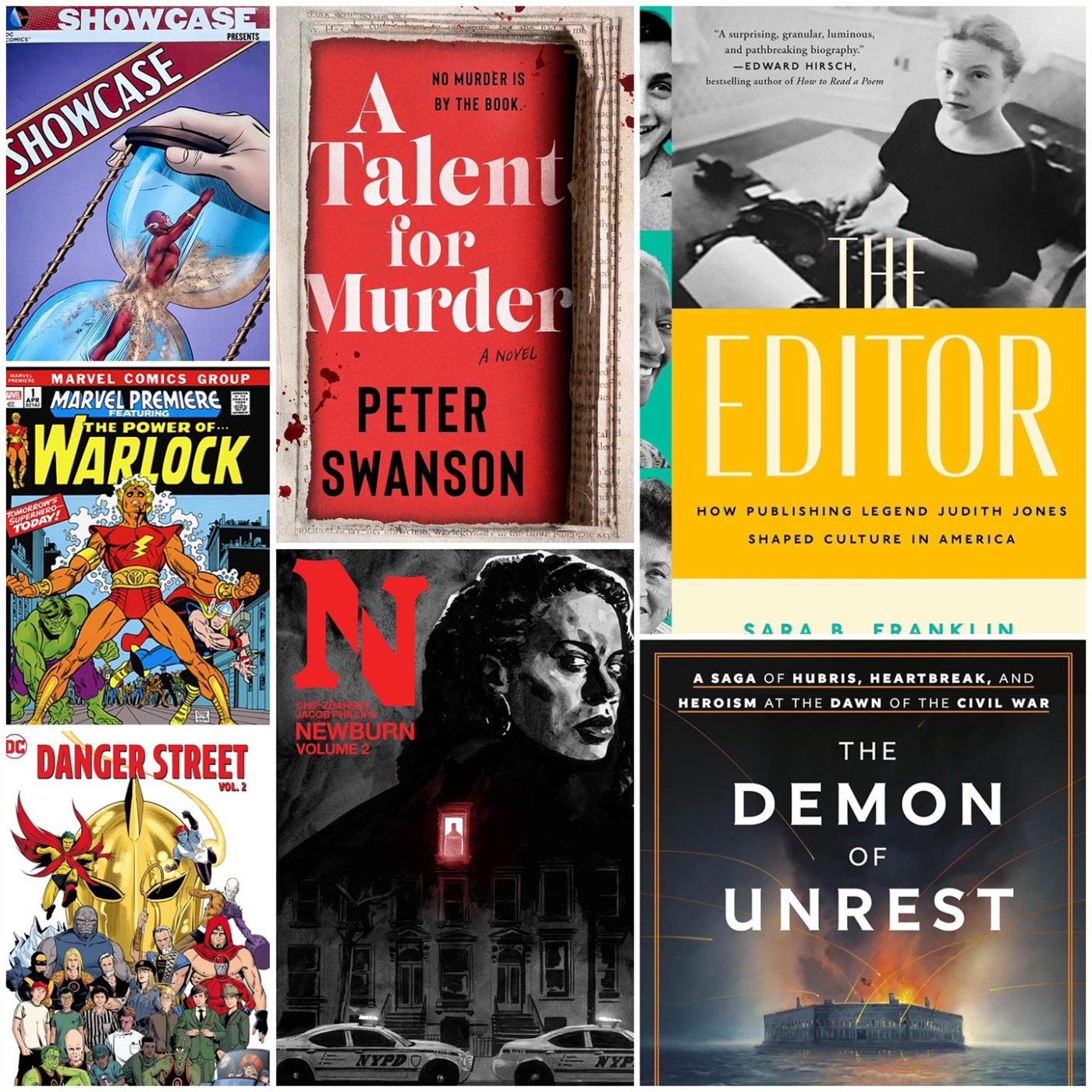
Yikes, the year is halfway over! Lots of good books this month though … here’s what I read!
The Editor: How Publishing Legend Judith Jones Shaped Culture in America by Sara B. Franklin
Like a lot of people, I’m guessing, I first became aware of editor Judith Jones on the MAX TV series, Julia, about the legendary television host and cookbook author Julia Child. I loved that show (more the first season than the second) mainly because of the performances of the actors, including Sarah Lancashire as Child, David Hyde-Pierce as her husband, Paul, and an absolutely beguiling young actress, Fiona Glascott, as Jones. So when I found out there was a new biography on Jones, I jumped on it, and, boy … am I glad I did. It’s very rare that we get a behind the scenes look at the work that goes into publishing books, and Jones was an editor for the ages. While she is best known for her work with Child and other cookbook authors (much of this book is, in fact, about cookbooks), she also edited fiction authors like John Updike. As a young editorial assistant, she saved The Diary of Anne Frank from the trashcan, and later, as an editor, brought Sylvia Plath’s first book of poetry to the U.S. She led an absolutely fascinating life, too, and author Sara B. Franklin presents it in all its depth, both good and bad times. By the end of this book, you’ll know Judith Jones intimately, and I’m not ashamed to say I was openly weeping in the final chapter. This is a great, fascinating biography of someone book lovers owe a lot to, for her taste, her editorial skills, and her ability to bring out the best in her authors.
The Demon of Unrest: A Saga of Hubris, Heartbreak, and Heroism at the Dawn of the Civil War by Erik Larson
Any new Erik Larson book is a cause for celebration, and I found this one both fascinating and tedious. It’s a countdown to the start of the Civil War via Abraham Lincoln’s ascension to the presidency and the firing on Fort Sumter. The book draws heavily from personal accounts and diaries, which are written in the language of the time, which tends to be very flowery and detailed. (I found myself wishing that Mary Chestnut would just shut up.) While it’s a fascinating look at the way the South existed and the lead-up to the Civil War, this is not one of my favorite Larson books, which include The Devil in the White City, Isaac’s Storm, and The Splendid and the Vile. This one was way too granular for me, and those Civil War diary entries are a bit too much.
A Talent for Murder by Peter Swanson
This is the latest book by Swanson featuring his dynamic duo, Lily Kintner and Henry Kimball, and to be honest, while entertaining, it’s the weakest of the three (the first two were The Kind Worth Killing and The Kind Worth Saving). This time Lily, who definitely personifies the title of this book, is called upon by an old college friend who suspects her rather odd husband is a serial killer. Lily, who has killed a few people herself, gets on the case, and then as usual in a Swanson book, a major surprise occurs and the book is turned upside down. I love Lily—and by extension, her sometime partner, PI Henry Kimball—and her attitude towards life and death (she strongly embraces both). If you’re going to read this, I definitely recommend reading the first two novels before tackling this one … they’re all engrossing reads with great characters, but this one—for some reason—didn’t hit me like the first two. But I’m up for a fourth!
Danger Street, Vol. 2 by Tom King and Jorge Fornés
I had pretty much given up on Tom King after the whole Batman/Catwoman fiasco. I didn’t like Mister Miracle or Strange Adventures, but I did like Supergirl: Woman of Tomorrow, so I thought I’d take a tumble on Danger Street (and Human Target, for that matter). I loved the idea of taking all the characters from the 1970s 1st Issue Special books and weaving them together into one long story. That all-but-forgotten series had some of Jack Kirby’s final work for DC in it, and King made good use of his characters, Atlas and the Dingbats of Danger Street, alongside Joe Simon’s The Green Team, plus the Creeper, Lady Cop, Doctor Fate, and the first non-Kirby version of New Gods. Jorge Fornés art reminds me of Curt Swan here, for some reason, and Dave Stewart’s coloring is excellent as always. One tip to the reader: DS Vol. 1 came out months ago, and I had to reread it to get back up to speed. Same deal with Human Target, whose second volume comes out soon. I’ll be rereading Vol. 1 before I tackle the second one.
Showcase Presents Showcase by Various
When DC first debuted their Showcase Presents line of thick, black and white reprint trade paperbacks back in 2005, I hated them. “Why were they black and white?,” I lamented. But over the years, the line—which ran 11 years until 2016, pretty much at the rate of two per month—has kind of grown on me, and I find myself drawn to the more obscure ones: Enemy Ace, The War That Time Forgot, Bat Lash, and now this one, with the almost oxymoronic title, Showcase Presents Showcase. It reprints issues 1 through 21 of the seminal DC tryout title that started in the 1950s and lasted until the ‘70s, with various incarnations since (including this one). For the most part the reproduction is crisp and clear, so it’s almost like a bargain-basement artist’s edition. It includes the early high-concept stuff (fireman, frogmen, manhunters, and outdoor tales) before settling on the rebirth of The Flash with issue #4, followed by Jack Kirby’s Challengers of the Unknown, then Lois Lane, Space Ranger, Adam Strange, and Rip Hunter, Time Master. DC was very timid in this era when it came to new titles; both Flash and Challengers required four issues each before they earned their own titles, with Adam Strange settling into Mystery in Space after three Showcase issues. DC didn’t even put “#1” on covers back then, because a first issue might be viewed as too risky to warrant space on newsstands. Flash got his own book with issue #105, restarting the Golden Age Flash’s numbering. The Challenger stories interested me most in here, with pristine Kirby art, some of them inked by Wally Wood, and the Lois Lane stories are a hoot, definitely setting the stage for her own wonky, long-running title. You can find these Showcase Presents volumes online relatively cheap (depending on the title), and they—thankfully—reprinted some pretty obscure series.
Adam Warlock Omnibus by Stan Lee, Jack Kirby, Roy Thomas, Gil Kane, and Jim Starlin
As I’ve mentioned in the past (probably too much), I’m not much of a fan of the Omnibus format, but I’m slowly being converted. This latest acquisition—the Adam Warlock Omnibus—is the kind that really appeals to me: An almost-complete reprinting of a character’s run, in this case Adam Warlock. It starts in Fantastic Four and moves on to Thor, when Warlock was still called “Him,” then moves into the short-lived Roy Thomas/Gil Kane series (two issues of Marvel Premiere and eight of Warlock). Thomas and Kane didn’t last long, but Kane’s beautiful design of Warlock’s costume did, and Jim Starlin brought the character back in his usual cosmic fashion for a spectacular run in Strange Tales, continuing with Warlock issue #9. It’s all here, including various Marvel Team-up issues and the classic Avengers Annual #7 and Marvel Two-in-One Annual #2, which wraps up—for the most part—the Warlock saga. There’s also a ton of original art and special features, like the Marvel Handbook Warlock-related pages and various covers from Warlock reprints. It’s a great package, and a pretty complete compilation of the character’s 1960s-1970s incarnation, pre-Infinity Gauntlet.
Newburn Vol. 2 by Chip Zdarksy and Jacob Phillips
This is the second and final volume of Zdarsky’s Newburn story, about an ex-cop in New York City who acts as a fixer and go-between for organized crime families. I like Zdarsky’s writing a lot (and his art, too, on things like Sex Criminals and Public Domain). This volume neatly wraps up the story, which would make a great modern noir movie (it’s too brief to be a streaming series). I like Jacob Phillips’ art; his style lies close to his father’s, Sean Phillips, work and is also reminiscent of Jorge Fornés, but I’m not fond of his coloring. While I like this book’s pallette, I don’t like his coloring style, which includes these weird rectangular highlights over faces, which just look awkward to me and calls me out of the story every time I see one. Zdarsky’s writing and characterizations more than make up for that minor default, though. If you’re going to read this, I recommend tackling both volumes at once (hopefully there will be a deluxe volume someday, collecting all 16 issues).
Currently reading: Trust Her by Flynn Berry
 @innocent-bystander.com
Leave a comment