

All art in this post TM & © MARVEL; all art is scanned from the original comics in my collection.
Click on the images to see them larger on your screen.
At the end of Part 01 of December 1965 (click here to read it), I eluded to the fact that the December cover-dated Marvel comics were famous for something else. That something else was the very first Bullpen Bulletins page.
Letter columns had been a staple (no pun intended) in comics since the early 1940s. The very first one appeared in Target Comics #6 in 1940 and various publishers used them over the years, including DC. That company’s letter columns were mainly a vehicle for readers to point out mistakes made in the books (although editor Julius Schwartz actually published thoughtful and insightful letters from fans, some of whom got pages of Silver Age original art as rewards). When the Fantastic Four jump-started the Marvel Age of Comics in 1961, Stan Lee was quick to include a letter column (in issue #3), which contained some filler letters that were probably written in the office (like the one from “S. Brodsky,” Stan’s jack-of-all-trades production person, Sol Brodsky). But Lee evolved the letters pages, urging letter-writing readers to stop with the “Dear Editor” stuff prevalent in the Distinguished Competition’s columns, and to use “Stan and Jack” instead, a rare acknowledgement of the partnership between the two men. Stan stretched some of the letter columns to two pages and added content such as a “Special Announcements” section and the “Mighty Marvel Checklist,” which listed some of the Marvel comics on sale in that particular month. A couple of “Marvel Bullpen Pages” appeared in the summer of 1965, but the checklists and special announcements section stayed on the various titles’ letters page.

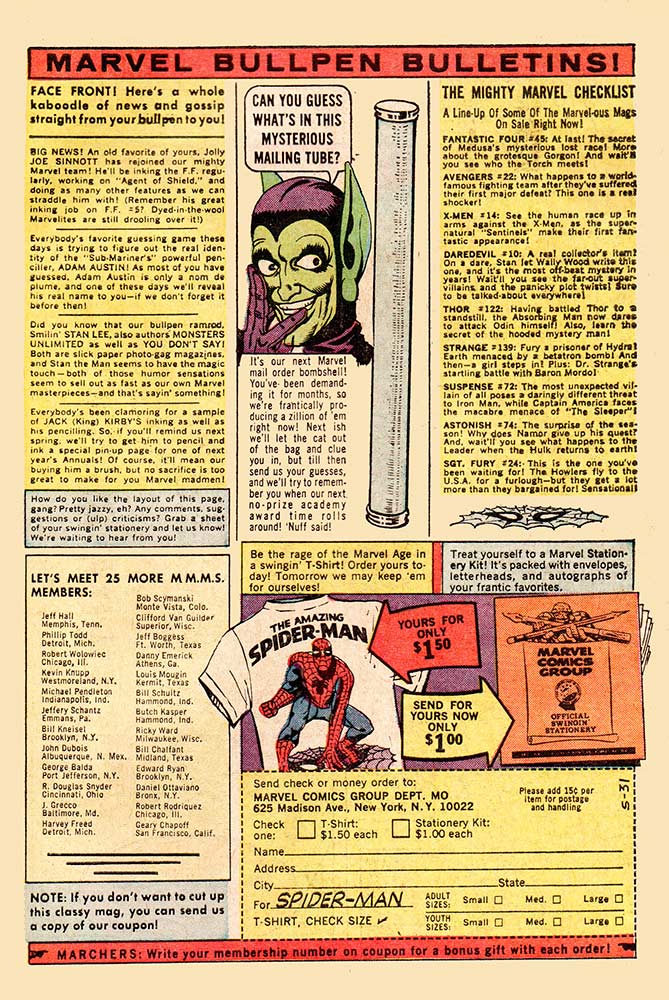
Note that these early Bullpen Bulletins pages were book-specific: The one on the left is from Fantastic Four #45 and features the Thing and the FF T-shirt … the one on the right is from Amazing Spider-Man #31 and features Green Goblin and the Spidey shirt. I’m sure doing this for ten or so books each month kept the production department hopping!
In the December 1965 cover-dated books, Stan took the next step, devoting an entire page to what he called “Marvel Bullpen Bulletins!” Written in his own breathless, hyperbolic style, Stan unleashed ITEM! after ITEM! of interest to Marvel’s readers. This page took the Checklist off the letter pages and these early pages also listed 25 M.M.M.S members’ names, with the towns and cities they lived in. (The M.M.M.S. was the Merry Marvel Marching Society, the Marvel fan club which Lee and company started in 1964.) The page also revealed new merchandise the company was offering, all of which was generated out of the tiny Marvel Comics office, not from an outside company like Marvelmania would do five or so years later. Eventually someone else would write the Bullpen Bulletins page (in Stan’s style) and Stan would relegate himself to a regular “box” on the page, called “Stan’s Soapbox.” The first one appeared in May 1967 and Stan got up on the box regularly until 1980, when he packed up the truck and moved to Beverly (well, Los Angeles). (There’s an excellent complete collection of all his columns, called Stan’s Soapbox: The Collection, which was published in 2009 by The Hero Initiative, the charitable group that helps comics creators. They still have third printing copies available … click here!)

I view the Bullpen Bulletins page as one of Stan Lee’s greatest achievements at Marvel. His ability to promote the company and create a feeling of community was vital to the incredible growth and appeal of Marvel. To be sure, I also feel Stan was a great editor and art director, and he knew—for the most part—what sold and what worked art-wise. He also had a knack for picking the right artists (who knew John Romita would bring Spider-Man to even greater success than co-creator Steve Ditko?). But it was Lee’s folksy, corny, “glorious leader” patter that made Marvel stand out even more, just like those lovely corner boxes did on the covers. By the time these December 1965 issues appeared on the newsstands (in September and October), Marvel was red hot, with its zenith yet to come.

So let’s look at the next five issues in our little saga, as they appeared on newsstands across this great land of ours in September and October of 1965.


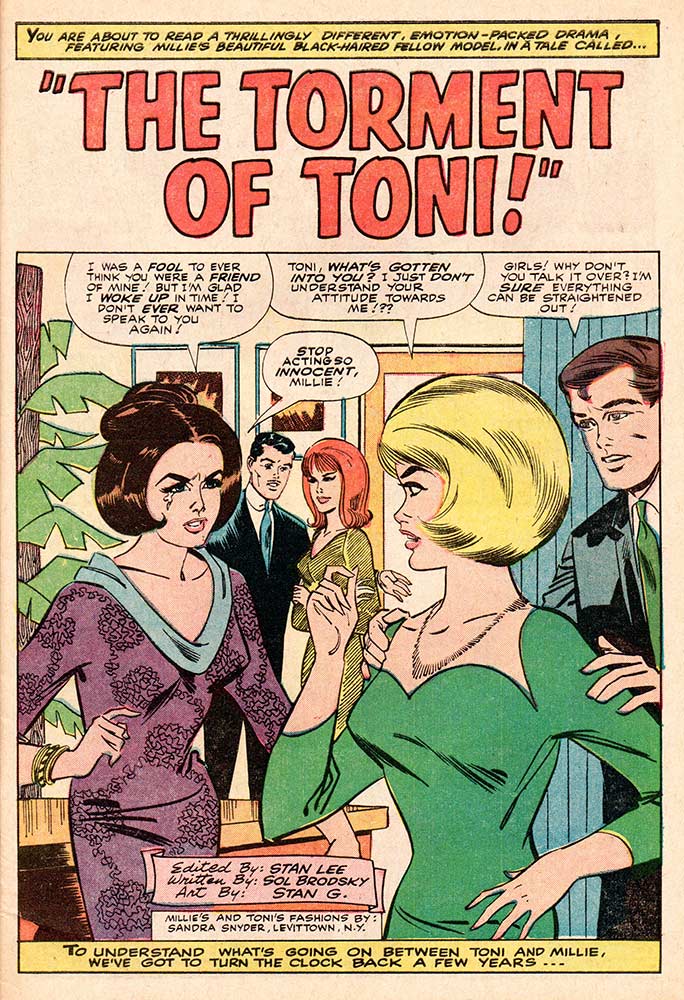

Millie the Model #133 by Stan Lee, Sol Brodsky, and Stan Goldberg
Marvel’s romance line was a little cottage industry all by itself, as were their Western titles. Stan edited the books (there were four of them at this point, two Millies and two Patsys), and they’re very much in the flavor of the other Marvel titles of the time, with the same corner boxes on the covers and the chatty letter columns. This issue, written by Sol Brodsky (we said he was a “jack of all trades,” didn’t we?) is one long story (“In answer to so many thousands of requests!” … pretty sure Stan wrote the cover blurbs) called “The Torment of Toni,” which chronicles the sometimes tortured relationship of Millie and her friend Toni. The three-part story is 18 pages long and every time Millie or Toni appear in a new outfit or with a new hairdo, there’s a credit. Keeping track of all those credits for the various hair and clothing designs that readers sent in must have a been a monthly back-breaker; there are at least 48 separate credits in this issue alone, including five fashion pages featuring various clothing and hair designs. Still Stan Goldberg’s art is charming and Millie the Model sold close to 220,000 copies per issue in 1965, a number that modern day comics—even Batman—would kill for.

Two more of the “Millie-Verse” books. We’ll look at Modeling with Millie #44 next time.
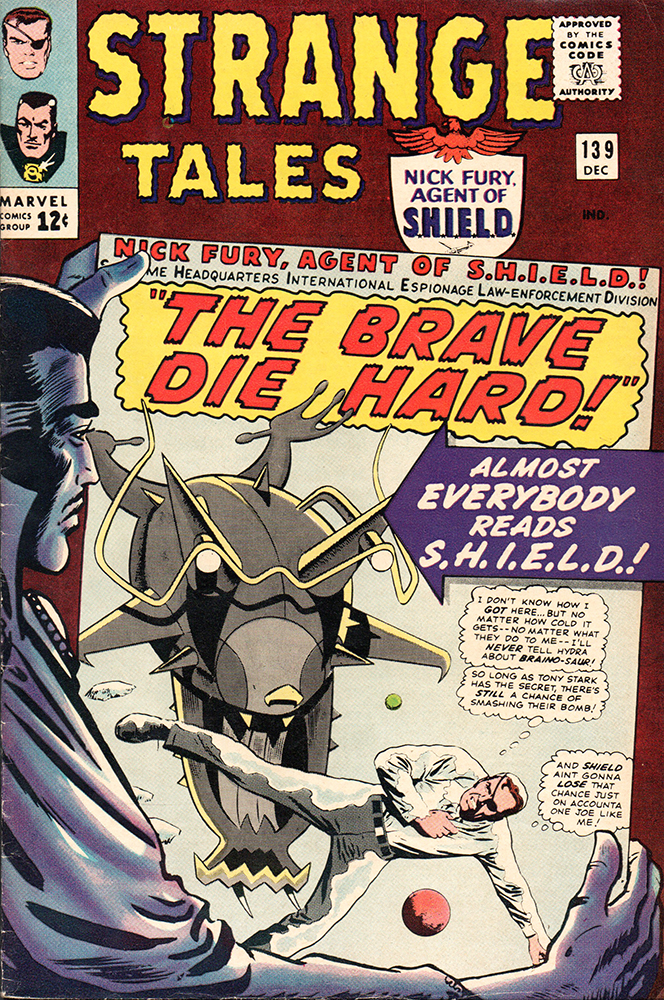


Strange Tales #139 by Stan Lee, Jack Kirby and Joe Sinnott (Nick Fury story); Stan Lee and Steve Ditko (Dr. Strange story)
Strange Tales #139 has one of those weird covers that looks more like a last minute paste-up job—the Nick Fury, Agent of S.H.IE.L.D. splash page inside is identical, except for the coloring—than an original idea. Only five issues into its run, Nick Fury appeared to be another Marvel series that was searching for both its identity and an artist. After John Severin did issue #s 136 through 138 (over Jack Kirby layouts), and this issue is once again features layouts by The King, but with finishes this time by Joe Sinnott. It’s a very pedestrian tale (“The Brave Die Hard!”), and Nick Fury wouldn’t really become the series it was meant to be until issue #151 (cover-dated December 1966), when an unknown artist named Jim Steranko stepped in and quickly made the book his own, by writing, penciling, and coloring it. Meanwhile, Steve Ditko continued his epic Doctor Strange story arc (17 issues!), which started in issue #130 and would run until he left the book with issue #146 (cover-dated July 1966), which incidentally featured the first-ever solo Doctor Strange Strange Tales cover (fortunately by Ditko, kind of a parting gift, I suppose).

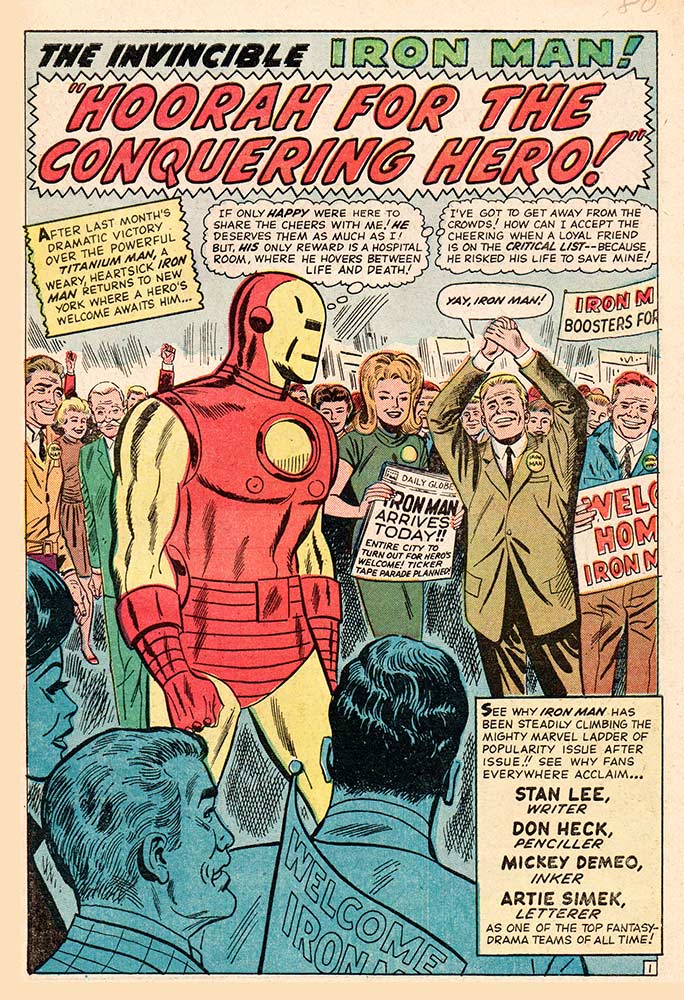
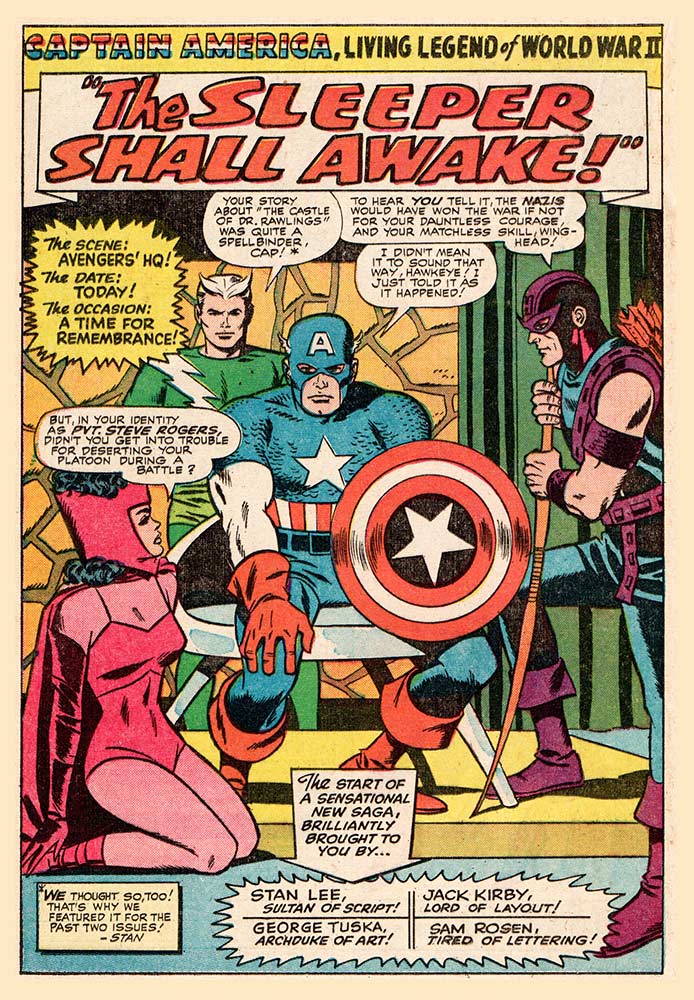
Tales of Suspense #72 by Stan Lee, Don Heck, and Mickey Demeo (Iron Man story); Stan Lee, Jack Kirby, and George Tuska (Captain America story).
I loved this busy, action-packed Captain America cover by Jack Kirby as a kid, and I still do today. This is also one of my favorite Cap story arcs from the “split-book” era, featuring the giant Sleeper machines left by the Red Skull to menace the world 20 years after World War II. And on top of all that, this issue returned Captain America to contemporary (well, 1960s contemporary) stories, after nine issues of new tales set in the 1940s war era. And while this story is credited to “Lord of the Layouts” Jack Kirby and “Archduke of Art” George Tuska, that splash page featuring Cap and the current Avengers line-up is unmistakably inked by Wally Wood. The very forgettable Iron Man story (which appeared first in this issue), features ol’ Shellhead battling the Mad Thinker and his Awesome Android, with art by Don Heck. And yep … Stan the Man wrote both tales.



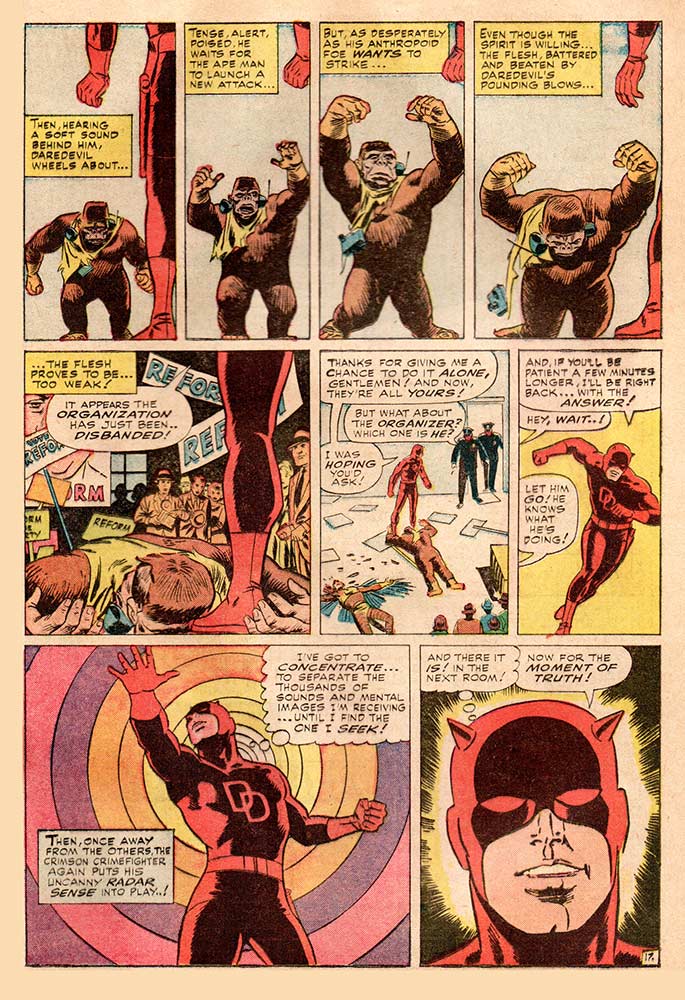
Daredevil #11 by Stan Lee, Bob Powell, and Wally Wood
Daredevil #11, the first monthly issue, was the last one Wally Wood worked on, and it’s a shame. Daredevil was the last big first wave creation at Marvel; Martin Goodman wanted another superhero team book like the Fantastic Four (he got both the Avengers and X-Men), and another Spider-Man … he got Daredevil, which was supposed to come out in the summer of 1963, but finally came out in early 1964 (it’s a long story … click here for more). Daredevil was half-baked, to say the least, for its first four issues, and Wood took over the art chores with #5, being credited on the cover, no less, by Stan. When he redesigned the character’s costume with #7, things really perked up with that all-red, simple but oh-so-effective design. But Woody balked at the extra work with no credit (or financial payment) for plotting and pacing the stories for Stan to add dialogue too. Stan finally allowed Wood to write Daredevil #10, grousing about it the entire time; when it came time to wrap up the story with #11, Stan said: “Wally Wood wrote part one of this two-parter last ish, just for a lark! But now it’s time for sly ol’ Stan to put all the pieces together and make it come out okay in the end! Can he do it? See for yourself!” It was too late for Woody, alas. He was only the inker over Bob Powell’s pencils on this issue (although to be honest, I think he also did layouts … sure looks like it, at least to me), and he inked some more Marvel comics, including the Avengers, but his clash with Stan sent him packing. Soon Steve Ditko and even Jack Kirby would follow suit. To be honest, this is a muddled, convoluted story, and Wood’s villains—The Organizer, Bird-Man, Ape-Man, and Frog-Man, were not his finest 1965 superhero comics hour; that would be reserved for T.H.U.N.D.E.R. Agents, which Woody co-created, drew (along with a slew of comics finest artists, circa the mid-60s), and edited for Tower Comics. Wood would do more sporadic work for Marvel, including a Doctor Doom series, later in the decade.
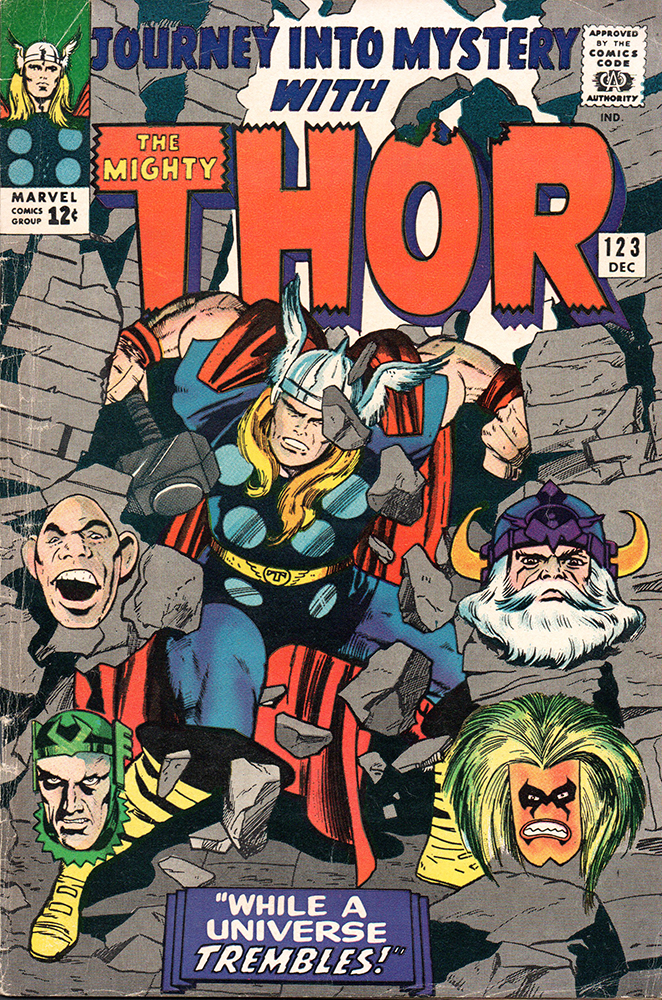
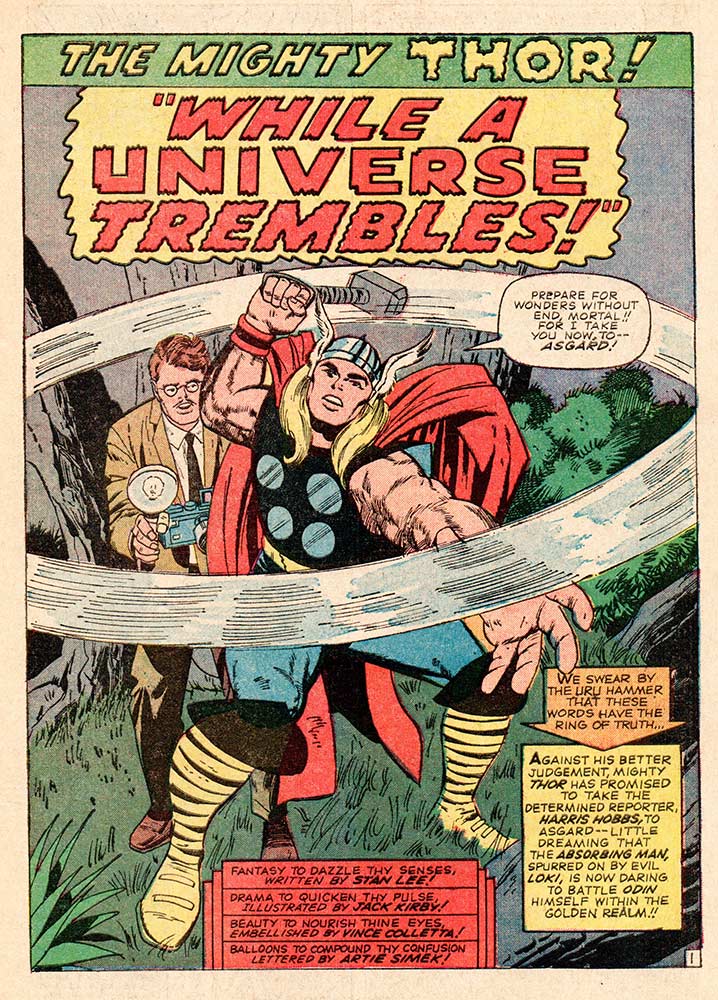

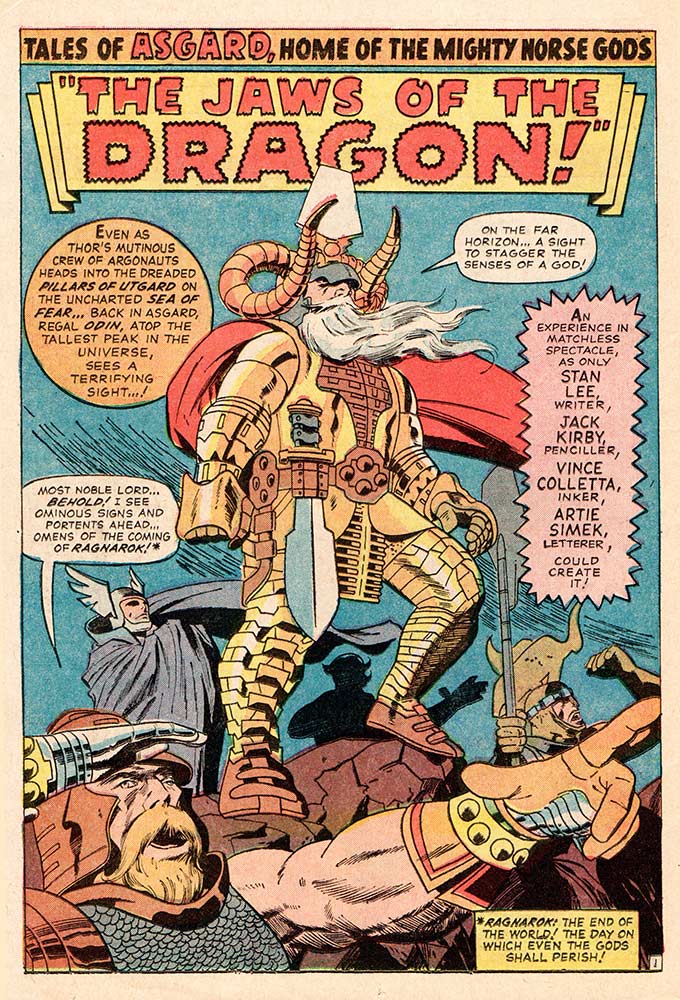
Journey into Mystery with the Mighty Thor #123 by Stan Lee, Jack Kirby, and Vince Colletta.
I wasn’t a big fan of Thor as a kid, but this issue is part of Jack Kirby’s great run on the character … just look at those pages above. Part of what turned me off at the time (hey … I was ten) was the mythic storyline. At this point, Stan and Jack had kind of abandoned the whole Don Blake secret identity thing and concentrated more and more on Thor as a god, with more stories taking place in Asgard. In retrospect that was actually a good thing, as Thor excelled in Asgardian and off-world adventures, going toe-to-toe with characters such as Galactus and the High Evolutionary. In a few short issues (with #126), the book’s title became simply The Mighty Thor, as Stan Lee realized there was no mysterious journey left; Thor was the real deal. “Tales of Asgard” was still a five-page back-up story, but you could tell Kirby really dug doing these and Thor in general; not even Vince Colletta’s lackluster and lazy inks can cover up the peerless power of King Kirby’s pencils (as Stan himself might have said), especially on that spectacular splash page featuring Odin, spectacular due solely to Kirby’s dynamic pencils.
Once again, one of the best parts of each of these issues were the plethora of house ads that appeared. There doesn’t seem to be much rhyme or reason to their placement and it almost seems like some were just created on the spot to fill a particular issue, never to be seen again anywhere else. I wish someone would just do a book of Marvel (and DC) house ads. They’re a lost art … the ones that appear in today’s comics have none of the charm and homemade qualities that make these early Marvel Comics ones shine.
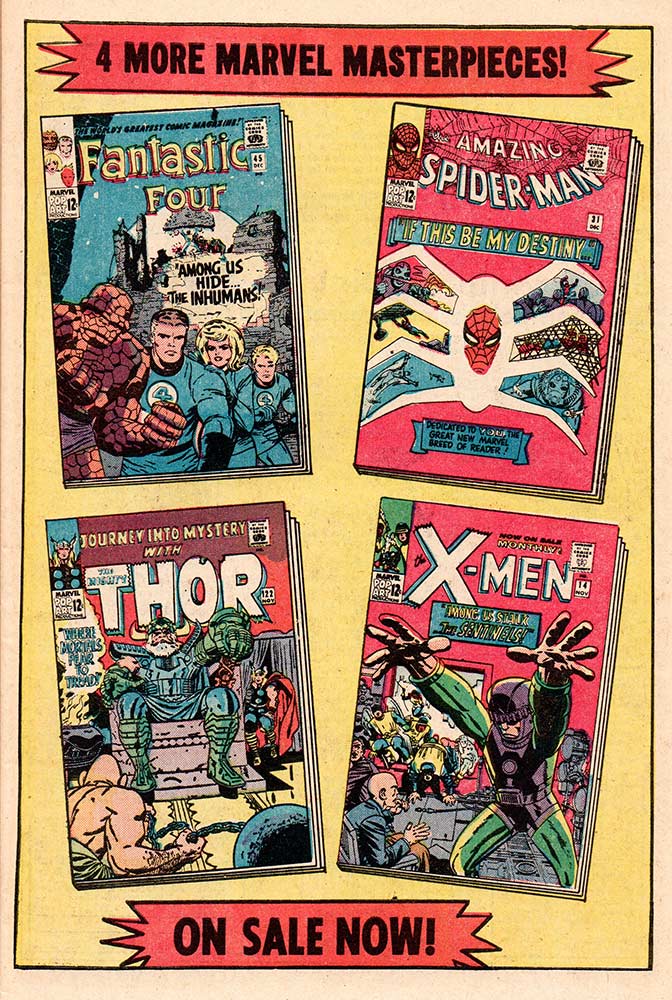


Two of these ads promote January 1966 books, including Fantastic Four #46 and Amazing Spider-Man #32. And Stan was leaning heavily into the promotion of the first issue of Marvel Collectors’ Item Classics, a 25-cent all-reprint, regularly scheduled book that re-presented “The most requested, unabridged editions of our earliest Marvel Masterworks–to help you complete your collection!” I guess the two annual editions of Marvel Tales (in 1964 and 1965) proved there’s gold in them thar’ reprint hills.
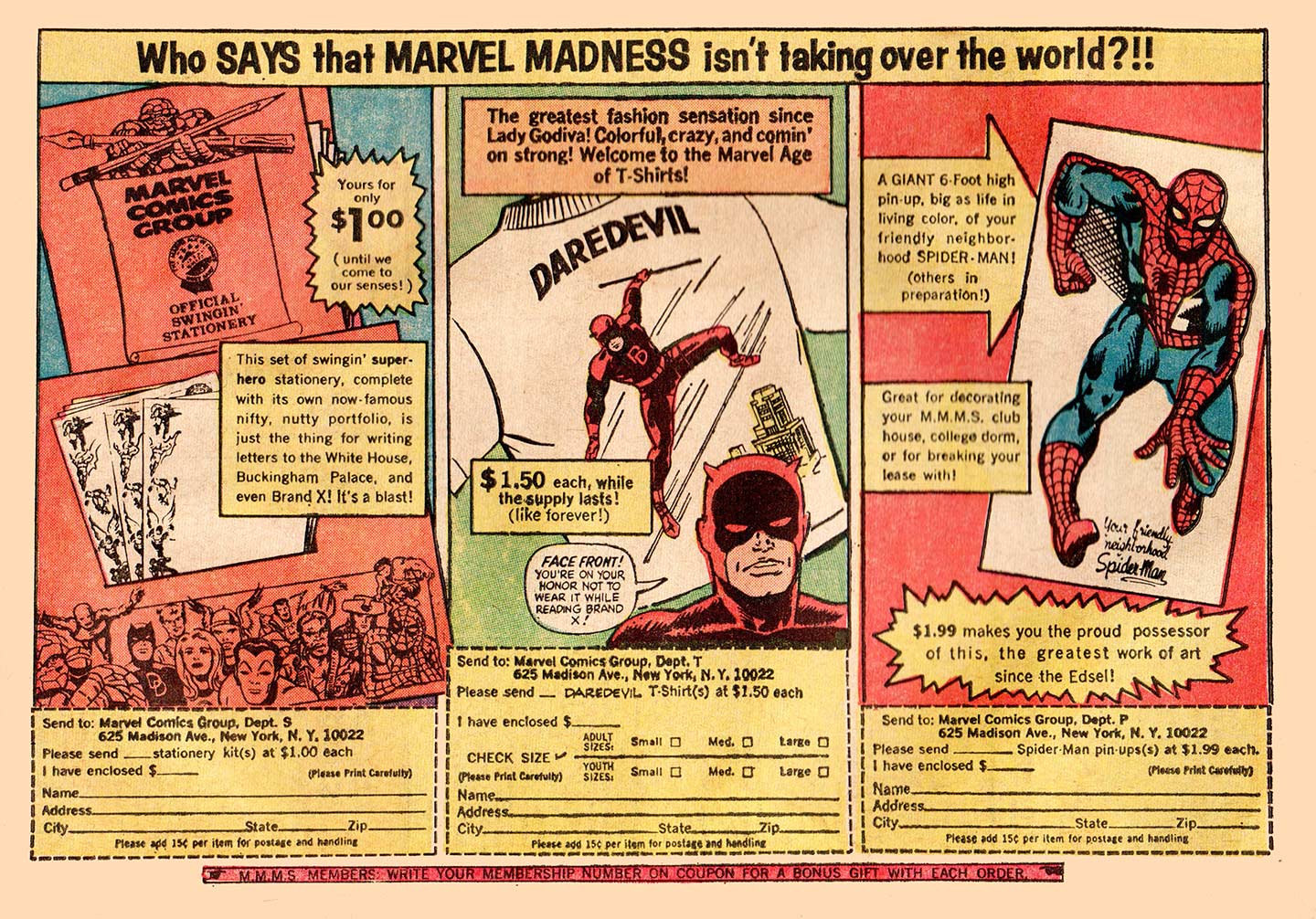
Merchandise was becoming an increasingly important part of the Marvel Age of Comics in 1965, as this ad from Daredevil #11 (note the DD-specific T-Shirt ad) showed. It’s hard for me to believe that all of this stuff was handled from the dinky little Marvel office at 625 Madison Ave., including the burgeoning popularity of the M.M.M.S., Marvel’s home-grown fan club. Fabulous Flo Steinberg, Stan’s secretary at the time, talked about envelope after envelope stuffed with dollar bills.
Next time: We look at the final five Marvel issues cover-dated December 1965, including Modeling with Millie #44, Patsy Walker #124, X-Men #15, The Avengers #23, and Sgt. Fury and His Howling Commandos #25, plus more house ads … face front, True Believer, there’s more fun to come!

To read all the “Tales from My Spinner Rack” posts, click here!

instagram.com/talesfrommyspinnerrack/
 @innocent-bystander.com