

All art in this post TM & © MARVEL; all art is scanned from the original comics in my collection.
Click on the images to see them larger on your screen!
I don’t know when the idea first came to mind, but at some point I decided I wanted to get every Marvel comic published in one month. I thought it would be a neat little time capsule of an era that’s gone but not forgotten, the Marvel Age of Comics. The 1960s personified creativity, excitement, and a huge leap forward in superhero comics, as Stan Lee, Jack Kirby, Steve Ditko, et al, produced a new kind of comic book, one that brought the spandex-clad stars down to a relatable, more human level. It was a kind of comic book that enthralled me. I was a Marvel Kid.
I think it was in 2018 or so when I bought a copy of Fantastic Four #45 at San Diego Comic-Con. My brother still had our original copy, purchased from one of our small town’s newsstands around September 9, 1965. Eventually, that original copy would once again come to be mine, and it’s one of my prized possessions (even though I just noticed the cover is loose—oops, guess I read it too much!), along with a mini-run of Captain America comics—issues 109 through 114—that still bear the date stamp from Brady’s Newsstand in Tamaqua, PA. Yeah, some collectors might get queasy seeing a cover with a smeary date stamped on it in ink; for me it makes it an actual historical document, a validated memory of my childhood. The copy of FF #45 doesn’t have a stamp, sadly, since we bought that at a different newsstand that didn’t stamp their books, so yeah … I kinda prefer the stamped ones, thank you very much.
But I’m veering off-topic here. When I realized I wanted an entire month of Marvel Comics, I decided that that copy of FF #45 was a good starting point. It was Marvel’s flagship book, the one that started it all. It was cover-dated for December 1965, even though it came out in September, three months earlier. Comics were like that back then (I believe they’re still cover-dated a month ahead even these days; at least the copy of Detective Comics #1076 I bought on November 1 says “December 2023” in the indicia). None of that is important to this tale though …
What is important are these two salient facts: First, there was no better time to be reading comic books than as a ten-year-old in 1965. Yes, school was back in session—fifth grade for me, top of the food chain at North Ward Elementary School—so my twice-weekly trips to the local newsstand were life-savers. I was a good student; not straight As, but close enough (a bit dim-witted when it came to math and science though, a trait that has stuck with me to this day; don’t ask me to figure out the tip when the check comes or explain an internal combustion engine; cars run on photosynthesis, right?).
And second, that FF #45 cover is my all-time favorite Fantastic Four cover; heck, maybe even my all-time favorite comic book cover. So that was a good starting point for my quest—no, make that MY HOLY QUEST, all caps—to get every Marvel comic cover-dated December 1965. Every collector likes a quest, right? The thrill of the hunt, the ecstasy of the find, the inevitable letdown when it’s all over. And to be honest, this was not as difficult as it sounds; in fact, I probably completed my self-appointed quest within a few months, maybe a year, tops. There are exactly 15 Marvel comics for December 1965, including one Western (Rawhide Kid #49), and four romance (for lack of a better term) books (Millie the Model #133, Modeling with Millie #44, Patsy Walker #124, and Patsy and Hedy Career Girls #103); all five of these books were surprisingly cheap on eBay for reading copies in decent condition. Besides the FF #45, two other issues were a bit pricey: Amazing Spider-Man #31 features the first appearances of Gwen Stacy and Harry Osborne, as Peter Parker goes off to college; and X-Men #15 contains the origin of Hank McCoy, the erudite and verbose Beast, whose vocabulary is bigger than his giant-size hands and feet (pre-blue furry version); the origin itself is about eight panels or so on two pages, so it’s not like a separate special story or even a back-up tale, so I’m not quite sure what all the hub-bub is, bub.

The famed Marvel Comics corner boxes separated their books from everything else on the stands. (We’ll get to that whole “Pop Art Productions” debacle in a few minutes.)
So let’s take a look at these books over the next few weeks here in the merry and festive month of December (because, after all, they are cover-dated for that month). Yes, consider it my Christmas present to you, for being such good little boys and girls. We’ll do five at a time, and—if you’re EXTRA GOOD—I’ll combine all 15 books into one video over on the official Tales From My Spinner Rack! YouTube channel, our first-ever new video not based on a panel presentation I did at Comic-Con or WonderCon (this is not as impressive as it sounds … I’ve only done two panel presentations that were re-created as YouTube videos; clearly I won’t be winning an Emmy Award, or what ever the You Tube equivalent is).
Oh, and for the record … I realized as I wrote this that this December 1965 Marvel Comics collection is the reason I got a spinner rack. The rack has 40 pockets (ten each on four sides) and I wanted to see all these books side by side on a rack, maybe sorta-kinda like it was in September 1965, when they first came out. But here’s the catch: Not all the December cover-dated Marvel comics were released in September; some came out in early October, so I’m going to break this up into groups of five by actual publication date, starting on September 2 and running through October 12, 1965. The Marvel release dates seem to be stacked at the beginning of each month, with all the books coming out in the first two weeks of September and October. This meant a long two-week wait until next month’s Marvels, an absolutely intolerable length of time for my ten-year-old self. I mean, REALLY?! … what was I supposed to read? Superman’s Girl Friend Lois Lane?
So here are the first five books in our little time travel trip back to December 1965 (let’s just keep calling it that month for the sake of consistency and because it’s December as I post this series).

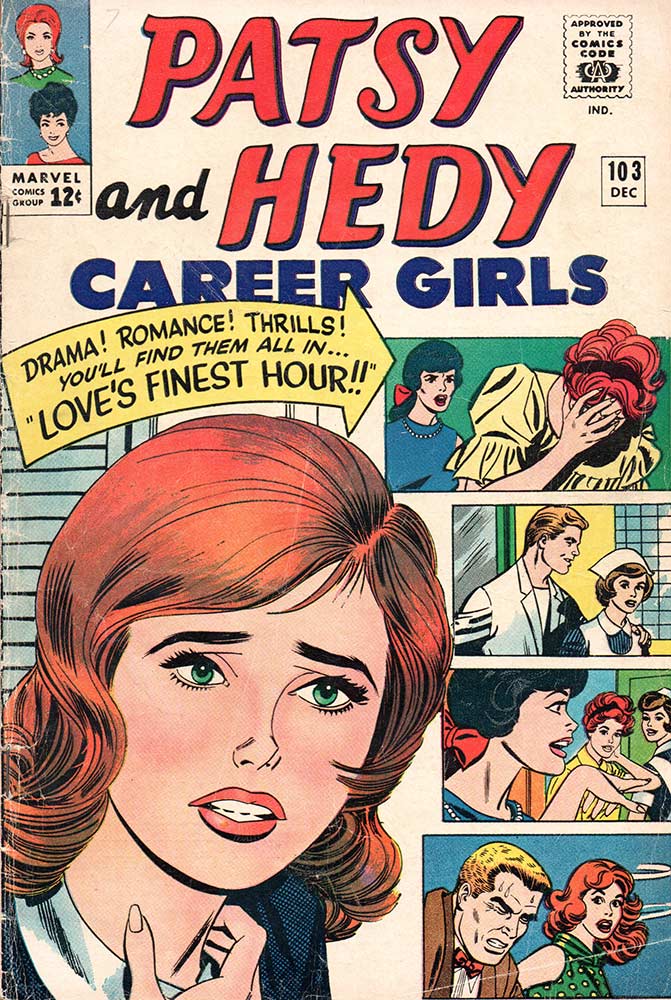

Patsy and Hedy Career Girls #103 by Al Hartley.
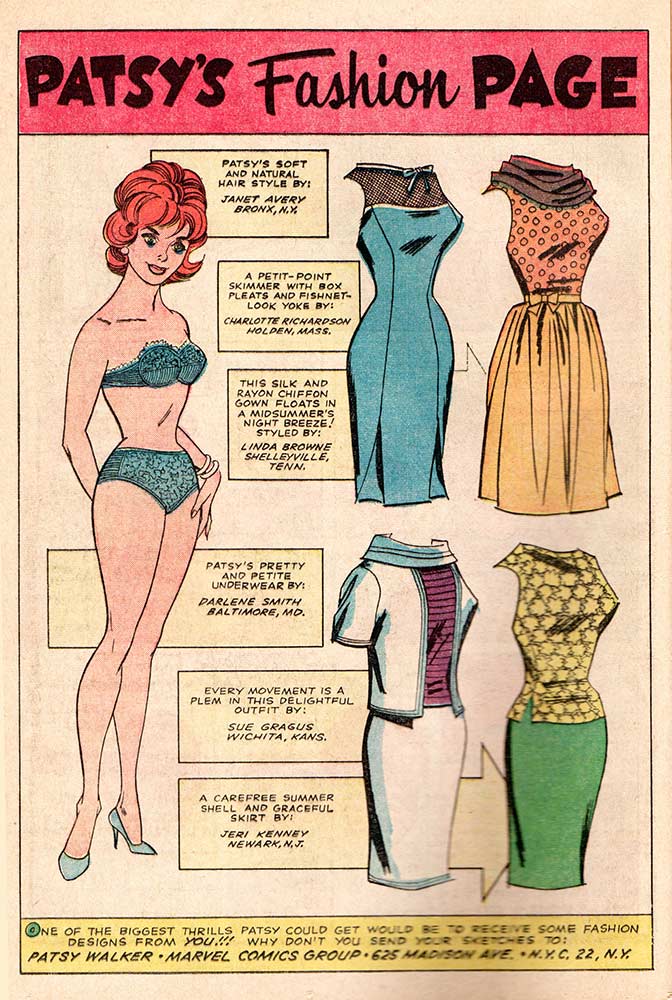
“Drama! Romance! Thrills! You’ll find them all in “Love’s Finest Hour!” This book seems to be all done by Al Hartley, who was a Marvel mainstay on their romance line. All these books, including Mille the Model, Modeling with Millie, Patsy Walker, and Patsy and Hedy Career Girls, featured soap opera-like stories and fashion and hairdo pages, all with designs sent in by readers. Each reader was given credit for their designs. I suppose it was something started by Bill Woggon on his creation Katy Keene and “appropriated” by that master trend-copier, Martin Goodman. I’m sure Marvel completists bought these books, too, although my brother and I drew the line at the occasional Western book. But they were certainly filled with pretty girls, and Hartley was adept at filling his quota. Not so much on superheroes, though: he did one disastrous Thor story (Journey into Mystery #90) and that was it, as far as I know. Thor looked pretty, though.
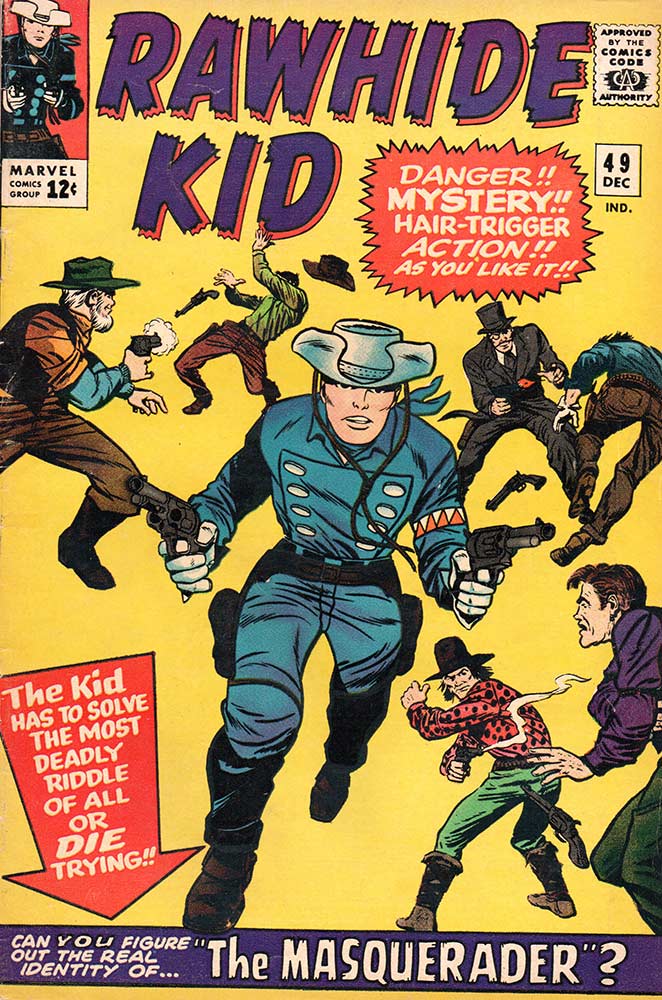


Rawhide Kid #49 by Larry Lieber and Carl Hubbell.
After writing some of the first Ant-Man, Thor, and Iron Man stories, Larry Lieber (Stan’s brother) was pretty much exiled to the Western titles, which he both wrote and drew. The other two Marvel Western titles were Kid Colt, Outlaw, and Two Gun Kid, so there were a lot of “Kids” to keep track of.

The other two Western titles from Marvel on the stands when Rawhide Kid #49 came out.
This issue contains pretty much one long Rawhide Kid story, “The Menacing Masquerader!”. Lieber draws in a definite Jack Kirby-influenced style and he would go on to do a couple of Spider-Man Annuals (#4 and #5) and the Spider-Man daily comic strip for many years. Fun fact: Rawhide Kid was the first recurring character book Stan Lee and Jack Kirby collaborated on, starting with a revamp of the series in RK #17, cover-dated August 1960 (restarted after a three-year hiatus), in essence making him the first modern age Marvel hero, albeit a not-so-super one.

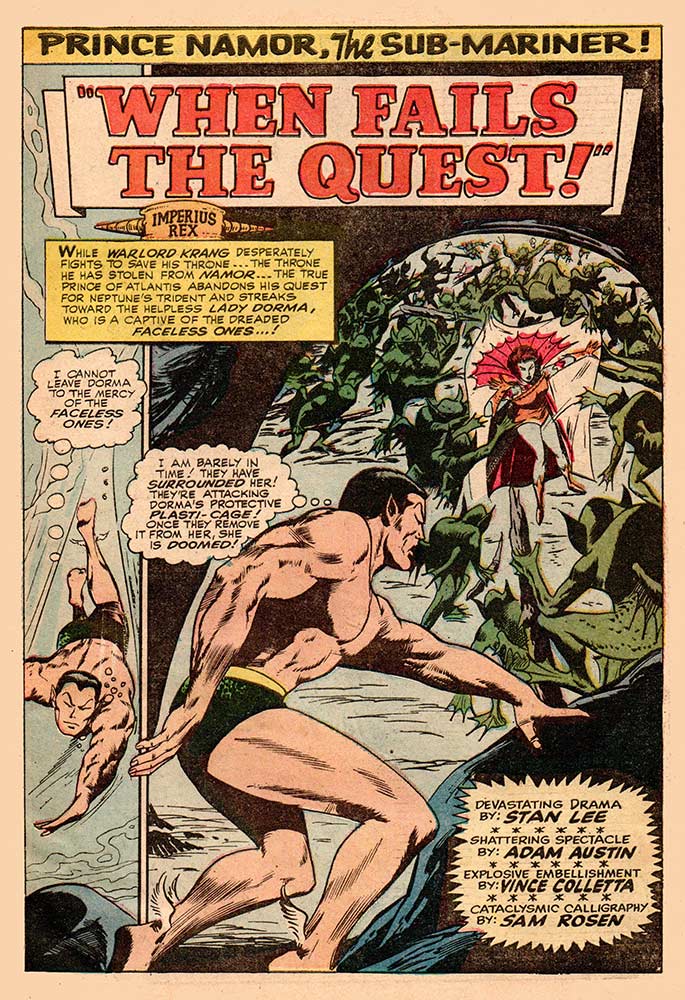
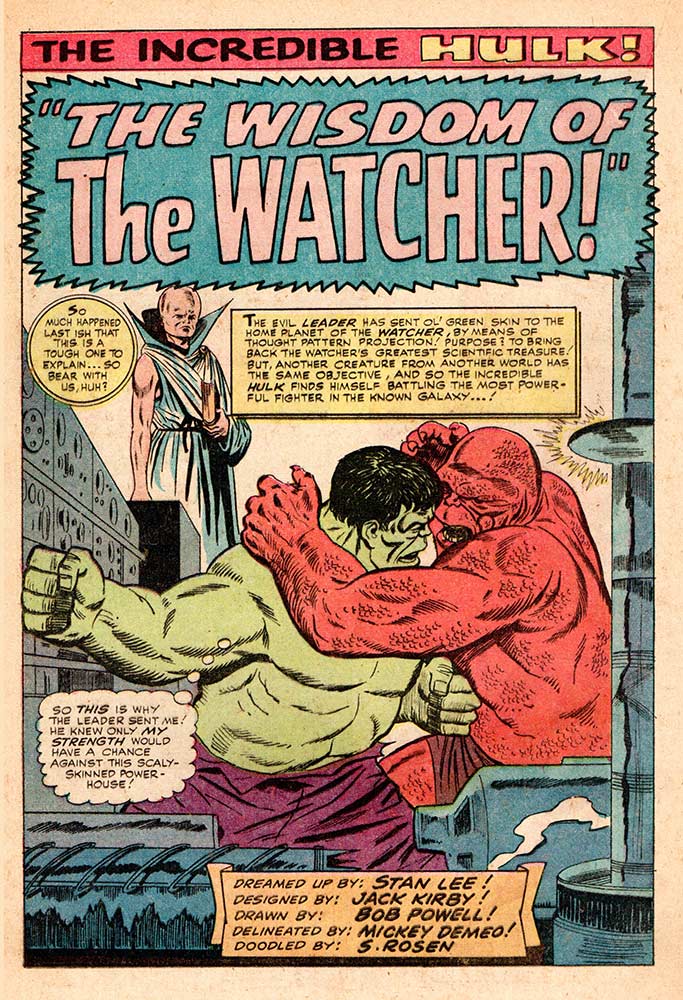
Tales to Astonish #74 by Stan Lee, Gene Colan, and Vince Colletta (Sub-Mariner story); Stan Lee, Jack Kirby, Bob Powell, and Mickey Demeo (Mike Esposito—Hulk story).
I’ve always felt Marvel “split books” were great, but this is probably one of the weakest ones, with both the Sub-Mariner and Hulk storylines a pair of meandering messes. Subby—by Stan Lee and Gene Colan, still calling himself “Adam Austin” in this fifth Sub-Mariner installment (the series had just started in Tales to Astonish #70, four months earlier)—was on some interminable—and quite frankly boring—quest. And the Hulk—who had survived the demise of his own six-issue series in 1962—went through a revolving door of artists while Stan Lee tried to figure out what to do with him. By this point, Steve Ditko had lasted the longest on ol’ Greenskin’s series (Tales to Astonish #60-67), but in another year he’d be gone from Marvel altogether.

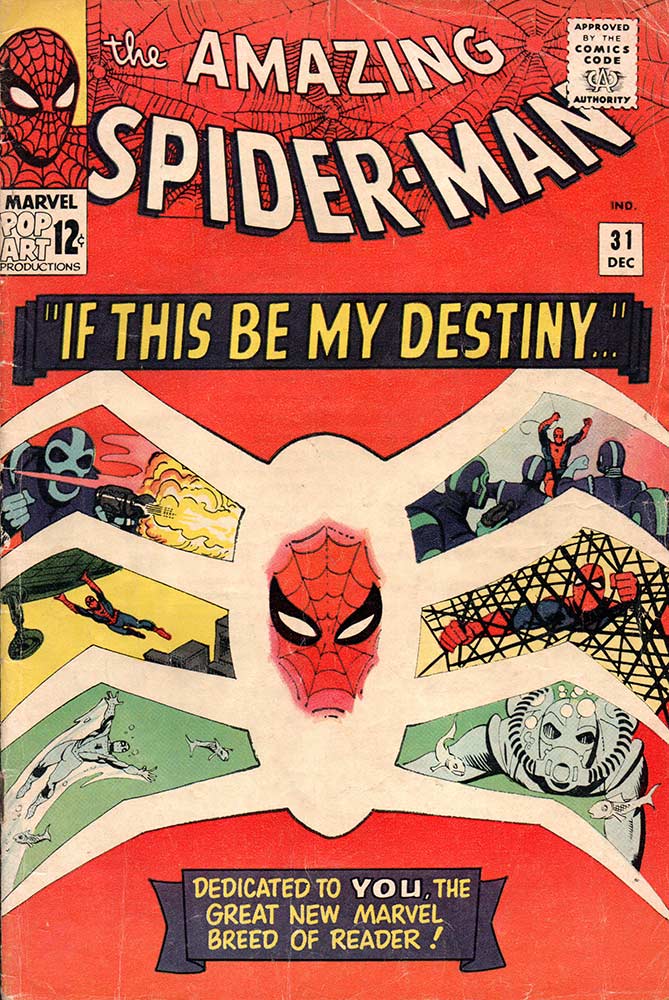


Amazing Spider-Man #31 by Stan Lee and Steve Ditko.
This issue—along with #s 32 and 33—is quite possibly Steve Ditko’s finest hour on Spider-Man. It sets up the epic “Master Planner” storyline, wherein Spidey has to deal with Aunt May’s illness (yet again) and fight off a new group of thugs terrorizing New York City at the behest of a mysterious boss (Spoiler Alert, 60 years later: It was Doctor Octopus!). Ditko is just credited for the art on this issue, but he demanded and got plotting credit starting with Amazing Spider-Man #25. He would be credited with “plot and illustration” for the concluding chapters of this three-issue epic in the following two issues, and given that same credit until he left the book with #38, just seven short months after this issue.

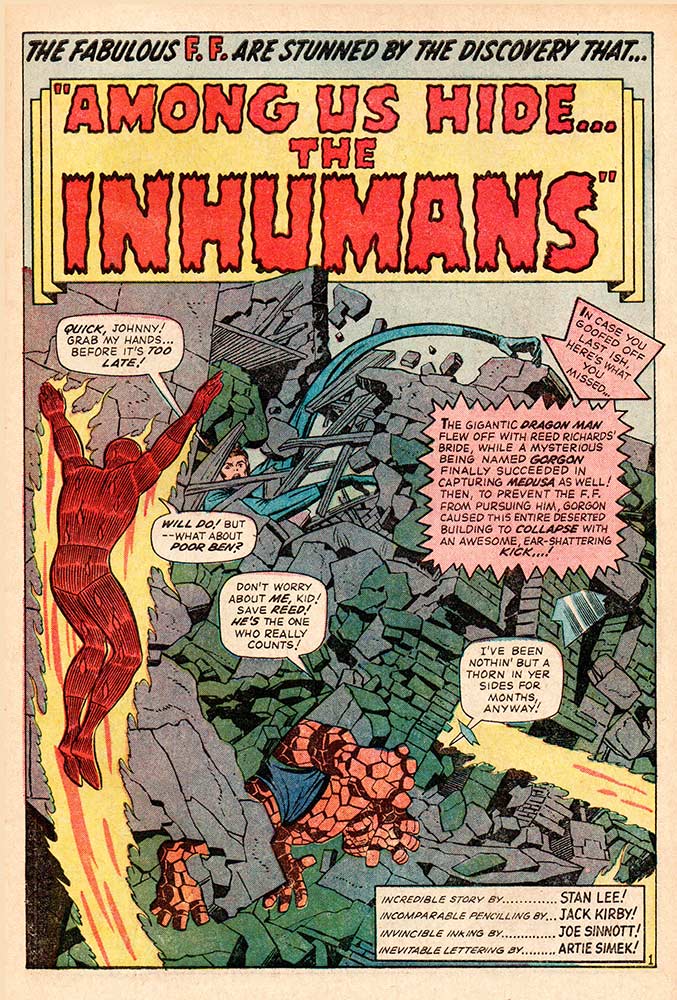
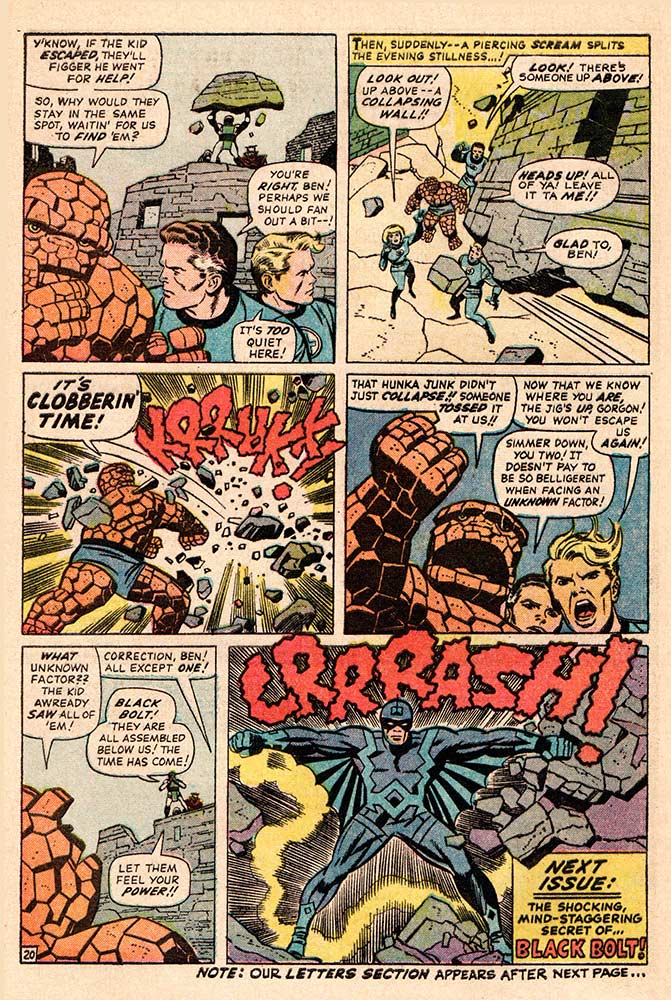
Fantastic Four #45 by Stan Lee, Jack Kirby, and Joe Sinnott.
As mentioned at the start of this post, this is my favorite Fantastic Four cover, although I’m not quite sure why. There are certainly more action-packed FF covers and more poster-like ones (FF #72 springs immediately to mind), but there’s just something about the coloring and the air of mystery that makes this so special to me. Who are those little guys behind the FF? This issue does, of course, introduce the Inhumans, even though Medusa was introduced in issue #36 as a member of the Frightful Four and Gorgon in the previous issue, #44. It’s also only the second consecutive issue that had Joe Sinnott inking Jack Kirby’s pencils, setting up what many people—including me—regard as the dream team of Marvel superhero art. The run that I refer to as the Kirby-Sinnott run, starting with issue #44 and ending when Kirby left the FF with issue #102 (there are a couple of non-Sinnott inked issues, to be sure), are amongst my favorite comics ever. It also started an unprecedented burst of creativity by Kirby and Lee resulting in the Inhumans (Black Bolt, Medusa, Gorgon, Karnak, Crystal, and Triton), Galactus, the Silver Surfer, and the Black Panther, all in the space of about 11 issues, less than one year. It was an amazing time to be reading comics. I wondered each month what Stan and Jack would come up with next!

This first batch of Marvel books cover-dated December 1965 came out in September, right after the company’s summer 1965 annuals, three of which are shown in this house ad.
Before we end this week’s tale, let’s pause for a minute and talk about Marvel’s corner boxes. I truly love this addition to the Marvel covers and loved picking them out on the newsstand racks, where often times, just a glimpse of the book’s upper left corner was all you saw. Legend has it that Steve Ditko created them by adding one to the cover of Amazing Spider-Man #2 and Stan Lee carried it over for all the books. The look of them changed throughout the 1960s, eventually going away in 1970, during that one month that Marvel went to 25 cent books (click here to read about that), and changed their trade dress while they were changing their price. My personal favorite is the one with the hand-lettered “Marvel Comics Group,” big and bold and colorful, instead of just plain type, which was the original version.
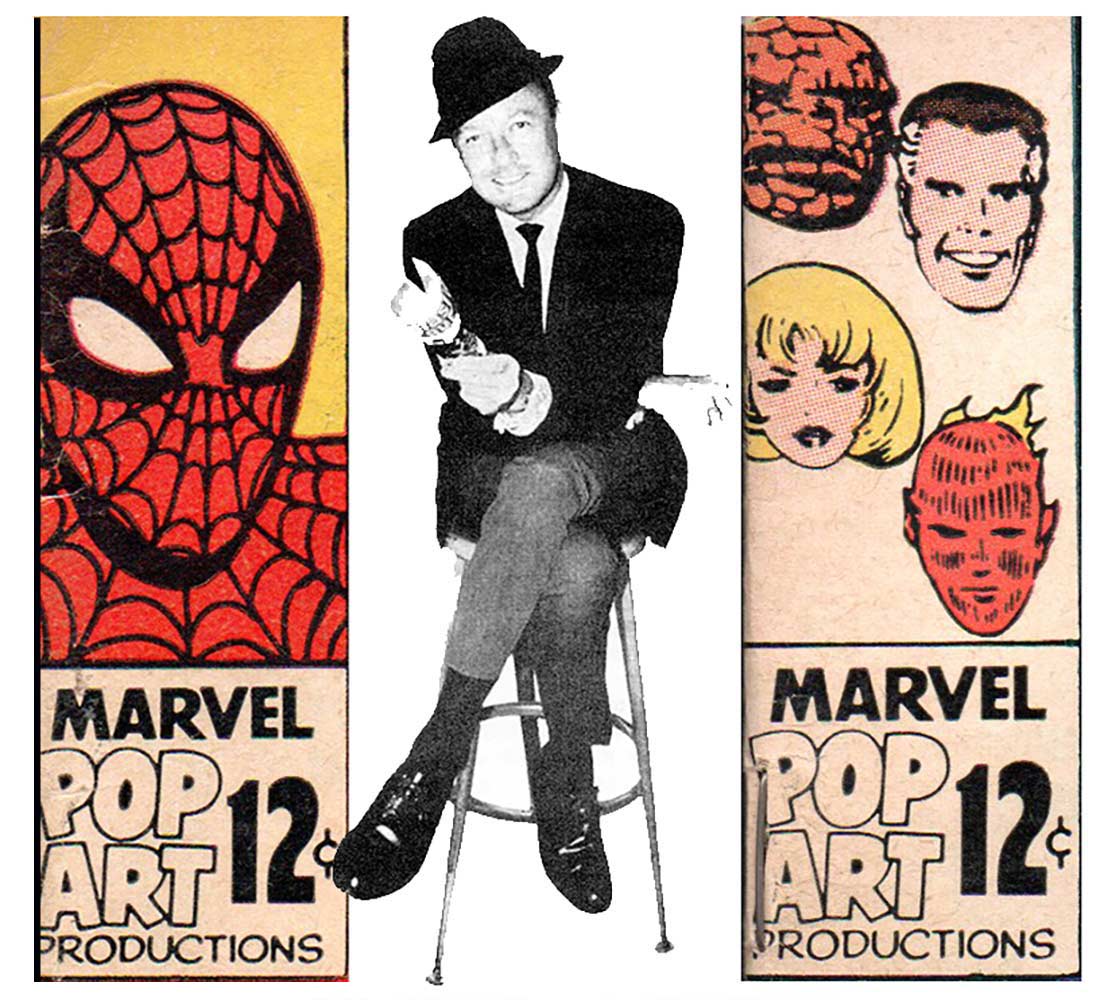
Ol’ Smiley himself in a photo from the inside front cover of Fantasy Masterpieces #1. He’s holding a copy of Fantastic Four #46.
But in 1965, Stan got a little too high-falutin’ with the success of the line and all the personal attention he was getting and decided to rebrand his books as “Marvel Pop Art Productions,” replacing the traditional “Marvel Comics Group” type in the corner boxes. Stan evidently figured Marvel was part of the pop art cultural movement of the time, pioneered by artists such as Andy Warhol and Roy (“Hey, I’ll just steal this comic book art and make a painting out of it, no one will notice.”) Lichtenstein, but boy … was he mistaken! This change only lasted for about three months (23 issues total), mainly in the September, October, and November cover-dated books. The outcry from the fans was so great that Stan issued an apology in the January 1966 cover-dated books’ Bullpen Bulletins page:
“WE GOOFED AGAIN DEPARTMENT!”—Remember how we tried to change our name to Marvel Pop Art Productions? Well, although some of you went along with us, we never realized how many thousands were intently loyal to the name Marvel Comics! Your mail, phone calls, and telegrams bowled us over! So once again, we fell on our red faces—and, from now on, we’re the Marvel Comics Group once more—SO BE IT!
I call this Stan’s Go-Go Checks moment, even though that happened a year later over at DC Comics. It was a miscalculation, but Stan—to his credit—realized his mistake and made things right. We can never forgive—or forget—Go-Go Checks on DC’s covers for over 500 issues (see Episode 3 on the official Tales From My Spinner Rack! YouTube channel for an explanation of DC’s Go-Go Checks as part of “Jimmy and Lois: Still Crazy After All These Years!” Click here to watch it now!)
Little did I know that there’s one other very special thing about the December 1965 cover-dated Marvel Comics Group publications … more on that in Part 02!
Next time: We continue our archeological dig into the December 1965 issues of Marvel Comics with looks at Millie the Model #133, Strange Tales #139, Tales of Suspense #72, Daredevil #11, and Journey into Mystery with the Mighty Thor #123. Until then, MAKE MINE MARVEL! at least in the Merry Marvel Month of December!
To read all the “Tales from My Spinner Rack” posts, click here!

instagram.com/talesfrommyspinnerrack/
 @innocent-bystander.com