
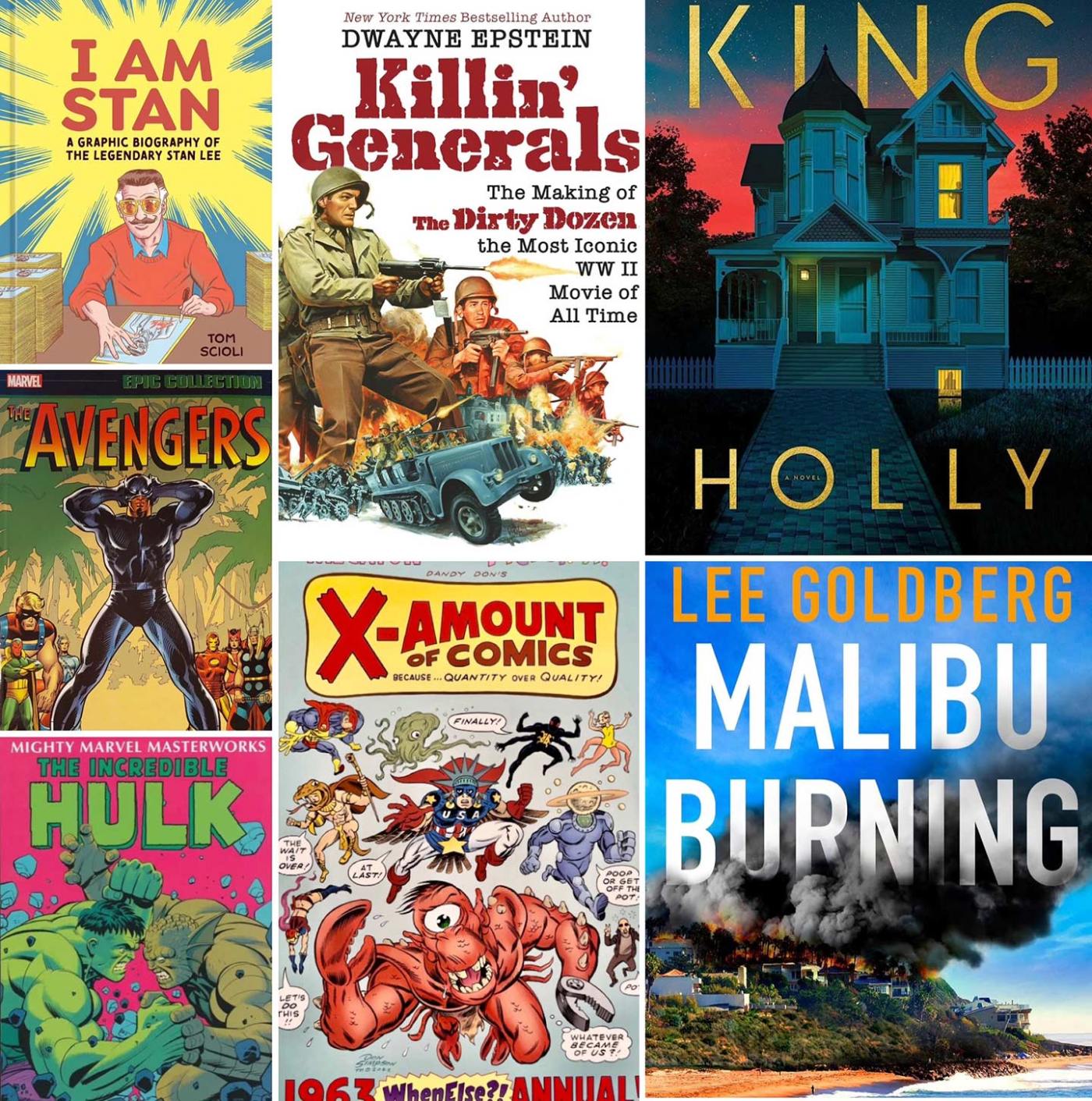
A busy month of reading, for me at least, while the days get shorter (did you know we lose 41 minutes of daylight in Southern California from September 1 through 30?) and the nights get longer, cooler, and quieter. Here’s what I read last month:
Malibu Burning by Lee Goldberg
I started reading author Lee Goldberg’s Eve Ronin series a few years back and have really enjoyed all four of the books. Goldberg’s television scripting background leads to good dialogue, great characters, and exciting plots, and Malibu Burning, the first in a series of novels featuring arson investigators Walter Sharpe and Andrew Walker, certainly fulfills all those categories. Sharpe and Walker try to figure out who started a fire that’s obviously arson and suspect a drone called “Icarus”—which firefighters use to fight fires—is being used. Walker is a former US marshal (think Raylan Givens, and yes, with the Stetson), whose man-hunting skills compliment Sharpe’s arson-sniffing nose to a tee. Throw in a former adversary of Walker—con man Danny Cole—and the machinations of a heist involving some of the biggest and most expensive homes in the LA fire-prone area with the largest wildfire in California history looming in the background, and you have a suspenseful, exciting, cinematic novel, a great start to a new series (book two, Ashes Never Lie, is already scheduled for next year). I’ve gotten to the point that I’ll read anything new by the prolific Goldberg: His next Eve Ronin installment (Dream Town) comes out in January, but before that, in November, Calico debuts … that’s three books by this author in five months. Bring ‘em on!
Killin’ Generals: The Making of The Dirty Dozen by Dwayne Epstein
The subtitle for this book is “The Most Iconic WW II Movie of All Time,” and I suppose that’s true or was true at the time it came out (1967). Author Epstein does a fine job on covering the making of The Dirty Dozen film (his recap of the original novel by E. M. Nathanson is a bit tedious, though … I recommend skipping that part), and all the personalities involved. He’s honest and forthright about Lee Marvin’s drinking, Charles Bronson’s surliness, and director Robert Aldrich’s skills in wrangling his dozen actors (plus the ancillary players like Ernest Borgnine, Richard Jaeckel, and Robert Ryan). To be honest, I rewatched the movie while reading this, and it’s a bit of a mess, but I do fondly remember seeing it at the Valley Drive-In in Hometown, PA, when It came out—and I was 12 years old. As I’ve said in previous movie-oriented book reviews, I love dishy movie chronicles like this one, and Epstein certainly delivers the dish.
X-Amount of Comics: 1963 When Else?! Annual by Don Simpson
Cartoonist Don Simpson attempts to—kinda, sorta—do the long-missing 1963 Annual which Image was supposed to publish 30 years ago, written by Alan Moore and drawn by Jim Lee, but which, of course, never happened. This is a parody of a satire of an idea … well, let’s just say I read it, I loved Simpson’s art, but I sure as hell didn’t understand it. Of greater interest to me is his text piece at the end of the book which chronicles some of the history behind this aborted project, which was basically Alan Moore creating a 1960s-type Marvel Universe with a battery of artists, including Simpson, Rick Veitch, Steve Bissette, Dave Gibbons, and others, including letters pages, fake ads, Bullpen Bulletins-like pages, etc. I recently picked up the original six-issue mini-series once again (I think it’s my third time), and while the concepts and characters are entertaining, it’s all pretty much impenetrable. Moore—who repeatedly denounces comics these days—and others, refuse to let this project actually happen, even though there is evidently a script (or outline) and artists willing to participate. Oh, well … 1963’s time was in the 1990s (if that makes sense), and a lot or Moore’s stellar work is a product of its original time, not nearly as entertaining today as it was when it was new.
Avengers Epic Collection, Vol. 5: This Beachhead Earth by Roy Thomas, John Buscema, Sal Buscema, Neal Adams, and Tom Palmer
This is primo Roy Thomas Avengers action from the early 1970s, including the classic Kree-Skrull War issues (#s 93 through 97), drawn primarily by Neal Adams and Tom Palmer. Thomas can be as wordy as Stan Lee, and if there’s a pop culture reference lying nearby, he certainly picks it up and uses it. These issues are action-packed—the volume actually reprints Avengers #s 77 through 97, and a ton of original art stats, including some of Adams’s pencils from issue #93—and I remember them fondly from my youth. Pair this with the previous volume (#4: Behold … the Vision), which includes the introduction of the Vision and you have Roy Thomas’s finest work on this title.
Marvel Masterworks The Incredible Hulk, Volume 3 by Stan Lee, Jack Kirby, John Romita, Gil Kane, Bill Everett, and John Buscema
Hulk write this one.
Hulk not understand why so many artists in this book (Volume 3 features stories from Tales to Astonish #75-91). Hulk easy to draw, just big and green. Hulk like Jack Kirby layouts with John Romita finishes and Bill Everett finishes make Hulk look scary, but Hulk like looking scary. Hulk smash Gil Kane though … not right fit for Hulk. Gil Kane draw good skinny guys, not hefty Hulk; should stick with that DC Green guy he famous for. John Buscema okay, but should go back to Avengers. Hulk hate Avengers. Hulk stories by Stan Lee have too many words. Hulk hate words. Hulk think “The Boomerang” guy look like refugee from Blackhawks superhero era. Not a good look. Hulk glad he drown.
Just let Hulk alone, okay? Hulk say bye now. Go away or Hulk smash.
I Am Stan by Tom Scioli
This is writer/artist Tom Scioli’s followup to his 2020 cartoon biography, Jack Kirby: The Epic Life of the King of Comics, this time focusing on Stan “The Man” Lee, the writer/editor that most of the movie-going public think created every Marvel character and maybe even Superman, too. Scioli’s Kirby book was a fascinating look at the artist’s life and career, but—for me, at least—it was marred by Scioli’s drawing technique, which made Kirby look like he stepped out of one of Margaret Keane’s big eye waif paintings, and his attempt to make all his pages look like an old comic book was distracting (not as distracting as the way he did pages in Fantastic Four: Grand Design, but distracting nonetheless). In I Am Stan, Scioli has changed his drawing style to a much simpler—and more effective—look and opted to use just a consistent light tan color on his pages. The other difference with I Am Stan is that each page seems like a self-contained story, a little vignette of Stan Lee’s life that moves this chronological tale forward. It’s sad. Scioli is definitely in the Kirby Camp of who did what, Marvel-wise (as am I), so there’s no hero worship here. Overall, I think I might have liked this one better than the Kirby one, which was more of a detailed biography, and a bit talky at times (kinda like Stan Lee wrote it, maybe). I Am Stan is head and shoulders above the Peter David/Colleen Doran Amazing Fantastic Incredible bio on Stan from almost 10 years ago, though; Stan was still alive for that one and it was done with his approval. This one is far less worshipful and more honest, but sometimes warts and all seem much more tragic in cartoon form.
Holly by Stephen King
I love the character of Holly Gibney, the rare recurring character by the prolific Stephen King. Evidently King loves her, too. I particularly love the Mr. Mercedes TV series version, played as a much younger version than the books by Justine Lupe (who narrates the audiobook version of Holly), as opposed to the Cynthia Erivo version in the excellent HBO mini-series, The Outsider (Erivo’s portrayal was amazing, but too serious for me; Lupe’s performance has a lot more charm and humor in it). So I was pleased to find out that King was going to devote a whole book just to Holly after three appearances in his Mr. Mercedes series, a supporting role in The Outsider, and a novella in If It Bleeds two years ago. Holly is actually a 55-year-old woman with OCD and treading somewhere onto the autism spectrum, but she’s incredibly intelligent and intuitive; some say she has King’s trademark “The Shine,” which includes other characters with heightened abilities throughout his books.
Holly, the book, deals with Holly’s search for a number of missing persons, all who have disappeared without a trace in her small town. While the reader knows from the start what has happened to at least one of them (and the rest are slowly revealed), Holly has to use her intuition and detective skills to hunt down what appears to be a serial killer … or killers. It’s a horrifying tale of pure evil, minus King’s usual supernatural bent, akin more to a detective novel than a horror one, even if the people responsible are walking nightmares. I found Holly to be really enjoyable, if a bit of a slow burn, but just being able to spend time with the character was great. I believe Holly Gibney is also going to be a character in King’s next book, just not the lead.
 @innocent-bystander.com
Leave a comment