
Snapshot is an irregularly-scheduled series featuring reminiscences of places and experiences in my life. To read all my Snapshot posts, please click here.
Click on the images in this post to see them larger on your screen!
Let’s take a little trip back in time to early September 1967, 56 years ago. School had just started for me, along with the close to 300 or so classmates of what would eventually become to be known as the “Class of ’73”, the largest single class to ever graduate from the hallowed halls of Tamaqua High School, even if it was whittled down to about 250 in the next seven years, by the time graduation actually rolled around. Our class—which is celebrating its 50th anniversary reunion this year—was the last one to experience some of Tamaqua’s old school buildings, including Tuscarora, which was devoted to combining all the sixth graders from the various schools in town (North Ward (mine), South Ward, Arlington Street, Pine Street, and Penn Township, south of Tamaqua), all bussed to this rural school. It was a kind of “basic training” for Junior High School with multiple teachers and going to different classes in different rooms. We were the last class to go through the old, decrepit, about to fall down Junior High building (originally the high school—see below) in the center of downtown, which was quickly razed after we left to build “The High Rise,” basically an old folks apartment complex, which is still standing. We were the first class to use the old high school in South Ward as a Junior High for our eighth grade, and the first class to go through the brand new High School, at the top of Stadium Hill, for all four years, freshman, sophomore, junior, and senior.

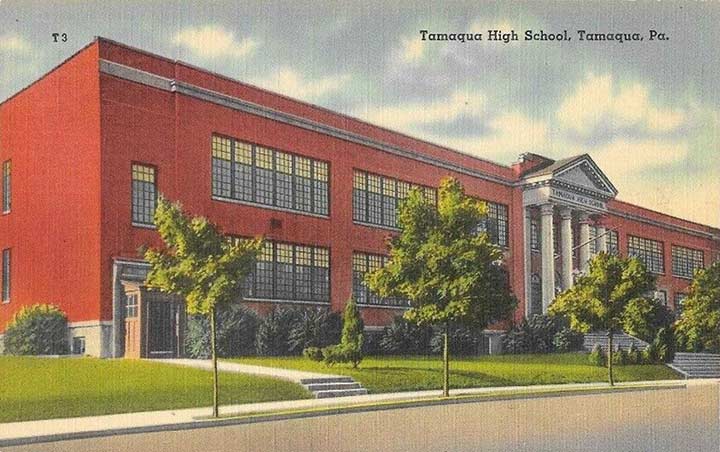
How I spent my Junior High years: On the left, the ancient original high school on Broad Street in downtown Tamaqua, which we closed down in seventh grade; on the right, my eighth grade home, the second High School, which became the Junior High, on High Street in the South Ward.
In 1967 I entered my first year of Junior High, a daily adventure that began and ended each day with a hike from my home near the top of North Ward, down the hill (always fun in wintertime!) to the middle of downtown Tamaqua, and an ancient and decrepit building that was in its final year. (I vaguely remember one of the last days in that building before the summer break, when a corner of one of the classrooms was covered with swarming termites, almost like they sensed the end was near.) While I had to carry a lunchbox to sixth grade, in seventh grade we were bon vivants, living high on the hog, sometimes lunching at one of the local “fine dining” establishments, like the S&A, or the Royale, right near the Junior High building. At the S&A (which stood for Stan & Ann, I believe, after the owners), we dined on French fries with gravy; the Royale was remembered mostly—by me, at least—for its Cherry Cokes in a styrofoam cup with crushed ice (why does every drink taste better over crushed ice?). I’m sure I didn’t go to either of these places every day, maybe just once a week, probably on Friday (which was payday for my Dad, his cash pay—$125/week!—given immediately to my Mom and placed in a kitchen cupboard), but I don’t remember carrying a lunch to school (along with a big ol’ stack of heavy books; we didn’t have book bags or even backpacks—the only people who had backpacks in 1967 were soldiers and hobos). My Munsters lunchbox from sixth grade, the one that took me forever to decide on, was long gone, the victim of an errant dog who used it as a toilet one warm spring morning while it sat on the sidewalk waiting for the bus. (Must have been the scent of my usual Skippy peanut butter sandwich inside that attracted him.) Besides, as a bonafide seventh grader, I was too cool for a Munsters lunchbox. Carrying a brown paper bag was almost like being a hippie!

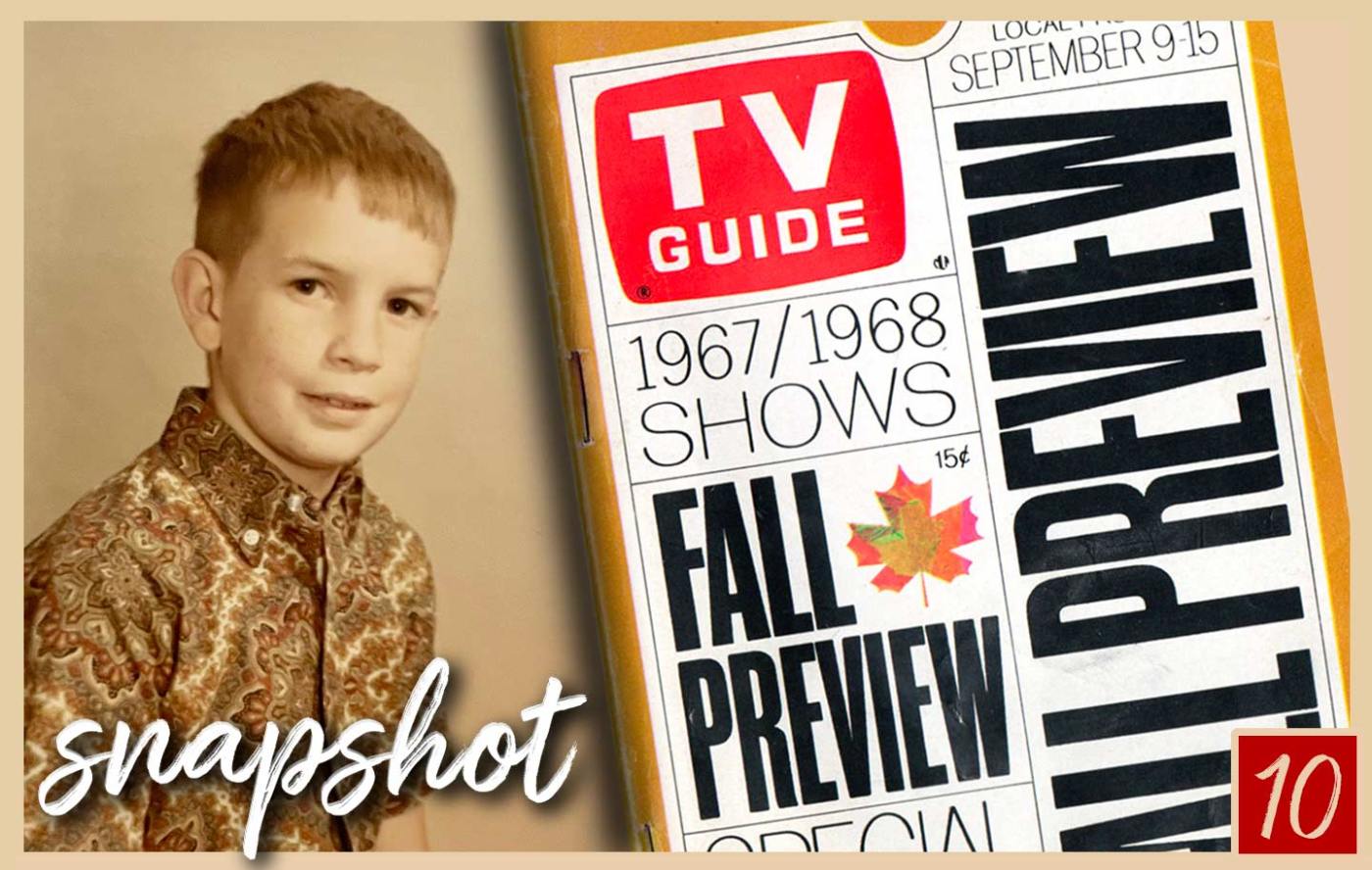
The reclaimed issue, from September 1967. I don’t know who you are Mrs. Reinard, but thank you for taking such good care of your TV Guides.
But no matter how I felt about Junior High, there was one other escape valve waiting for me each day: Television. One other lasting memory I have of this time of year—early September—is of the Fall Preview issue of TV Guide, which ran down the coming schedule for the 1967-68 year. Recently, someone jogged that memory when they wrote about these special issues in a post on Instagram, and as I am wont to do—especially at 3:00 AM, when I can’t sleep—I promptly went on eBay and searched “TV Guide Fall Preview” and found a reasonably priced issue from 1967 that featured the Philadelphia TV stations (“Mid-Atlantic Regional Edition” I believe they called the one that had both the Wilkes-Barre/Scranton and Philadelphia stations; the one I bought off eBay is the “Philadelphia Edition”) that we watched every day. We were early adopters of cable TV in Tamaqua, “Blue Ridge Cable,” to be exact, one of the first cable companies in the country, and that arrangement meant we had Philadelphia stations for part of the day and Wilkes Barre/Scranton stations the other part, when the respective network affiliates mirrored each other. (News-time, like 6:00-7:00 and 11:00-11:30, usually had the Philly station broadcasts, at least in the 1960s, probably because it was a superior product.) So seeing all these familiar call letters—KYW, WCAU, WFIL (the NBC, CBS, and ABC affiliates, respectively)—made this particular purchase even better. Philly had a couple of independent stations, too—WPHL, WIBF, and WKBS—but they didn’t compare to the indy stations out of New York City that we also got with our cable TV monthly subscription: WOR, WNEW, and WPIX. We also had WGAL out of Lancaster, PA, and a local (Scranton-based) PBS station, which regularly showed Monty Python, but that mind-blowing program was a bit in the future.
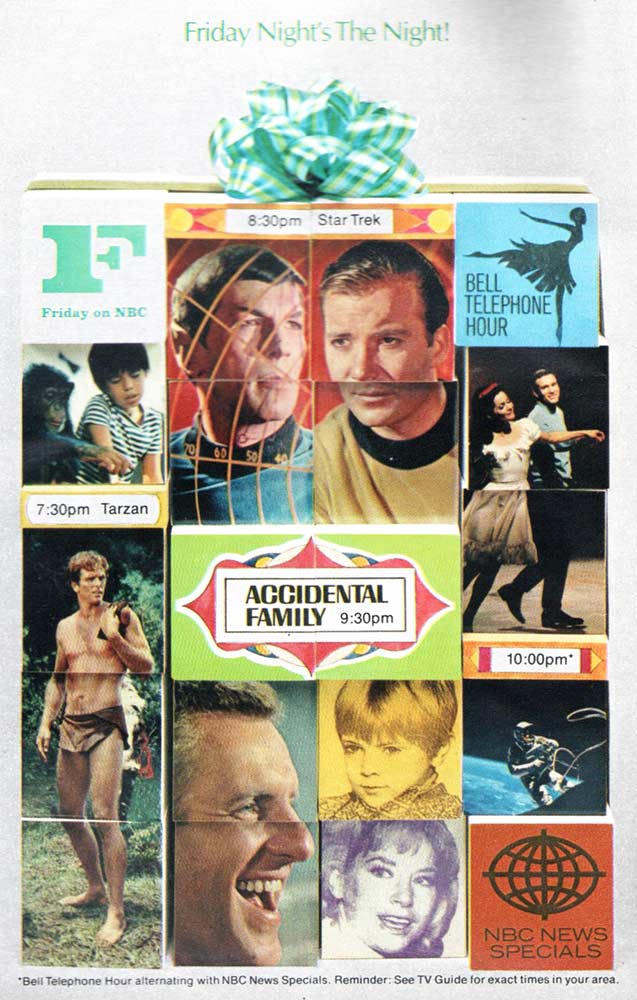
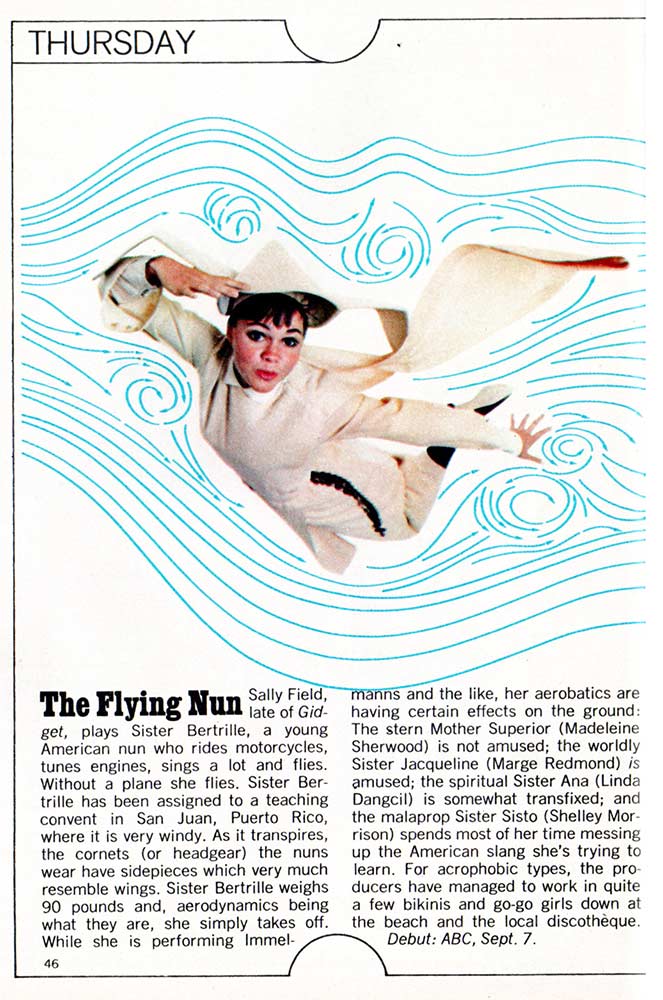

An NBC ad (they had a seven-page ad in the front color section); everybody knows Star Trek, but what the hell was Accidental Family? Sally Field’s Gidget became The Flying Nun for a season or two, and Raymond Burr’s Perry Mason became Ironside. TV was all about familiarity, if anything.
By the time the 1967 season rolled around, the TV Guide Fall Preview Issue was something special. It revealed all the new network TV shows in detail, with either a half- or full-page entry, including a full-color photo. It had articles on upcoming movies on TV, too; big screen movies were still a big thing on TV … there was no other way to see them, pretty much, once they left theaters; no VHS, no DVD, and no streaming, of course. This particular issue of TV Guide touted the two-night premiere of The Great Escape on CBS, a movie I was dying to see in a movie theater in 1963, but was deemed “too grown-up” for me when we were on vacation in Asbury Park, NJ the summer it came out, so my Dad and older brother went to see it, leaving me with my Mom on the beach. I do remember being sufficiently “grown-up” enough four years later to watch it on TV, even if I did have to stay up past my usual 10:00 PM bedtime to experience both nights (luckily one one of those nights was a Friday).
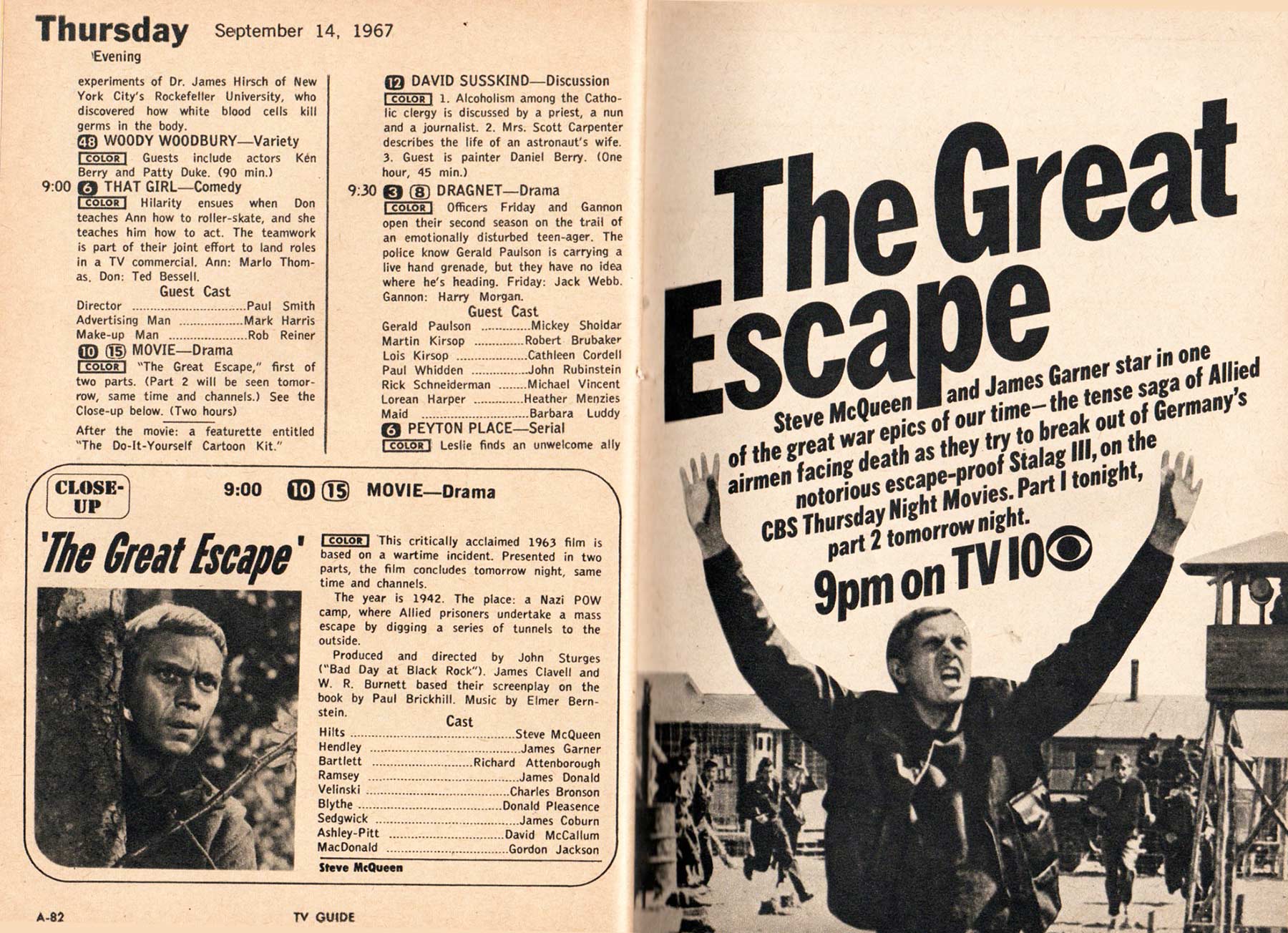
The Great Escape premiered on TV on Thursday, September 14th, 1967, with a big two-night special broadcast, stretching the movie’s length to four hours. I finally got to see it for the first time.
The Fall TV season that TV Guide previewed in its September 9-15, 1967 issue was pretty special, content-wise, for someone my age. Batman was in its third and final season, winding down to only one night from its original two-episodes per week schedule when it premiered in January of 1966 (its first season ran until May 1966, it’s second from September ’66 to May ’67). This season introduced Yvonne Craig as Batgirl, adding a redhead to my list of favorites on TV, women that made me wonder what exactly was going on with the way I felt when I saw them (the other two were Mary Tyler Moore—a brunette—and Elizabeth Montgomery of Bewitched, a blonde).


As far as I was concerned, these were the real “Temptations” appearing on 1960s TV, not the soul group from Motown which showed up regularly on The Ed Sullivan Show. Left to right, Elizabeth Montgomery of Bewitched, Mary Tyler Moore of The Dick Van Dyke Show, and Yvonne Craig of Batman.
There were a number of shows on in 1967 that appealed to the fanboy in me, including Star Trek (in its second season on Friday nights on NBC), and Tarzan starring Ron Ely, also in its second—and final—season. Neither show was a favorite, but I still watched them regularly. There was also Lost in Space (“DANGER, Will Robinson!”) and The Invaders, two series that solidly landed within the realm of what my Dad called “kook shows;” I could take them or leave them, to be honest. I enjoyed the World War II dramas Garrison’s Gorillas and The Rat Patrol. Comedy-wise, CBS’s line-up of “rural” sitcoms like The Andy Griffith Show, Gomer Pyle USMC, The Beverly Hillbillies, Petticoat Junction, and Green Acres still ruled and we watched them all, even if I did want to strangle Mr. Haney every time he came on screen on either of the latter two shows’ connected universe; that guy was like fingernails on a blackboard to me. The Man from U.N.C.L.E. still scratched my James Bond itch, as did the weird and interesting The Wild, Wild West with Robert Conrad as a kind of secret agent in the Old West. I didn’t appreciate Mission: Impossible as much as I should have, I suppose; it was a bit too complicated for me at that age. Detective shows also were common (two new shows, including Mannix and Ironside, the latter with Perry Mason star Raymond Burr, premiered in 1967 … both would last for years to come), and Westerns still dominated the fall line-up (Bonanza and Gunsmoke remained the big two), including a new show called Custer, which lasted just about as long as the General did at the Little Big Horn. In fact, there were 12 Westerns on the air that year, if you count The Wild, Wild West.

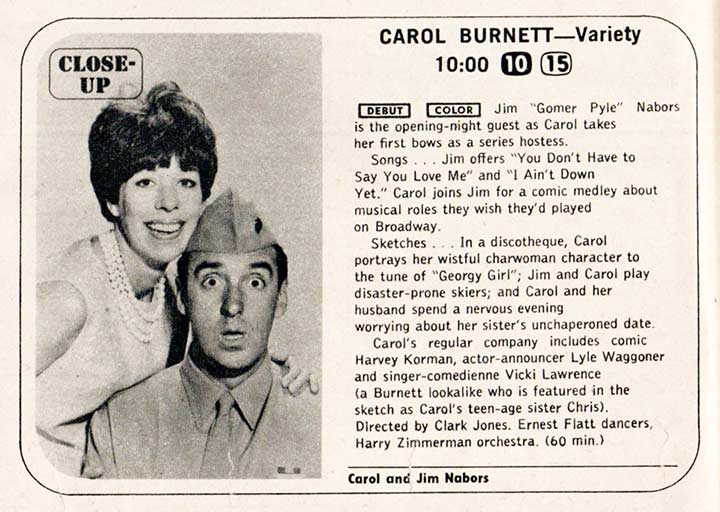
The Carol Burnett Show was eagerly awaited by the editors of TV Guide … and me.
One of the more interesting shows to me that premiered in September 1967 was The Carol Burnett Show. Up to this point, Burnett was a comedic actor who appeared on other people’s shows and specials, including The Garry Moore Show (a name now relegated to relative obscurity, but a definite force in 1950s-60s TV), and The Lucy Show, starring TV’s most celebrated carrot-top, Lucille Ball. The Carol Burnett Show was one of the great last gasps of the variety show genre on network TV. Rowan & Martin’s Laugh-In and The Flip Wilson Show (a ground-breaker) would follow, but the format was dying, soon to be replaced by more sophisticated comedic vehicles like All in the Family and The Mary Tyler Moore Show. Still, in 1967, the networks’ schedules were dominated by variety shows like Hollywood Palace, The Dean Martin Show (my Mom’s favorite), The Red Skelton Hour, Kraft Music Hall, The Bell Telephone Hour, The Lawrence Welk Show, and an outlier called The Smothers Brothers Comedy Hour, the polar opposite of the baton-waving Mr. Welk. I still think The Carol Burnett Show was one of the funniest variety shows ever on the tube, and one of the more consistent, due to the chemistry of Ms. Burnett, Harvey Korman, Vicki Lawrence, and—of course—Tim Conway. Just watch this famous sketch, and yes, I know, Nazis and Hitler shouldn’t be regarded as funny, but it was a different time and place, and Conway making Korman lose it is priceless.
Finally, the 1967 TV Guide Fall Preview graced us with its “Nighttime Network Shows at a Glance” schedule grid, something that was not dissimilar to my own Comic-Con programming grid years later, perhaps even the inspiration for the color version that debuted in Comic-Con’s Quick Guide almost 45 years later. The TV Guide version conveniently highlighted all the new shows in yellow, just so you could easily pick them out. The Fall Preview issues were standouts and I saved those issues for years to come, glancing through them from time to time, just to remember all those fallen soldiers, the shows that lasted just a season or two. So much promise, cut down in their prime.

TV Guide died for me when it dropped its digest-sized format and became a full-fledged, full-color, glossy-papered magazine, an unfortunate change that had to be done. The digests were such a warm, familiar part of my childhood, something my Mom picked up each week from the newsstand or the check-out line at the Acme supermarket (we didn’t want a ripped-up subscription copy sent through the mail each week; we wanted a pristine, brand-new, mint copy; I often felt the mailman took out his frustrations on having to carry the extra burden of this little magazine by doing his best to damage them). I poured over each issue once it came out of the brown paper grocery bag, but you had to be careful to make sure the bag-boy didn’t put it next to the milk or the frozen TV dinners … it would get all wet!
Looking back at this virtual time capsule, I’m struck by how few viewing choices we had, but how much more special they all seemed. Nowadays, the choices are endless, and even so, there are nights that I just don’t want to take the time to search for something to watch on Netflix or Prime or Max or Hulu or BritBox or all the +s: AMC, Apple, Disney, Paramount, etc (I am, in fact, cutting way back on my streaming options). We had fewer choices but we appreciated them more for that very simple reason. Color TV was still relatively new, our giant Admiral console set seemed like something sent to us from the future (if only we knew how many people would be streaming TV shows on their much smaller phones and tablets and laptops almost 60 years later), and yep, most of those shows were dumb and chintzy looking, but some of them were true classics, definite memory-makers. And while I will argue until I’m blue in the face that Breaking Bad is the best show ever on TV, I’m still mighty fond of the shows I watched in the fall of 1967 and how TV Guide previewed them for me in their special Fall Preview issue that year and every other one. I’m glad I could recapture a little piece of that with just one eBay purchase.
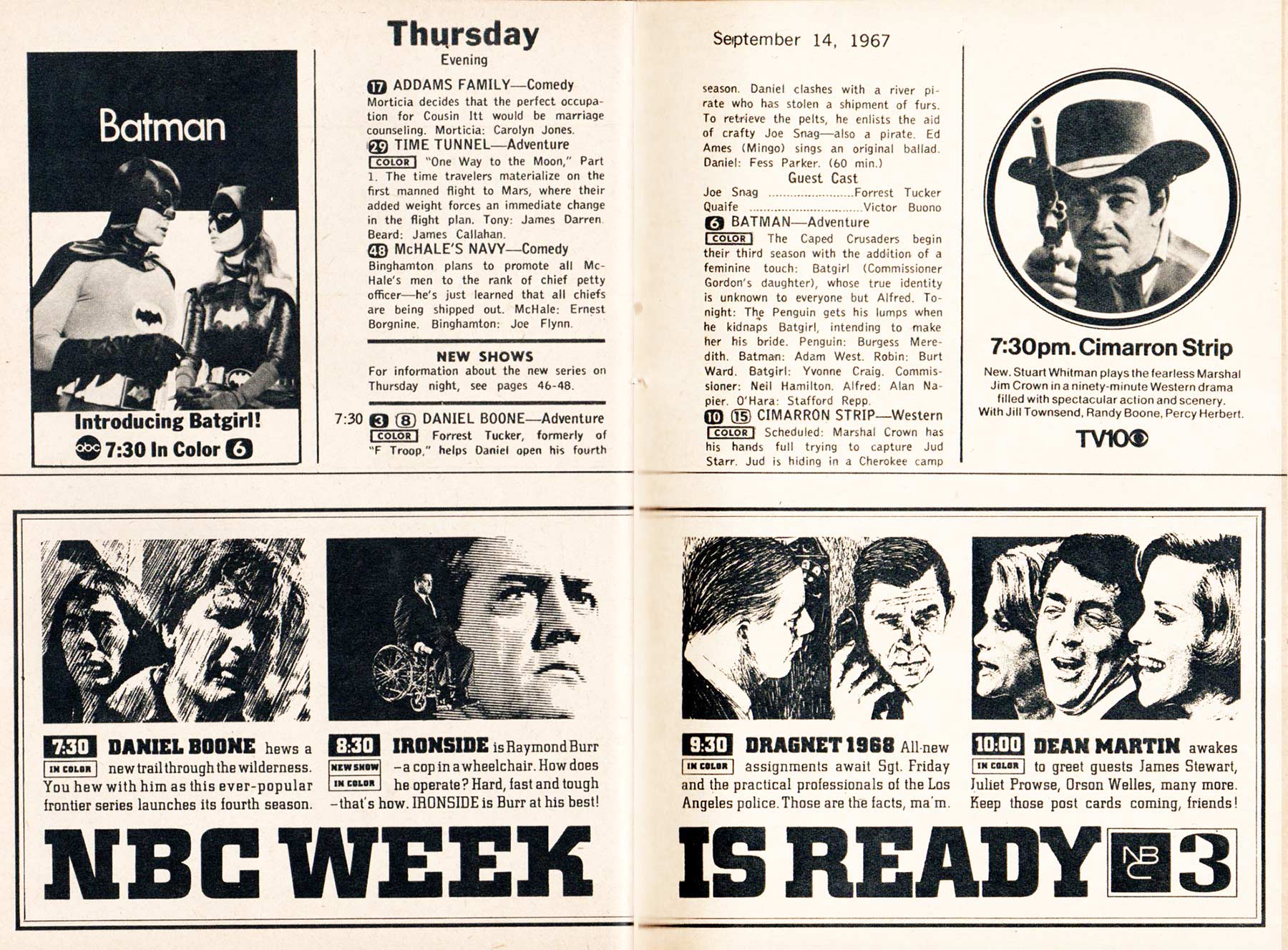
This is what the “heart” of TV Guide looked like in 1967. The black and white newsprint pages were the regional listings, where you’d find the day-by-day, hour-by-hour schedule for your local stations.
 @innocent-bystander.com
Leave a comment