
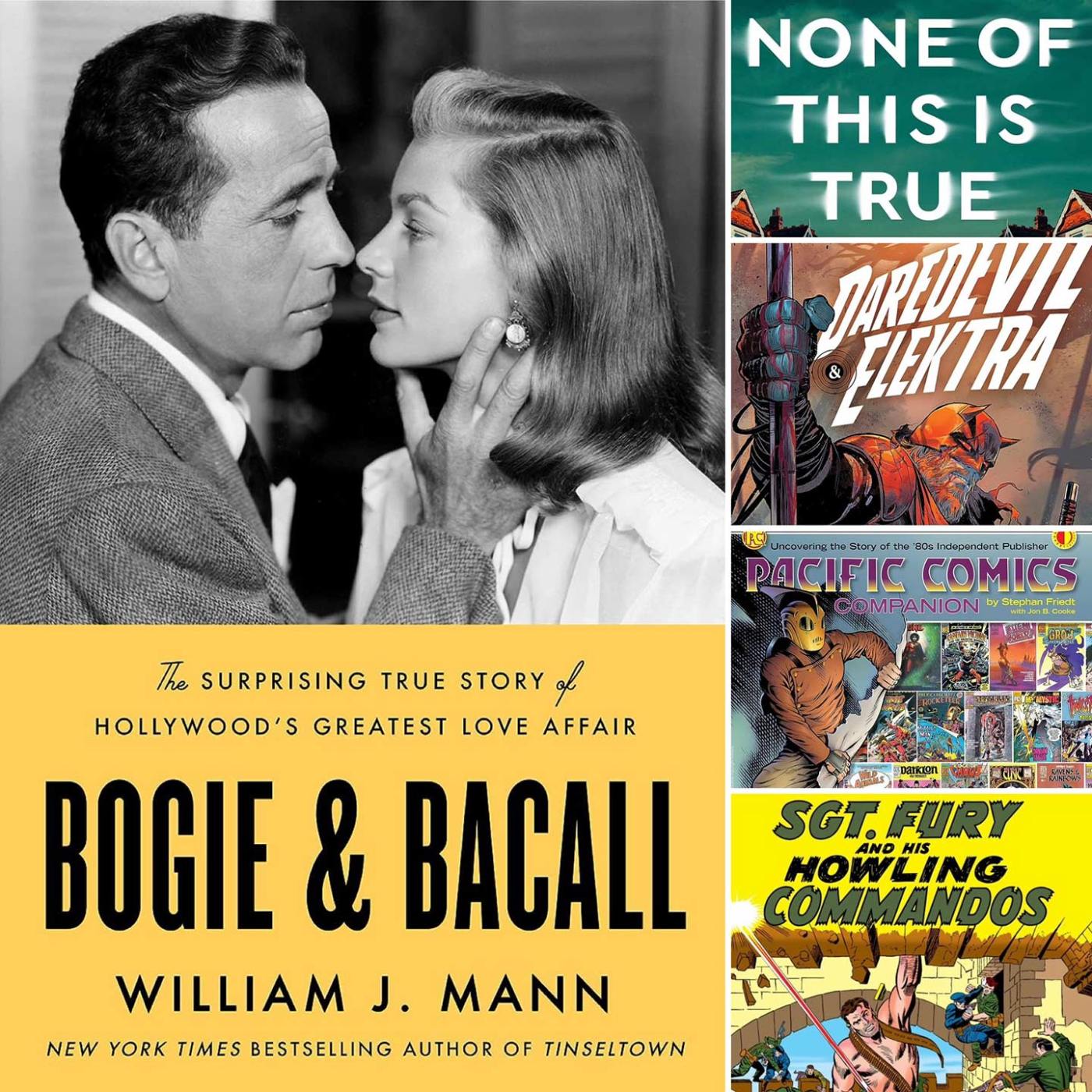
After the insanity of Comic-Con last month, August was a relatively quiet month with just two “real” books and three graphic novels read by yours truly. I’m slowin’ down in my old age, folks, but I’m still on track to hit my GoodReads goal of 75 … I hope!
Bogie and Bacall: The Surprising True Story of Hollywood’s Greatest Love Affair by William J. Mann
This warts-and-all dual biography of one of Hollywood’s most enduring couples attempts to tell the true stories of both Humphrey Bogart and Lauren Bacall and their short married life together. Author William J. Mann does an admirable job chronicling both their lives, separate and together. The bulk of the book covers Bogie’s slow rise to fame and his tortured life, which included an unloved childhood with indifferent parents, eventual alcoholism, four wives, and a horrible fight with cancer which ended his life at the age of 57. Bacall lasted a lot longer, but over the years she guarded both Bogart’s legend and her own to the point that this is probably the most honest account of both of them ever published. It’s a long and dense read, and it pretty much takes no prisoners, but never comes across as judgmental or ill-tempered. I enjoyed Mann’s Tinseltown, which focuses on scandal in the beginning years of Hollywood, and I’m always up for a dishy, well-researched movie history book; this certainly fits that bill.
None of This Is True by Lisa Jewell
Lisa Jewell is to summer reading for me as Michael Connelly is to fall; each brings a solid, enjoyable novel into their own season, and it’s as dependable as clockwork. This one is hard to explain, though, but let it be said, I think it ranks up there with my favorites, which include I Found You (the first Jewell book that I read) and Then She Was Gone. The central characters are Alix, a successful podcaster with a rich, real estate agent husband who caters to her every whim (except when he’s binge-drinking and disappearing for days on end), and Josie, a woman with a troubled home life with her creepy, much-older husband and two daughters, one a virtual prisoner in her bedroom and the other gone missing years ago. Josie meets Alix at a posh restaurant where they’re both celebrating their 45th birthdays, and manages to attach herself to Alix like a malevolent barnacle. And Alix’s life gets worse from there. As usual with Jewell’s books nothing and no one is what they seem to be. Let me put it this way, if someone ever approaches you anywhere—especially in a posh restaurant—and says, “HI! I’m your birthday twin!” run like hell. This is prime Lisa Jewell. And even though I will more than likely read it, I’m a bit disappointed to find out that next summer’s Lisa Jewell book will be based on Marvel’s Jessica Jones … and I’m a life-long comic book fan, to boot!
Daredevil & Elektra: The Red Fist Saga Part Two by Chip Zdarsky and Marco Checchetto, et al
Boy, I hated this book. Zdarsky should have quit the Daredevil series after the Devil’s Reign “event” arc, while he was ahead. Instead we’re left with a mystical Daredevil with supernaturally boosted powers and Elektra as his counterpart DD. They’re on an island, trying to reform Z-level Marvel villains, because as DD puts it in issue #8 (this volume reprints issues #6 to 10), “There are evil actions, but no evil men. Just people who have lost their way.” (Hitler evidently didn’t exist in this version of the Marvel Universe.) I don’t like the supernatural trend in comics these days. Batman in Detective Comics and World’s Finest seems to be heading that way, now here’s Daredevil—an urban, gritty, down-to-earth hero with an unusual power—going the same route. Maybe it’s all those James Tynion series where something is killing the children at the house by the lake or whatever, but it’s not for me. Checcetto’s art is still great—when he actually draws the book; it seems like only two of the issues in this collection are totally by him. Zdarsky has already ended his run on DD with issue #14, which means the third and final volume of this story arc—which features an also supernaturally-enhanced Punisher, who just wants to kill EVERYBODY—will be a slim four issues, for which Marvel will undoubtedly charge $15.99. I love Zdarsky’s work on Batman and Public Domain, and I enjoyed his noir series, Newburn, too. I’ll spring for the last DD trade, just to close the circle on his run on this character, but I doubt very much that I’ll enjoy it, sad to say.
The Pacific Comics Companion by Stephan Friedt with Jon B. Cooke
Hot on the heels of The Charlton Companion comes another dense, art-filled comics history book from TwoMorrows, The Pacific Comics Companion. I was lucky enough to purchase an advance copy of this book from the company at Comic-Con 2023, and I’m very glad I did. While Pacific Comics certainly doesn’t have the longevity or diversity of Charlton, it’s nonetheless a fascinating story. Two San Diego brothers, Bill and Steve Schanes, started as comics collectors and retailers, built their own distribution company and then went into publishing. And while some amazing books and characters came out of Pacific in the short time it existed—like The Rocketeer by Dave Stevens and Captain Victory by Jack Kirby, one of his final ongoing titles—along with books and series by artists such as Neal Adams, Steve Ditko, Mike Grell, and Berni Wrightson, to name just a few, the marketplace worked against them and Pacific flamed out pretty quickly. Both Friedt and Cooke (who does his usual exemplary job on design and production) tell the tale of PC very thoroughly; the wealth of cover and art reproductions (along with a comprehensive checklist) is worth the cost of the book alone. Another fascinating comics history book from TwoMorrows!
Sgt. Fury and His Howling Commandos Epic Collection Vol. 2: Berlin Breakout by Stan Lee, Roy Thomas and Dick Ayers
This second Epic Collection of Fury and the Howlers reprints issues #20 through 36 and Annuals #1 and 2, a solid, if a bit stolid group of books. Sgt. Fury doesn’t really start howling—for me at least—until the war team supreme of Gary Friedrich, Dick Ayers, and John Severin take over with issue #44, and then there’s about a 35-issue run that’s just wonderful. Roy Thomas takes over the scripting of Fury in this volume with issue #29, his first regular scripting gig after some other earlier work at Marvel, including an Iron Man story, some Doctor Strange scripts over Steve Ditko plots, and the ubiquitous—and lovely, I’m told—Millie the Model. (Everybody loves Millie.) I always liked Sgt. Fury more than DC’s Sgt. Rock (although in retrospect, that Joe Kubert and Russ Heath art is ridiculously great), and when Stan Lee and Jack Kirby updated Nick Fury and made him a super-spy around this time (1965-66), I was in seventh heaven. I was very surprised and pleased to see a second Fury Epic Collection, especially in this 60th anniversary year for the title, since I doubt reprints like this are burning up the sales charts. Good but not great, this volume is an example of war, Marvel-style, and Ayers certainly went down in history as THE Sgt. Fury artist. WA-HOOO!
 @innocent-bystander.com
Leave a comment