
Click on the images above and below to see them larger on your screen!
Let me set the scene for you …
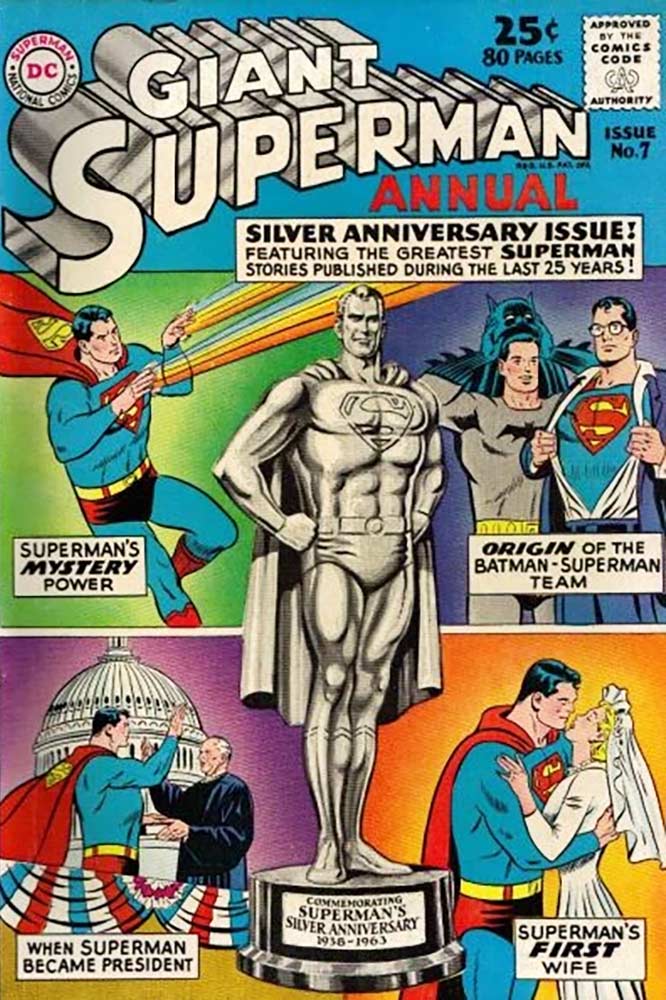
It’s the summer of 1963 and three long months of relative freedom extend before me. School is out and it’s four months before the US will change forever. Things to look forward to: Our annual vacation in Asbury Park, NJ in August, just a few short weeks before school—third grade for me—starts again on the Wednesday after Labor Day. Oh, yeah … and comic books. Lots and lots of comic books. DC has already jumped into summer with the release of Giant Batman Annual #5 in May, followed by Giant Superman Annual #7—with that stunning Curt Swan statue cover, celebrating the character’s 25th anniversary—in June. Still to come, the first Giant Flash Annual in August. But in the meantime, the “Marvel Age of Comics” was revving up its engines and its first two annuals featuring the Fantastic Four, and the Human Torch and Spider-Man, were the best books of the summer of ’63, at least to eight-year-old me.
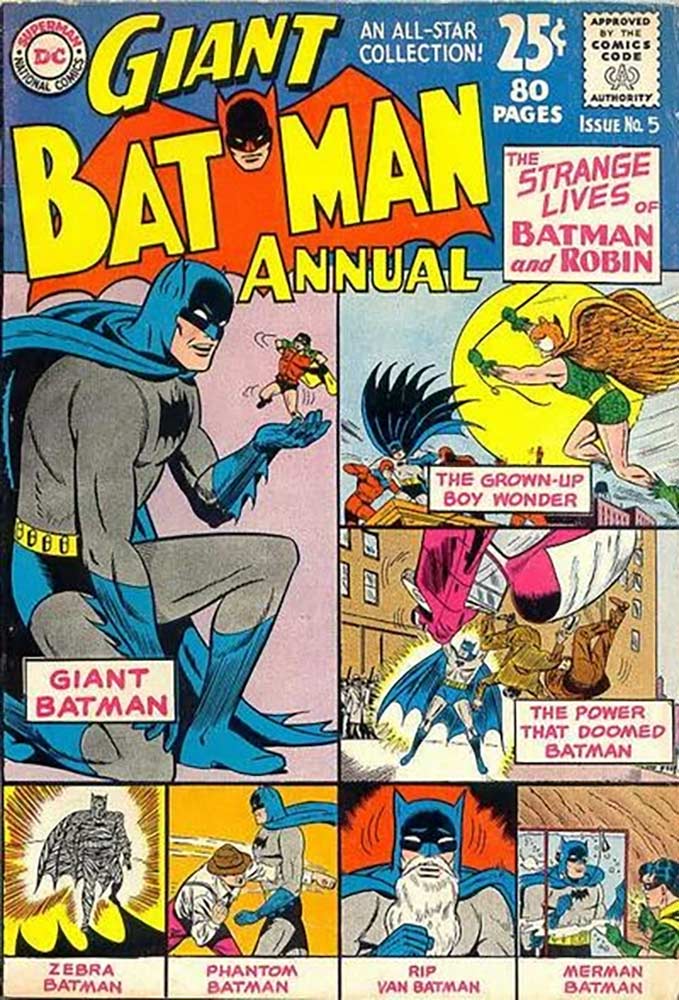

DC’s summer of 1963 Annuals. TM & © DC.
Yep, every summer from around 1962 through 1968 was what I like to call “Annual Season,” filled with surprise bonus books that cost more, but—at least for those years—were worth every penny, especially the ones from Marvel. Stan Lee and company put a lot into their annuals, making all of them special in those years. In fact, they weren’t even really called “Annuals” for some of those years; Marvel preferred “King-Size Specials,” perhaps in deference to DC’s “Giant Annual” nomenclature. After all, don’t tick off the company who is distributing your books.
I’m pretty sure the first Marvel Annuals were part of the usual reaction of Martin Goodman to what other publishers—especially DC—were doing. He probably somehow saw the sales figures—or that enticing 25-cents price tag—on the Giant Superman and Batman Annuals and told Stan, “We need to publish annuals, too.” But the concept of the comic book annual—or larger format publication—wasn’t new; in fact it dates back to almost the beginning of the comics industry.


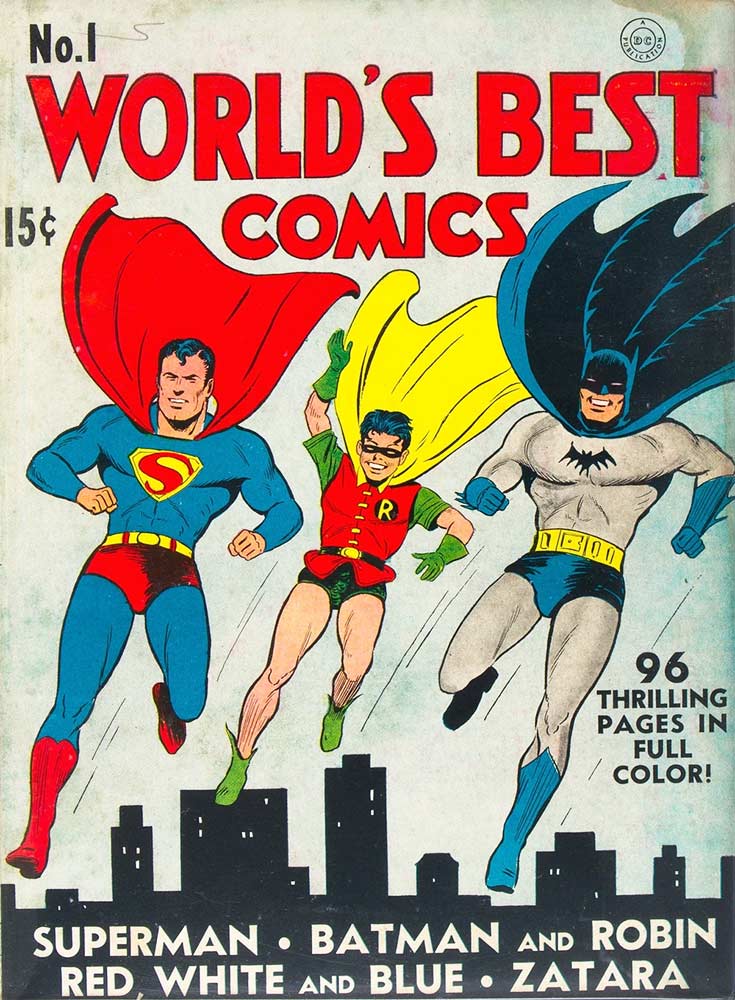


The larger format annual was created by DC for the New York World’s Fair and continued after as a regular, quarterly book, ultimately titled World’s Finest. DC’s sister company, All-American Comics, also got into the act with The Big All-American Comic Book in 1944 and the ongoing Comic Cavalcade, which featured 96 pages for 15 cents. TM & © DC.
The first real comic book annuals were published by DC way back in 1939 and 1940. They were promotional comics created for the New York World’s Fair, featuring DC characters and titled (duh) New York World’s Fair Comics. Each issue was a whopping 96 pages for 15 cents, simultaneously both more (page count-wise) and less (price-wise) than the 1960s incarnation of the annual. The books proved popular enough to produce an ongoing series, first called World’s Best Comics, which immediately became World’s Finest with issue #2. It maintained the 96 pages and 15-cent cover price and was published quarterly.
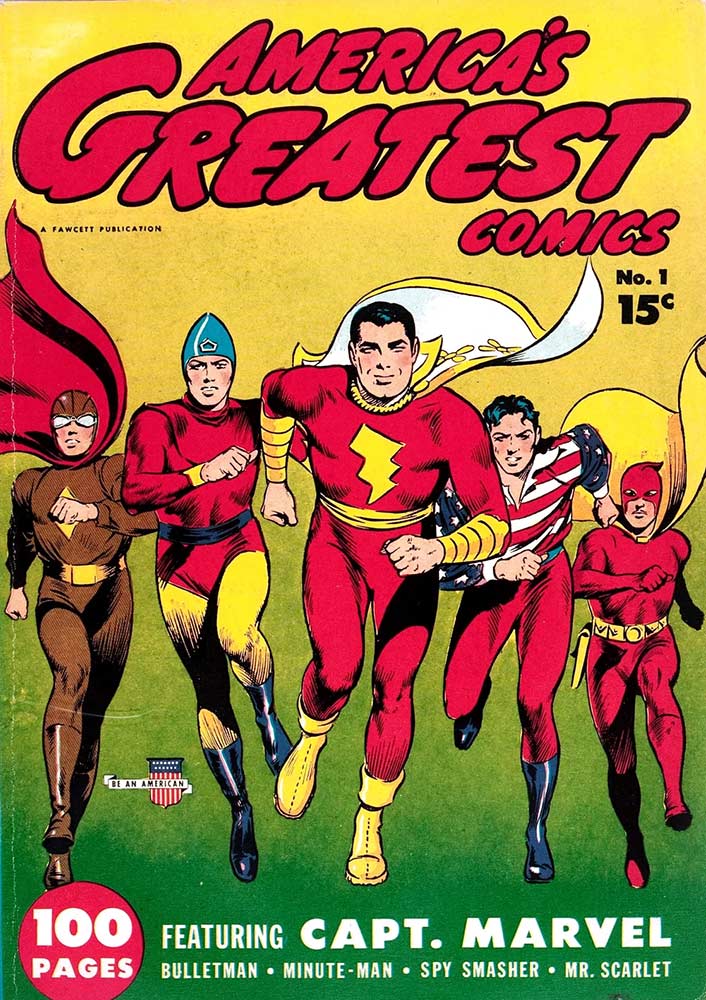


Fawcett’s whopping larger format collections included new stories in America’s Greatest Comics and bound-together returns in books like Xmas Comics and Gift Comics. TM & © DC.
Not to be outdone, Fawcett Comics, the home of Captain Marvel and his extended Marvel Family, countered with America’s Greatest Comics, keeping things a little bit closer to home. First published in 1941, AGC clocked in at 100 pages for 15 cents, and featured the whole Fawcett line-up, including the Big Red Cheese himself, Spy Smasher, Bulletman, Minute-Man, and, of course, the absolutely unforgettable—and way ahead of their time—Mr. Scarlet and Pinky. It lasted only eight issues, probably a victim of World War II paper shortages. Fawcett also collected returned (unsold) comics and published them as giant books, variously called Xmas, Gift, and Holiday Comics. Xmas Comics started in 1941 and was an incredible pre-World War II 324 pages, as was issue #2; both were priced at a very pricey (for that era) 50 cents. It stopped publication until 1947, probably due to wartime paper shortages, but returned in 1947 with a much more manageable 196 pages. It continued for four more issues from 1949 through 1952 at that page count and the 50-cent cover price.


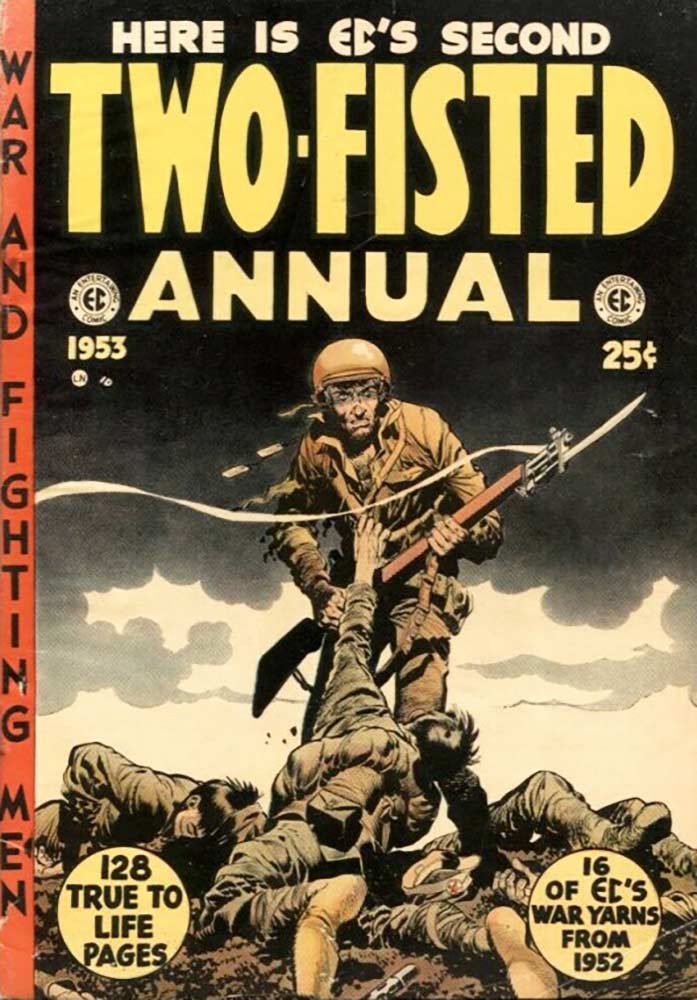
EC’s annuals were also collections of unsold comics, bound under new covers. TM & © William M. Gaines Agent, Inc.
EC Comics published their own annuals in 1952 and 1953 and, like Fawcett, used the returned comics model of collecting comics (four issues) under a new cover. Each EC Annual was different. As editor Al Feldstein put it: “The Annuals were made up of ‘full copy’ returns stored in warehouses. When we had enough of them, I’d do a cover and we’d bind in four issues with a new cover. The selection was random, so your copy of Tales of Terror #1 might be different from my copy of Tales of Terror #1.” There were three Tales of Terror Annuals, two Weird Science-Fantasy Annuals, and two Two-Fisted Tales Annuals.


In the 1950s, giants walked the Earth, at least from various comic book publishers. Covers TM & © Respective Copyright Holders.
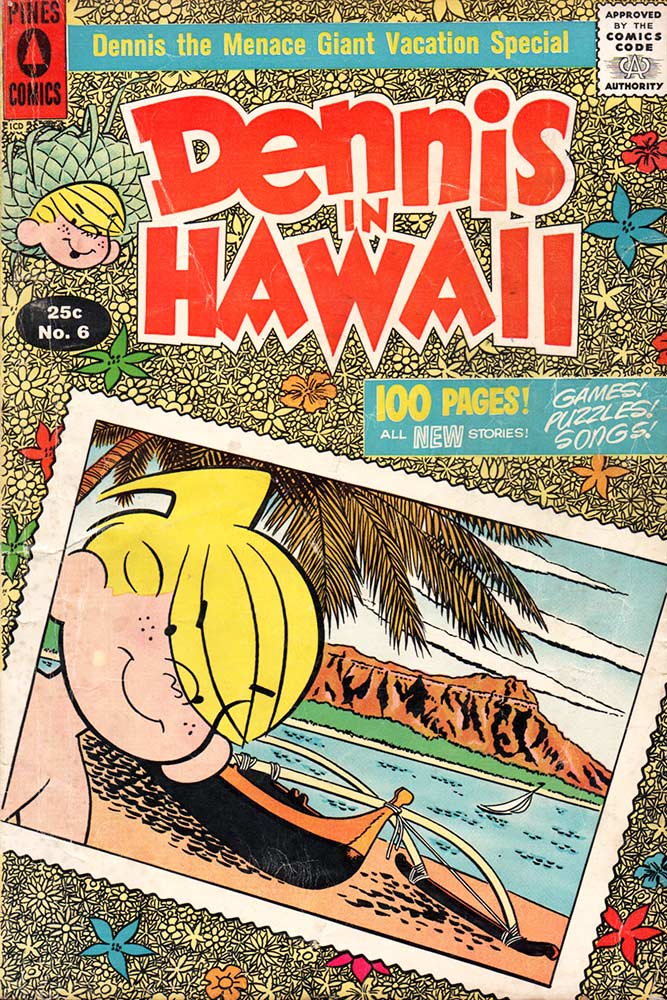
Flash forward to the late 1950s and early 1960s and numerous comics companies jumped on the 25-cent giant format, including Dell and Harvey. There were Dell Giant issues for a lot of the company’s licensed comics (before they defected to Western Publishing’s new imprint, Gold Key Comics), and a 35-issue series of books numbered as Dell Giants. Harvey had Harvey Giant issues for a lot of their kiddie properties (Casper, Richie Rich, Hot Stuff) and their licensed newspaper strip reprints like Dick Tracy and Joe Palooka; in fact all of those strip reprint books ended their runs at Harvey as “Harvey Giant” issues, including Dick Tracy #141-145 (my own particular favorites). The Dennis the Menace 100-page specials were truly special. I still have copies of Dennis’s visits to Hawaii, Hollywood, and Washington DC.
But it was DC Comics that jumped into the fray in 1960 with their Giant Superman Annual #1, which was published on June 23 of that year. Cover-billed as “An All-Star Collection of the Greatest SUPER-stories Ever Published!”, the truth of the matter is this was a pretty lackluster collection, dating back only a few years in its choice of reprint material. New material in the form of special features was limited to a half-page flag of Krypton, a two-page spread Map of Krypton, a three-strip reproduction of Superman daily comic strips (in black and white on the inside back cover), and a look back at “Famous First Issues!” on the back cover, showcasing the covers of Superman #1, Superboy #1, Superman’s Pal Jimmy Olsen #1, and Superman’s Girl Friend Lois Lane #1 … “Save these souvenir covers!” proclaimed the cover text, along with the original publication dates of each book.

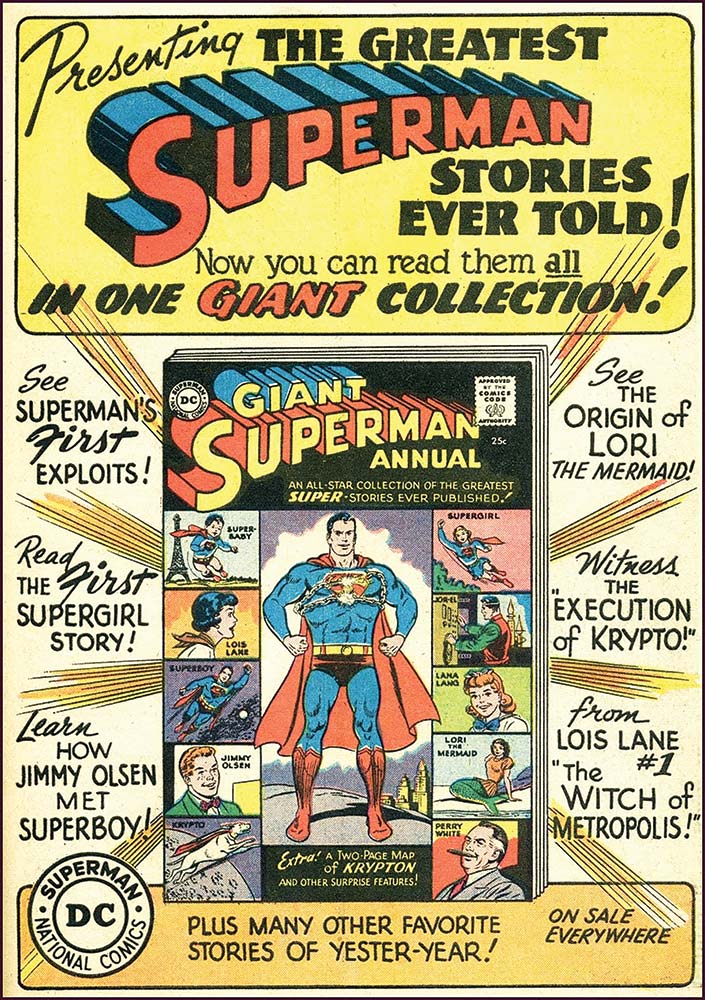

DC Comics set the stage in 1960 with their publication of Giant Superman Annual #1 with that iconic Curt Swan cover. More Giant Annuals followed. TM & © DC.
In retrospect, Giant Superman Annual #1 wasn’t exactly a great book, but many fans of that era cite it as particular favorite, including me. I remember spotting it at my local newsstand, apart from the regular comic book racks, tucked away in a large stack in a back corner of the shop. Maybe it was waiting there to be put in its proper place or maybe the owner didn’t quite know what to do with a 25-cent comic book, when all the others (save for a few Dell comics and Classics Illustrated) were just ten cents. In fact, if memory serves me correctly, those Classic Illustrated issues were also in the same place as the first Giant Superman Annual, so maybe it was a pricing conundrum for the shopkeeper. We’ll never know, since we’re talking about 60 years ago now.
Only that very first Giant Superman Annual was actually an annual; issues #2 through 8 came out twice a year, one in the summer and one around the holidays. By 1964, there were eight Superman issues published, and then DC took their annuals—which by then included Batman, Lois Lane, Flash, Secret Origins, and Sgt. Rock—and folded it into a separate series called 80-Page Giant; the first three issues (published in 1964) featured Superman (#1), Jimmy Olsen (#2), and Lois Lane (#3). That lasted for 15 issues, before the 80-Page Giants were again folded into the regular numbering of each series it was reprinting.
(I have recently fallen in love—yet again—with the Giant Superman Annuals, so you can expect a post just on those at some point, I’m sure. While I’m not too fond of the reprints contained therein, those Curt Swan segmented covers are just beautiful and call me back to a much simpler time each time I see them. I spent a good portion of Comic-Con 2023 looking for them, and between the San Diego Convention Center and eBay, scooped up and entire run of Giant Superman Annuals #1 through 8, plus 80-Page Giant #s 1-3.)
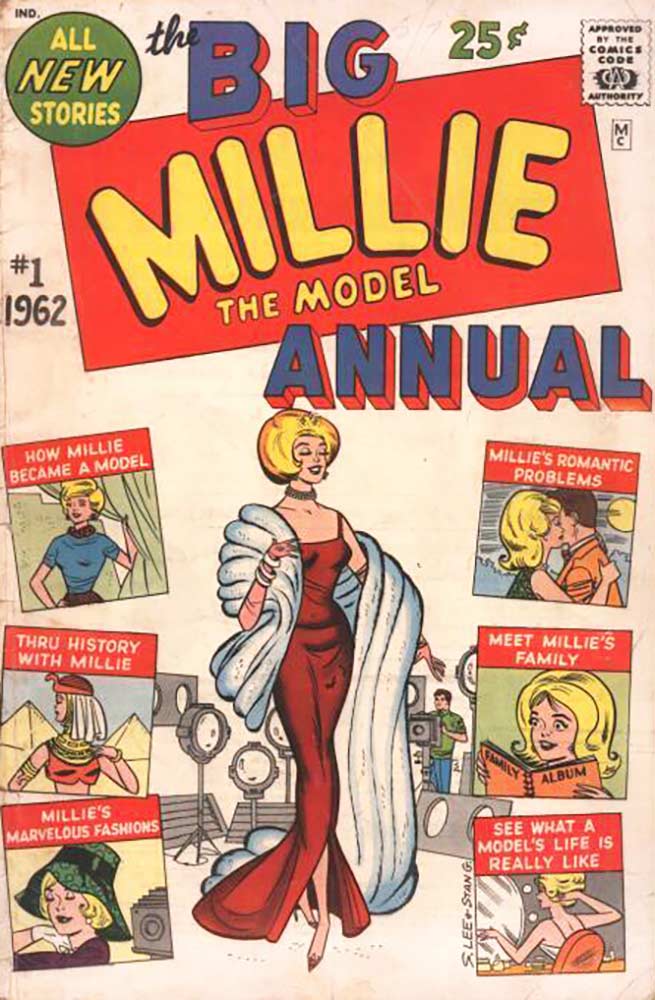

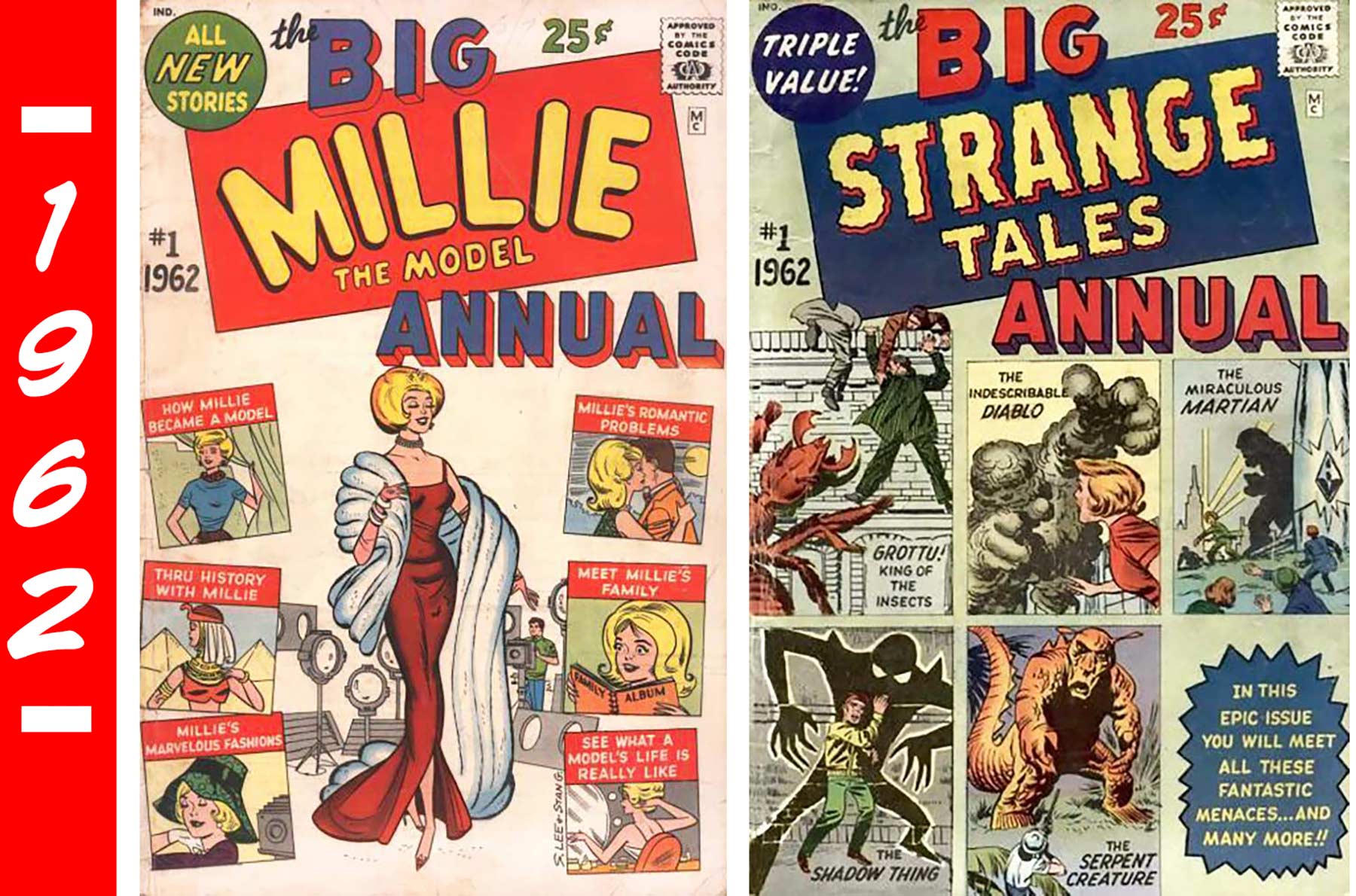
The first two Marvel Annuals appeared on the same day, July 3, 1962. TM & © MARVEL.
But back to that almost certain conversation about annuals between Martin Goodman and Stan Lee, which resulted in Marvel’s first annual, The Big Millie the Model Annual #1, which debuted on July 3, 1962 (I’m assuming the Annual was Big, not Millie). I don’t own this book, but the cover states it’s “All New Stories!,” which is something Marvel would lean more heavily into in their superhero annuals. The Millie—and Patsy and Hedy—books, had a lot of special feature pages in them, including fashion and hairdo designs, so I’m sure that was included. The all-new aspect for a 72-page book is something to note, though; DC certainly wasn’t doing that, except for a few special features.
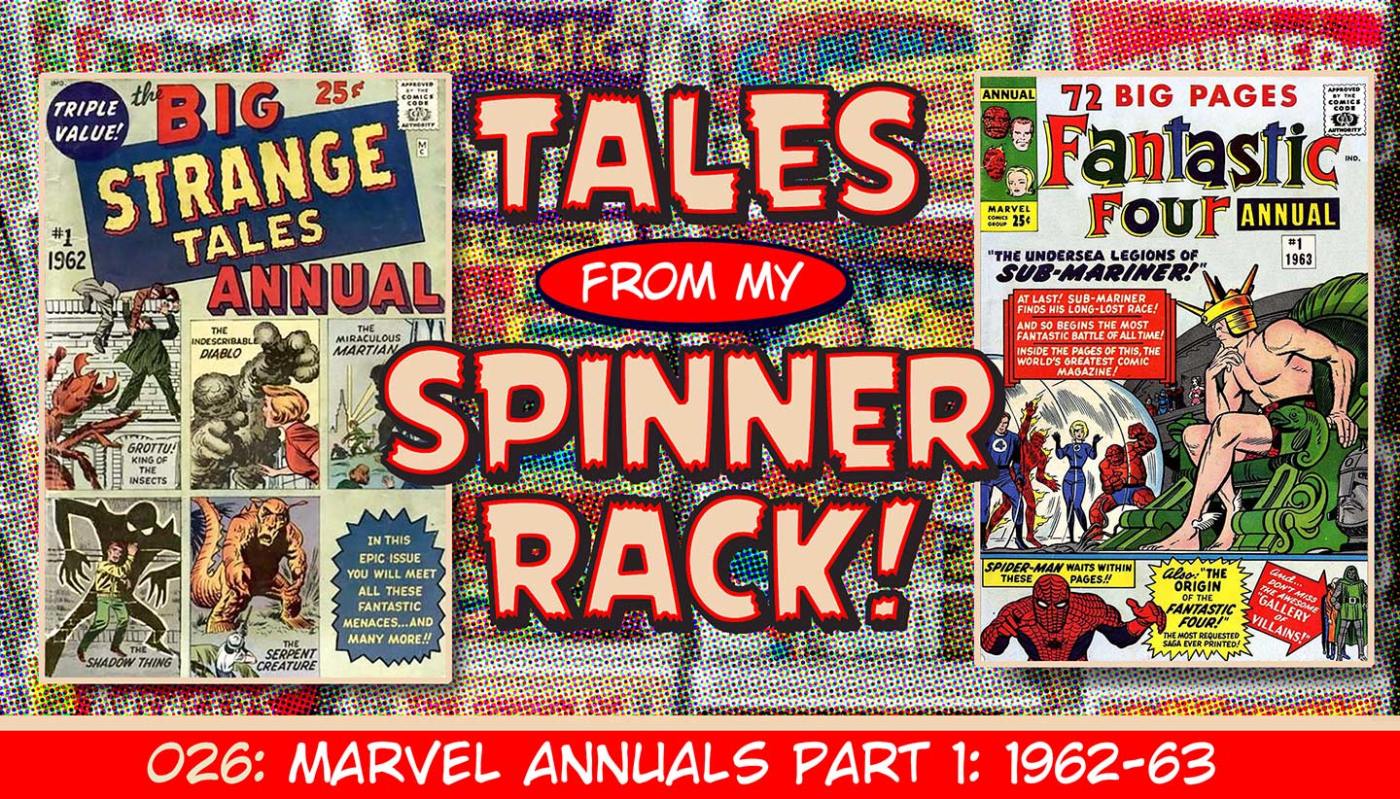
The Big Strange Tales Annual #1 also hit the stands on July 3, 1962, the same date as the first Millie the Model Annual. It included 13 different stories and despite the title, not all of them were from Strange Tales; these reprinted stories came from Journey Into Mystery, Tales of Suspense, and Tales to Astonish, in addition to the eponymous annual title. These tales—it’s up to you to decide exactly how “strange” they were—featured art by Jack Kirby, Steve Ditko, Don Heck, and Paul Reinman, to name a few, and most of them—if not all—were written by Stan Lee. It was billed as “Triple Value!” on the cover, and at 72 pages, I suppose that’s true. Note that it’s “Big,” but not “Giant” … evidently DC had the word Giant all sewed up. I guess “The Extremely Large Strange Tales Annual” would have been too much of a mouthful.
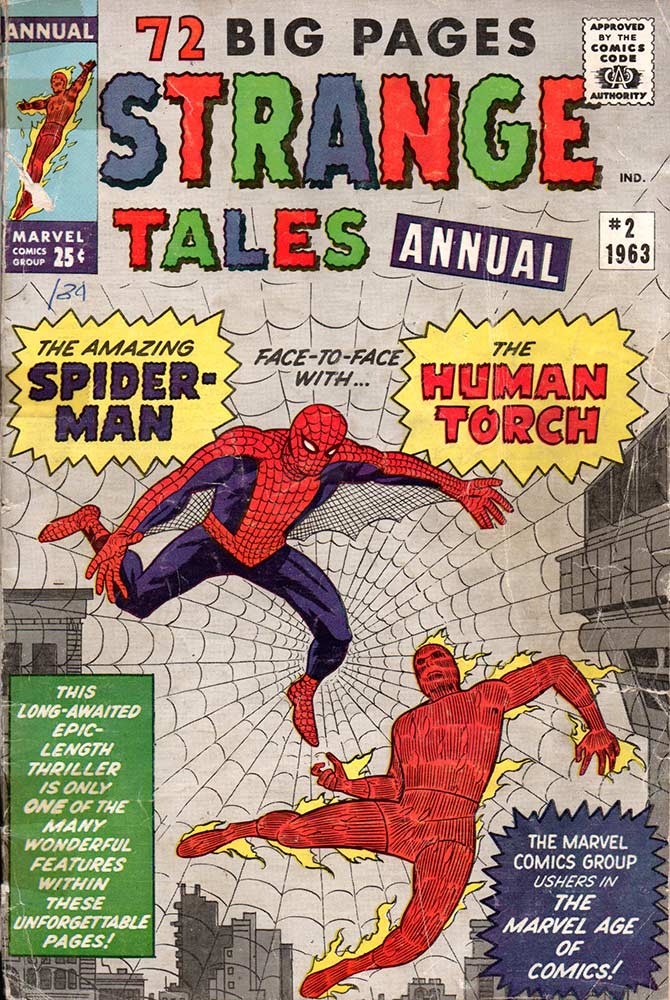
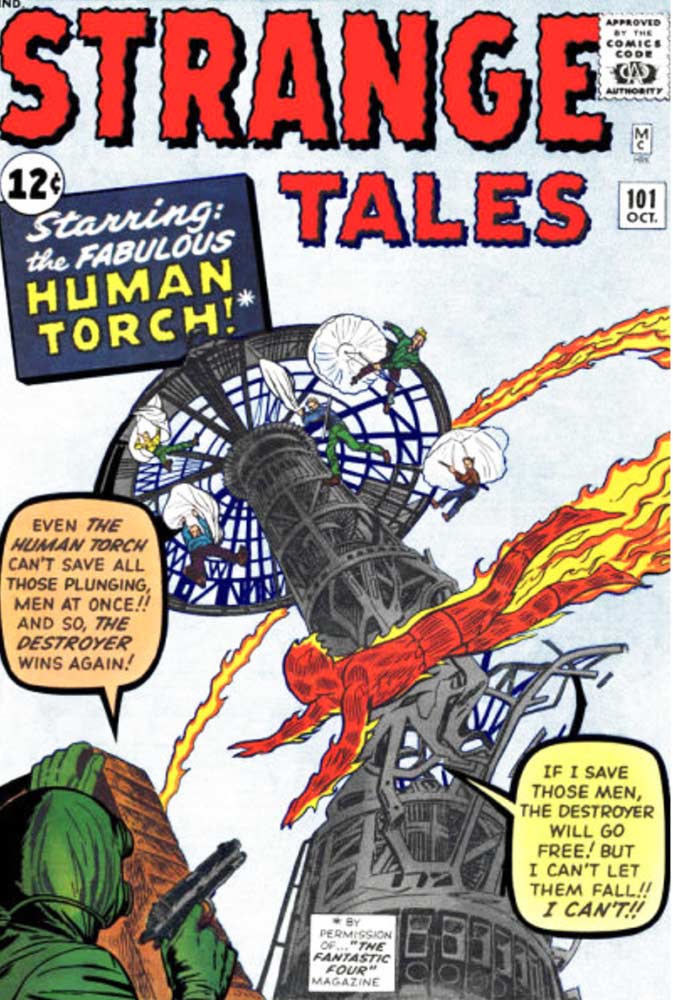

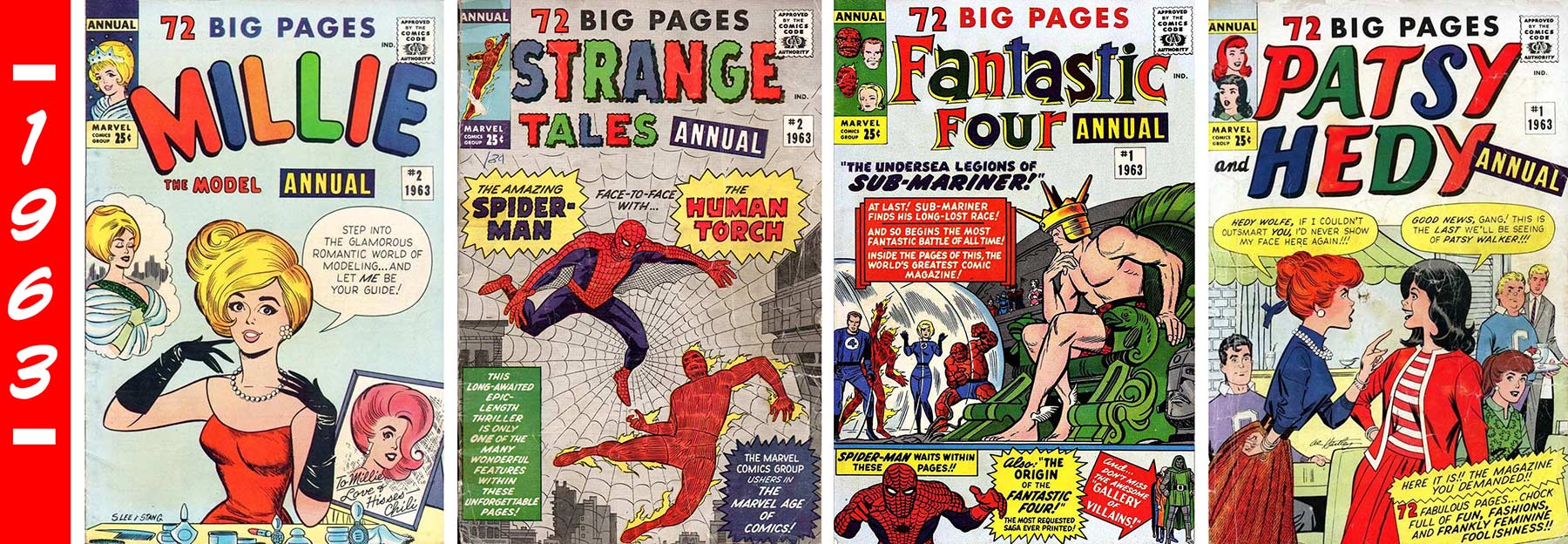
Strange Tales Annual #2 is the first Marvel superhero annual. TM & © MARVEL.
The Marvel Annuals continued in the summer of 1963, with Strange Tales Annual #2 debuting first, about three weeks before Fantastic Four Annual #1. One of that ongoing series’ quartet—Johnny Storm, the Human Torch—had carved out a story slot in the monthly Strange Tales title, starting with issue #101 (cover-dated October 1962, but released on July 10). By the time the summer of 1963 rolled around, Strange Tales published issues 112 and 113, with the second Strange Tales Annual landing right in the middle of the June and July issues. The Annual was released on June 11, and featured a very early Marvel team-up of the Human Torch and Spider-Man (who had met once before in Amazing Spider-Man #1, published on December 10, 1962, thus creating the Marvel Universe), in an 18-page story (“On the Trail of the Amazing Spider-Man”) written by Stan Lee, pencilled by Jack Kirby (note Kirby’s traditional forgetting of the spider-symbol on Spidey’s chest on the cover; I’m not exactly sure how that got to press without notice), and inked by Spider-Man artist and co-creator, Steve Ditko (who made damn certain that spider-symbol was present in all the interior story pages). The Annual also contained ten reprint stories from older Marvel/Atlas titles (I’m guessing from the late 1950s) from titles such as Strange Worlds and World of Fantasy, but none from Strange Tales (go figure).
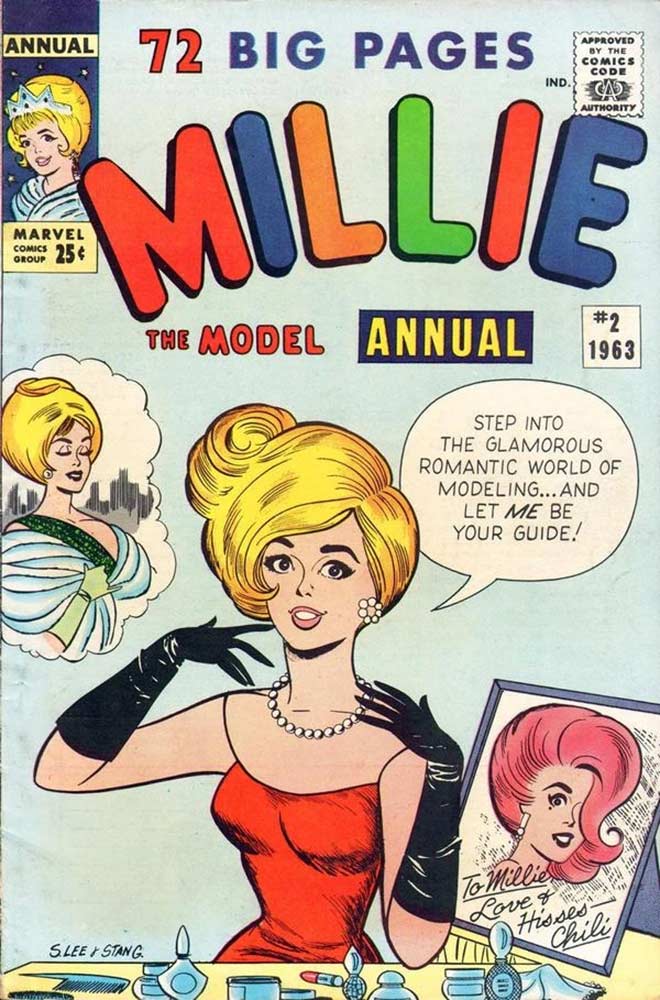

Oh, girls … TM & © MARVEL.
In addition, Marvel released two of their girls books as annuals in 1963, Millie the Model Annual #2 (released June 11) and Patsy and Hedy Annual #1 (released July 3), billed on the cover as “72 Fabulous Pages … Chock Full of Fun, Fashions, and Frankly Feminine Foolishness!” I don’t own either but the Patsy and Hedy Annual is part of the new Marvel July 1963 Omnibus, which very thoughtfully and thoroughly lists all the original issues the stories in this Annual came from. While the Millie and Patsy and Hedy books clearly have girls as their target audience, I hesitate to call them “romance books;” it seems to me they’re kind of a combo of Archie type humor with romance and glamour stories, with a bit of soap opera thrown in. Both of these 1963 Annuals seem to be all-reprint, as opposed to 1962’s Millie “All-New Stories!” edition. Millie has a cover signed by both Stan Lee and Stan G (Goldberg), possibly a first for the credit-happy Stan the Man. Millie was evidently a big seller for Marvel; her Annual appearances would continue through 12 years, ending in 1975.


“Sure to be a sell-out!” I bet Fantastic Four Annual #1 was just that. TM & © MARVEL.
Three weeks later, on July 2, 1963, Fantastic Four Annual #1 debuted, and it was a revelation, the perfect model of what a 1960s comic book annual should be. I wrote about this watershed book for me in one of my early Tales From My Spinner Rack! posts … here’s some of what I had to say:
I don’t remember buying FF Annual #1 off the newsstand, but I know we (my older brother and I) did, the moment we first saw it, probably on or around July 3, 1963. I think the prospect of reading “The longest uninterrupted super-epic of its kind ever published!” was probably daunting for eight-year-old me, even though I had been plowing through comic books, pretty much reading on my own, since I was five or so. And they’re dense pages, too, filled with lots of words in lots of balloons inhabiting lots of busy Jack Kirby panels. But this Annual, unlike its Distinguished Competition’s counterparts, contained a ton of new material.
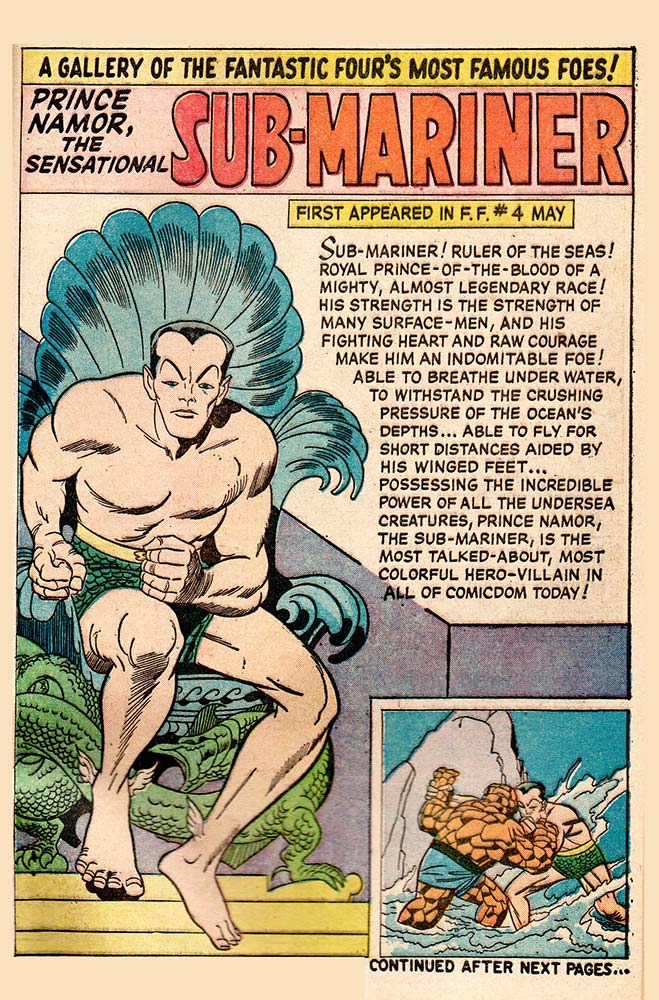


One of my favorite features of the early Marvel Annuals, these gallery pages in both FF Annual #1 and #2 and Amazing Spider-Man Annual #1, were fascinating to me as a kid. TM & © MARVEL.
In addition to the 37-page epic cover story, “Sub-Mariner Versus the Human Race,” there was page after page of special features, including my favorite: “A Gallery of the Fantastic Four’s Most Fearsome Foes,” a series of one-page pin-ups that showcased one big drawing of an FF villain, plus a single-panel illustration and info on the villain himself, including the issue in which he first appeared. This included everyone from FF #1 (the Mole Man) through #15 (the Mad Thinker), eleven villains in all (Doctor Doom and Sub-Mariner repeated numerous times). It was a great way for Kirby to show off his costume design skills and—dare I say it—a Marvelous special feature. FF Annual #1 also included a new story that expanded upon the tale from Amazing Spider-Man #1 in which Spidey invaded the FF’s Baxter Building headquarters in an attempt to get a “job” with the foursome, this time told from the perspective of the FF and drawn by Kirby and inked by Steve Ditko, who drew the original Spidey story. Also included was a reprint of Fantastic Four #1, featuring the origin of the FF, and their first battle with the Mole Man, and a couple of other special features, including a two-page spread of “Questions and Answers about the Fantastic Four,” and a cutaway view of the FF’s Baxter Building headquarters (which greatly expanded on the original cutaway from FF #3). In short (well, too late for that, I guess), FF Annual #1 was an eight-year-old’s fever dream, a massive 72-page compendium to read again and again and treasure always. (Click here to see more art in my original post from February 2023).
(It’s important to note that on that same day, July 2, 1963, both The Avengers and The X-Men debuted, alongside Fantastic Four Annual #1. I wrote more about that just about a month ago … click here to read that installment of Tales From My Spinner Rack!)
So Marvel released six annuals total in the years 1962 and 1963. Here’s how it breaks down, with each book’s release date and (where available), where the annuals fell in order of the regular series.
| 1962 ANNUALS | RELEASE DATE | ORDER |
| The Big Millie the Model Annual #1 | July 3, 1962 | N/A |
| The Big Strange Tales Annual #1 | July 3, 1962 | N/A |
| 1963 ANNUALS | RELEASE DATE | ORDER |
| Millie the Model Annual #2 | June 11, 1963 | N/A |
| Strange Tales Annual #2 | June 11, 1963 | Between ST 112 & 113 |
| Fantastic Four Annual #1 | July 2, 1963 | Between FF 18 & 19 |
| Patsy and Hedy Annual #1 | July 2, 1963 | N/A |
One more note about these early Marvel Annuals: In order to make them stand out more on the newsstand, someone at Marvel—I’m guessing either Stan Lee, Sol Brodsky, or colorist/cartoonist Stan Goldberg (Stan G.)—used multi-colors for the title logos, thus giving them a more distinctive look. This was true for both the 1963 and 1964 Annuals, but dropped for subsequent years. Much more about the 1964 Marvel Annuals (and 1965, too!) next time.

From those humble beginnings, the Marvel Annuals took off over the next five summers. Join us next time when we look at 1964 and 1965, including Fantastic Four Annual #2, Amazing Spider-Man Annual #1, and the start of Marvel’s fondness for reprint-only publications with Marvel Tales Annual #1 (all in 1964), and the wedding of Reed Richards and Sue Storm in Fantastic Four Annual #3, the first—and only meeting to-date—of Spider-Man and Doctor Strange in Amazing Spider-Man Annual #2 by Steve Ditko (and, begrudgingly, that Stan Lee guy), plus the first Thor and Sgt. Fury Annuals in 1965.

To read all the “Tales from My Spinner Rack” posts, click here!

instagram.com/talesfrommyspinnerrack/
 @innocent-bystander.com
Leave a comment